“The international landscape has changed significantly,” he explains, pointing to clubs abroad that are able to spend heavily without the same financial constraints. It’s not hard to find examples: Michele Kang is building a multi-club imperium with OL Lyonnes, Washington Spirit and London City Lionesses. The investment group Mercury13 manages Como, Bristol and the Spanish side Badalona, while Crux Football invested in Montpellier and FC Rosengard. English clubs spend large sums on salaries, facilities and transfer fees, subsidised by the men’s team.
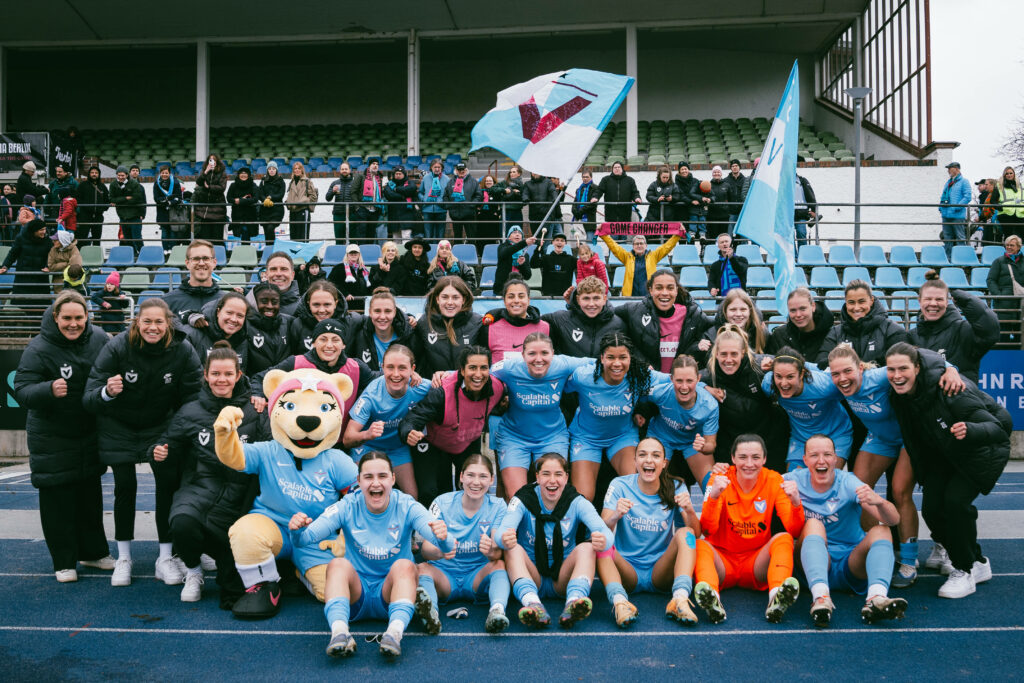
Such models clash with the German rule of 50+1, which means that investors cannot acquire a majority stake in a German club. “The 50+1 rule remains important, and I believe that its advantages outweigh the disadvantages”, says Hartmann. Yet, investment on a lower scale is possible, as exemplified by Viktoria Berlin, a second-tier club. Its group of investors includes the Monarch Collective, which also holds stakes at Angel City FC and the San Diego Wave, ex-German international Ariane Hingst and comedian Carolin Kebekus. The DFB welcomes such initiatives.
The global competition has had a direct impact on player salaries, which have more than doubled in Germany in recent years. While this marks important progress – “most players can now focus fully on their sport”, Hartmann says – the question remains how German clubs can keep up the pace set internationally.
Rather than attempting to match the spending power of wealthier leagues, German clubs are focusing on talent development as a competitive advantage. Expanded performance centres and standardized training frameworks are central to this approach, ensuring that young players receive high-level support across the country. In 2024, the DFB accredited high-quality youth performance centres for the first time. Eleven clubs are part of this system, having fulfilled strict criteria concerning the infrastructure and the staff. The aim is not only sporting success, but also the generation of transfer income, says Hartmann. With transfer fees rising steadily and passing the one million mark, this can become a viable business model
Infrastructure and professionalization are equally important. Investments in modern stadiums, administrative structures, and performance departments are seen as essential to raising overall standards. However, Hartmann cautions against overextension, particularly when it comes to stadium strategy. “The key question is economic viability,” he says, noting that large arenas bring significant costs and must be matched by consistent demand.

Media rights represent another area of growth, but also a challenge. Currently accounting for around 20 percent of league revenues, the next broadcast cycle offers an opportunity to enhance the league’s visibility. Hartmann refers to innovations such as additional camera angles and on-pitch coverage, though he acknowledges the associated costs. “We try to be creative and open to new formats,” he says.
A sentence that can not only be applied to media rights, but to the challenge of German women’s football reinventing itself in general.
Author: Helene Altgelt