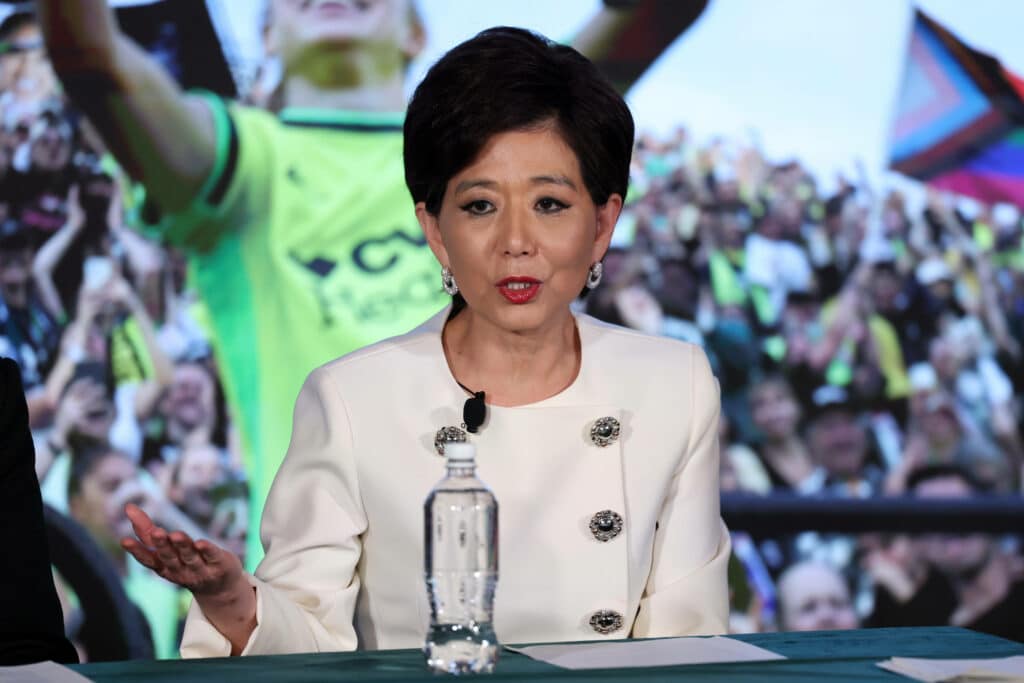
With clubs already under her control in France, England and the United States, Kang’s interest in Spain has sparked debate not only about ownership models, but also about the financial realities of a league that is fully professional — yet unevenly supported.
A Professional League, Unevenly Backed
Liga F now operates independently and has taken clear steps towards professionalisation. However, that progress has exposed longstanding imbalances.
At many historic clubs, women’s teams remain financially tied to their men’s sides. When financial fair play pressures emerge, it is often the women’s budgets that are affected first. Investment is inconsistent, long-term planning fragile, and the competitive gap at the top remains significant.
Real Madrid stands apart as the clearest example of sustained backing. Elsewhere, even established sides such as Atlético de Madrid have struggled to retain players, while smaller clubs face constant uncertainty.
The consequences are increasingly visible. Liga F has become a selling league for the Women’s Super League, with young Spanish players leaving in search of better contracts, greater visibility and more stable sporting projects.
Speaking exclusively to The Rise of Women’s Football, Reyes Bellver, a key figure in the rise of women’s football in Spain, acknowledged the concern: “Yes, it is a concern. The outflow of players to England is worrying. There needs to be a more competitive league and higher attendances. Supporters who follow the national team should also be drawn to Liga F matches. Increasing the league’s visibility is key to attracting and retaining talent.”
She also highlighted the importance of collaboration:“Liga F knows the federation’s hand is extended. Progress cannot be made in isolation — not by the league, not by the federation, and not by individual clubs. Building a competitive league requires clear planning and a shared vision of women’s football over the next five years. Everyone involved needs to be aligned.”
Investment as a Response
The situation at Levante UD Femenino has become one of the clearest examples of the league’s fragility.
Just three seasons ago, Levante were competing in the UEFA Women’s Champions League, built around a settled, experienced squad. Today, they are fighting near the relegation zone.
In that period, the club sold Mayra Ramírez, Alba Redondo and much of the core that defined its most successful era. The departures were driven less by sporting strategy than by financial necessity — a pattern repeated across Liga F.
Against that backdrop, Levante’s ongoing negotiations with Sphera Partners represent a bid to stabilise the project. The proposed investment would inject capital while allowing the club to maintain control of its women’s team — a model increasingly seen as essential for survival rather than expansion.
Kang has been linked to Liga F on several occasions, but this time the situation appears more serious. She previously explored acquisitions of Levante UD and Valencia CF, though neither led to an agreement. Sources indicate she is now close to finalising a deal for next season, with rumours pointing to Badalona Women as a potential target — though that has not been confirmed.
Through Kynisca Sports, Kang has developed a multi-club ownership model dedicated exclusively to women’s football, with teams in three major markets and a clear emphasis on independence, professional governance and long-term planning.
Bellver addressed the speculation around Kang directly: “Interest from investors in Spanish women’s football is always positive. It can strengthen the league and increase competitiveness. A club that currently has limited resources may gain new opportunities with external backing, which ultimately benefits the competition. At this stage of the industry’s development, investment interest is a positive signal.”
Multi-club ownership remains a subject of debate, but within Liga F the discussion has become increasingly pragmatic. With competitiveness eroding and talent leaving, external investment is viewed by many as the only realistic path towards the type of league players such as Aitana Bonmatí have repeatedly called for — one capable of competing at the highest level, week after week.
No deal involving Kang has been officially confirmed. But alongside Levante’s talks with Sphera Partners, the message is clear:
Liga F is no longer debating whether it is professional. It is confronting how that professionalism is financed — and whether it can evolve without significant external investment.
Author: Irati Vidal