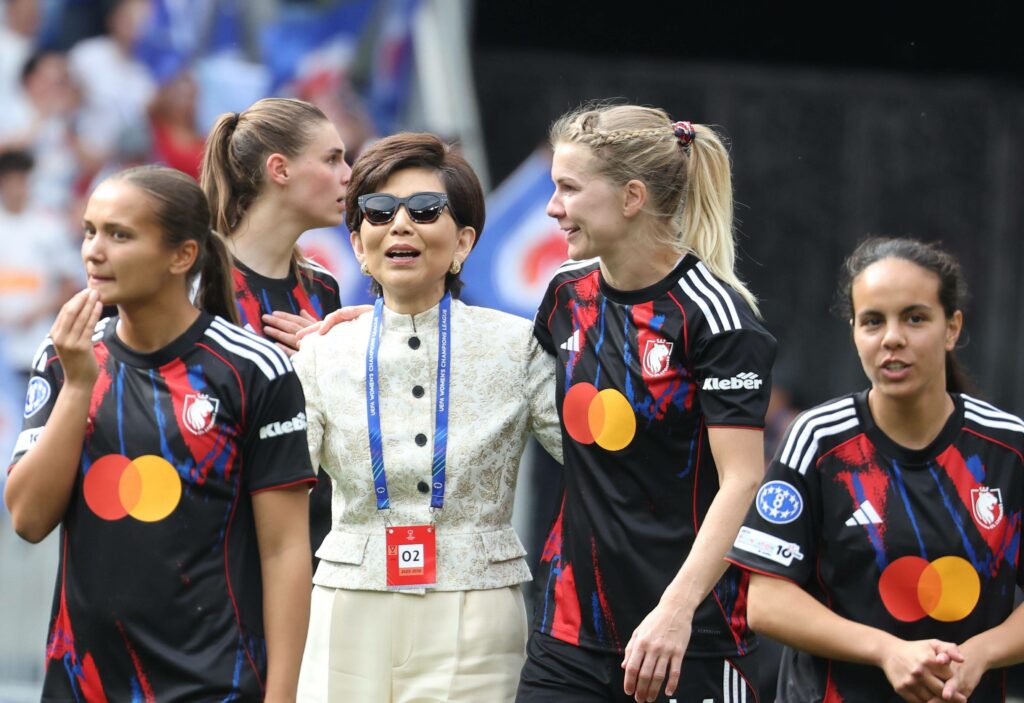
In February 2024, American entrepreneur and billionaire Michele Kang made headlines when she acquired a stake in Olympique Lyonnais Féminin, one of the most decorated clubs in the history of women’s football. Kang went on to create a sports network, “Kynisca”, including the English side London City Lionesses and NWSL club Washington Spirit. Three clubs across two continents, bound together under a single ownership umbrella. It was a signal, if one were still needed, that multi-club ownership (MCO) has arrived in the women’s game.
Once a model associated almost exclusively with men’s football – City Football Group’s global empire, Red Bull’s network of feeder clubs – MCO is spreading rapidly across women’s leagues. Five ownership groups now hold stakes in 14 clubs across eight countries, with more acquisitions widely anticipated. The model raises profound questions about what it means for competition, fan culture, and the long-term commercialisation of the women’s game.

A different kind of multi-club model
In men’s football, multi-club ownership has typically followed a hierarchical logic: a flagship club sits at the top, with smaller feeder clubs funnelling talent upward. The women’s game, observers say, is developing something more novel.
“What is happening right now in women’s football is very interesting. In men’s football, there has always been a main club and feeder clubs. In women’s football, the idea is to create a group of clubs, developing best practices and new data methods”, says Luca Pastore, Sports Lawyer at Lombardi Associates, while speaking to The Rise of Women’s Football.
Pastore, whose research on multi-club ownership has been published in the Rivista di Diritto ed Economia dello Sport, points to a structural difference driving this divergence. Women’s sports science remains underdeveloped relative to the men’s game, and that gap is both a challenge and an opportunity for MCO operators. “Usually, all the knowledge and expertise for women’s teams comes from the men’s side,” he says. “But science has shown that women aren’t men, and this knowledge cannot simply be applied to them.” MCO networks, Pastore argues, are well-positioned to pool resources and build proprietary methodologies – from sports science to scouting – that are tailored specifically to female athletes.
Kara Nortman, co-founder of Monarch Collective – the group behind Angel City, San Diego Wave, Boston Legacy, and Viktoria Berlin – has been explicit about the scale of ambition involved. “We are building the Real Madrids, the Manchester Uniteds, the Dallas Cowboys, the Golden State Warriors, the Los Angeles Dodgers of tomorrow,” she told The Guardian, “but it’s not going to happen by accident.”
The appeal of MCO in women’s football for investors
For Markus Breuer, professor of sports economics at SRH University Heidelberg, the appeal to investors is twofold. “Multi-club ownership enables investors to diversify their risks,” he explains. “It is essentially a broad portfolio, where losses in one club can be offset by the success of others.” Beyond financial hedging, he points to operational synergies: “advantages in scouting, training, science, and player development” that can be shared across a network at relatively low marginal cost.
Yet the investment thesis for women’s football is a long-horizon one. Women’s football does not yet generate the revenues that would justify expectations of near-term returns. Pastore is candid about this: “Investors in women’s football know that there will be no returns in the short-term. It’s a long shot.” The commercial infrastructure, like broadcast deals, sponsorship income, match-day revenue, is still maturing, and some club owners, he notes, view women’s football more as a reputational or regulatory obligation than a genuine profit opportunity, investing “only the bare minimum” as a result.
There are signs, however, that the model extends beyond football. Monarch Collective recently invested in a new WNBA expansion franchise in Cleveland, pointing to a broader bet on women’s professional sport as an asset class. Pitch15, another emerging group, has taken positions across women’s football, golf, and cricket. These initiatives signal growing appetite among investors who see women’s sport as a correlated opportunity rather than isolated clubs.
Who comes next? Future MCO candidates
With five groups already active, attention is turning to the major men’s football conglomerates that have yet to formalise a women’s multi-club strategy. City Football Group, which operates the biggest MCO system in men’s football and already runs Manchester City Women alongside smaller women’s setups across its network, is widely considered the most likely to take the next step. Clubs owned by the City Football Group, like ES Troyes AC (France), Palermo FC (Italy) and Girona FC (Spain) already have women’s teams in the lower leagues (third / fourth tier). City Football Group also owns Melbourne City in the highest Australian tier, the W League. However, cooperation within the CFG network remains marginal in women’s football. If this changes and the CFG invests in their lower-league clubs, they would quickly become the biggest MCO in women’s football
BlueCo, the consortium behind Chelsea Women, is a similar case: Its portfolio includes RC Strasbourg Alsace, but there has been little communication on how that impacts both Chelsea and Strasbourg. These MCOs have made less headlines than the women-only ownership groups so far, but their impact may be even bigger, since their financial means are considerably higher.
Specific clubs are attracting attention as likely targets. Levante UD’s women’s team, a three-time Spanish champion with Champions League pedigree, is under financial pressure following the men’s side’s relegation difficulties, making it a possible target: Valencia is an attractive city, and the club may want to bring in fresh capital. Paris FC, partly owned by the Arnault family with a Red Bull minority stake, could deepen ties with RB Leipzig, since the Red Bull group may become more active in women’s football in the future. Currently, Red Bull has no women’s club in the United States, despite Red Bull New York and the NWSL’s Gotham FC sharing a stadium.

Competition, fairness, and the regulatory gap
The growth of MCO has outpaced the governance frameworks designed to oversee it. UEFA’s rules prohibit clubs under common ownership from competing in the same European competition — but those rules face growing pressure as the number of affiliated groups increases. Breuer is direct about the dynamics at play: “UEFA has lost market power because more and more MCO constructs are emerging. UEFA does not want to exclude those clubs that ensure the competition remains attractive. The trend is towards softening the rules.”
Player movement within networks has already attracted scrutiny. When coach Jonatan Giraldez moved from Washington Spirit to Olympique Lyonnais, from one Kynisca club to another, in 2025, critics questioned whether common ownership was distorting the labour market. The concern is not merely symbolic: if clubs within the same structure negotiate player values internally, the reference price for a transfer becomes opaque.

“The idea of a ‘fair price’ is essential for regulating multi-club ownership to prevent clubs within the same ownership structure from trading players at below-market prices. But regulation is difficult: the fair price for a player is not written on her forehead”, says Marcus Breuer, the professor of sports economics.
The question of match integrity also looms, though Breuer is measured in his assessment. “So far, there is no evidence or indication that games are being manipulated by the owner,” he says. “The players would have to go along with it, and the investor would have to be able to push it through.” The more immediate concern is structural: Monarch Collective currently holds stakes in three NWSL clubs — Angel City, San Diego Wave, and Boston Legacy — raising questions about whether competitive incentives within the same league can genuinely be separated. One mechanism Breuer points to: requiring minimum holding periods of ten years before shares can be sold, eliminating the incentive for short-term extraction.
Protests against MCO: investors versus fans
Nowhere has the cultural tension been more visible than at FC Rosengård. When Crux Football, the group that also owns Montpellier HSC, acquired a stake in the Swedish club, supporter groups disbanded in protest and redirected their allegiance to Rosengård’s reserve side in the lower divisions. Their grievances centred not only on the fact of outside ownership, but on the process: a lack of transparency, a rapid deal structure that excluded meaningful fan consultation, and reports that Crux had not disclosed its full investor list. The group had also indicated it might change the club’s name or colours, which fans saw as a betrayal of the club’s tradition. Rebranding is a controversial topic in MCO, and it also sparked anger amongst OL Lyonnes’ fans, when Kynisca changed both the logo and the name (from Olympique Lyon to OL Lyon).
It is a tension that runs through the broader MCO debate. Investors who enter women’s football often speak the language of purpose and transformation: of building sustainable infrastructure, of levelling the gap with the men’s game. But the financial logic ultimately requires a return, and the decisions that follow from that, like staffing, player recruitment, identity, may not always align with what communities built these clubs to be. Ultimately, it’s a tension that’s hard to disband and also exists in football clubs not connected to MCO. Modern football’s system both promises to investors that it is an investment opportunity and to fans that it’s an emotional connection. When these two claims clash, problems arise.
“Investors may have interests other than simply making profits, such as developing women’s sports”, says Markus Breuer, and many brand their investments as something that is more about equality and the development of women’s football than about financial returns. But there’s a caveat: “At some point, an investor may conclude that the goal of professionalisation has been achieved and that other goals can be pursued.”
The case for MCO in women’s football is not difficult to make. Professional structures, shared infrastructure, and sustained capital do not guarantee sporting excellence, but they make it more reachable. The gap between men’s and women’s football remains vast: in wages, facilities, media coverage, and institutional support. As Breuer explains: “Multi-club ownership can be a big opportunity in women’s football. Professional structures created by MCOs cannot close that gap on their own, but they can level the playing field.”
What is less certain is whether the conditions currently in place are adequate for the scale of change now underway. Fragmented regulation, limited transparency obligations, and structures that allow single owners to operate multiple clubs in the same competition, like the UWCL, all raise questions about how to guarantee equal chances for all. Governing bodies would be well advised not to wait and see how MCO in women’s football develops, but to investigate possible regulations by now, incentivizing investment while guaranteeing a level playing field for all.
Text & Interview: Helene Altgelt