Women’s football generated an estimated €500 million in annual revenue in 2024, a 300% increase since 2021. Brands are taking notice, and the many among them are realising that the most powerful entry point isn’t just a logo on a kit. Rather, it’s about framing sponsorships as a shared mission and finding meaningful connections with the fans.
According to research from the Women’s Sport Trust, 4 in 5 brand decision-makers say they are likely to invest in women’s sport sponsorship in the next three years. 77% cited showcasing social responsibility as a key factor, and 86% said their sponsorship had either met or exceeded ROI expectations. Values, it turns out, pay.
Sarah Kendall, Managing Director at Fuse Sport and Entertainment, states that a change has come in the industry: “We now rarely have a conversation with a brand client about football sponsorship without the women’s game being central to the conversation.” The investment has by now moved firmly beyond CSR and into core marketing budgets. Here are three partnerships that show how values-driven sponsorships are rewriting the rulebook, and the data that backs up this change.
Dove × NJ/NY Gotham FC: Keeping girls in sports
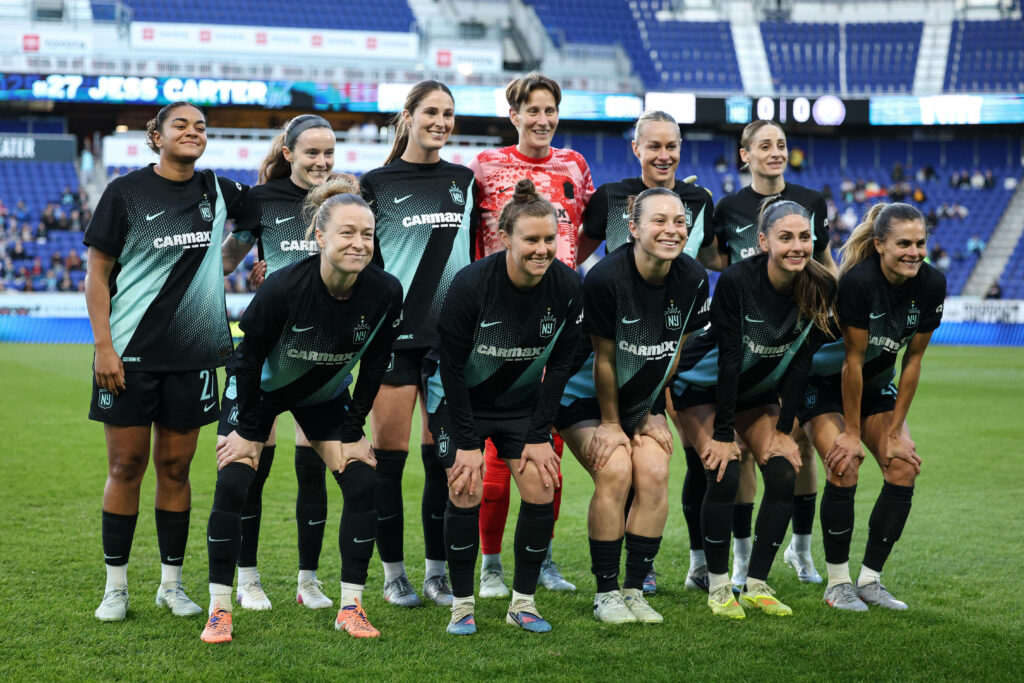
In February 2025, Gotham FC and Dove announced what became the highest back-of-jersey sponsorship deal in NWSL history, surpassing the previous record of over $500,000 per year. The headline figure matters, but the real story is why Dove signed up at all. This was the brand’s first-ever partnership with a sports team, be it men’s or women’s.
The deal centres on Gotham’s “Keep Her in the Game” initiative, which addresses a stark problem: girls drop out of sport at twice the rate of boys by age 14. Dove’s own data shows that 45% of girls quit sport due to low body confidence. The brand’s Body Confident Sport programme, a scientifically-backed coaching toolkit for 11-to-17-year-olds, made the fit almost too obvious.
In year one, Keep Her in the Game reached over 500 young athletes, with ambitions to double that along the line. Laura DiMiceli, Head of Personal Care Sports Marketing at Unilever North America, said of the deal: “The data is clear: Sports build confidence, leadership skills and resilience in young women, benefiting them for years to come.” What makes this partnership stand out is that the community programme isn’t a nice add-on, but the whole point: Dove ran a Super Bowl ad on the same theme just days before announcing the Gotham deal.
Deloitte × HSV Women: Invisible logo to raise awareness
Some of the most powerful sponsorships are the ones that subvert the format entirely. When Deloitte partnered with Germany’s Hamburger SV Women for the 2023/24 season, it decided not to put its logo on the front of the shirt but put it on the inside.
The campaign, called “Partner:innen” was a deliberate statement about the invisible status of women players in professional sport. Alongside the hidden logo, the inside of each jersey sleeve carried one of three values shared by both organisations: Support, courage, or diversity. The whole thing was then activated via a major social media campaign that turned the concept into the message.
The effect, according to SPORTFIVE, was extraordinary: “Measured against the costs, this was an incredible media success for Deloitte and HSV and brought both partners an enormous amount of media applause.” It was named the best marketing case at OMR 2024, Germany’s biggest marketing stage.
This partnership is a great example of creative sponsorship that earns attention rather than buying it. By making visibility the product, Deloitte made itself more visible than any front-of-shirt logo placement could have achieved.
Angel City and the 10% model
Angel City FC didn’t just sign sponsors with good values but went a step further: The NWSL club built a model that requires it. Under the club’s 10% Sponsorship Model, every sponsor must allocate 10% of their deal value to a community initiative of their choosing. Shared values are not just a nice-to-have in this example.
The results are striking, as Angel City leads the NWSL in sponsorship revenue – an estimated 35 million $ in 2024 – which means these 10% have a real impact. In four years, the model has invested over $3.4 million back into LA communities, served 171 000 LA residents, delivered more than 2 million meals, and provided 40,000 hours of free football programming.
The partnership with kit sponsor DoorDash is a textbook example: ACFC identified food-insecure communities across LA, and DoorDash mobilised its network to deliver meals. Over 1.5 million meals have been delivered to date. For this model to work, a club needs to take a consequent stance and even make sacrifices:
“We’ve walked away from many conversations with brands where it felt like they want to partner with us and use that 10% to show something that is disingenuous to what their company was or what their product was”, Jess Smith, Head of Revenue of Angel City, told SportBusiness in 2023. That willingness to say no is, paradoxically, one of the most powerful commercial signals: It tells prospective partners: this club means what it says.
What the data says: Growing numbers of sponsorships in women’s football
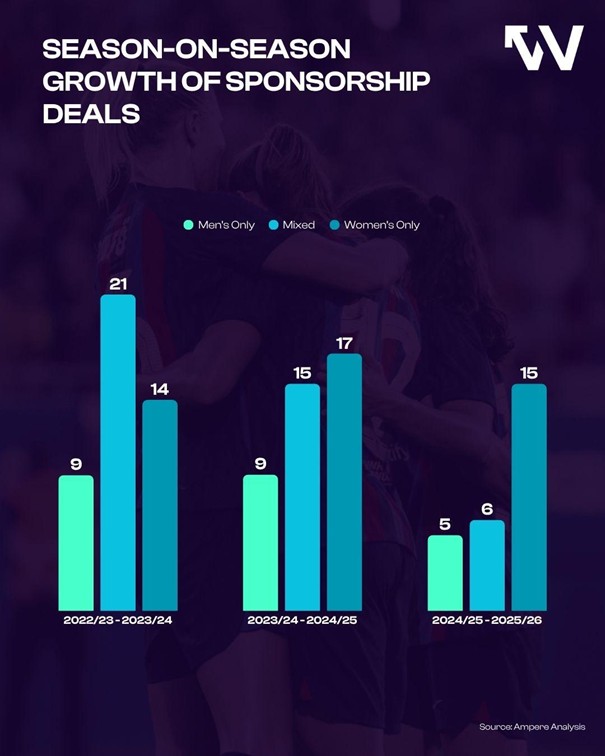
sponsorship deals across men’s-only, mixed, and women’s-only categories. Women’s-only deal volume has grown faster than sponsorships in men’s football and mixed deals.
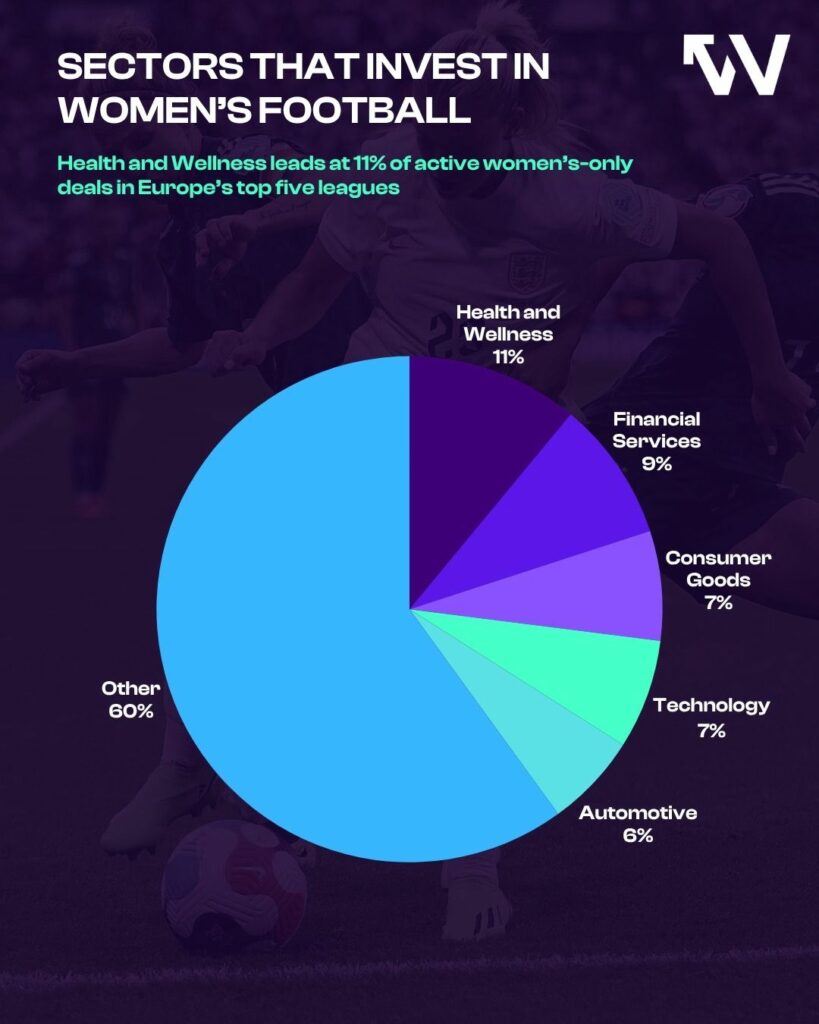
Ed Keppie, Head of Sponsorship Research at Ampere Analysis, shared exclusive insights with The Rise of Women’s Football for this article. A closer look at the sectors investing in women’s football is interesting. Health & Wellness leads at 11% of active women’s-only deals in Europe’s top five leagues, followed by Financial Services (9%), Consumer Goods (7%), Technology (7%), and Automotive (6%). Both Health & Wellness and Consumer Goods significantly over-index compared to men’s football, where they account for just 7% and 3% of deals respectively.
“For Health & Wellness, the majority of deals are with teams in the Frauen-Bundesliga and are wellness-related supplement manufacturers, medicine and health clinics,” Keppie explains. “On the consumer goods side, we’ve seen specialist companies such as ModiBodi and Snuggs sign deals with WSL women’s teams.” These are brands with explicit female-audience targeting and values around health and body confidence — exactly the kind of natural alignment that makes sponsorships feel authentic.
On the apparent slowdown in mixed deal growth visible in the chart, Keppie offers context: “There was a burst of sponsor activity in the seasons following Covid-19 which augmented growth rates, so I think this is more a normalisation than anything else. Women’s deals have comparably sustained high growth rates — many brands are new to sponsorship and it presents a more affordable entry point and test bed for activation and ROI.” He points to Revolut upgrading their women’s-only deal with Manchester City to include the men’s team as evidence of a virtuous cycle: brands enter through women’s football, prove out their ROI, and expand. Mixed sponsorship, according to this logic, can be expected to increase over the next years. They can also help convey a one-club-one-identity message, which clubs already emphasize on social media.
When it comes to which clubs are best positioned, Keppie is clear that on-pitch success matters, as five of the top 12 clubs for women’s-only sponsorship deals qualified for the UEFA Women’s Champions League last season. But it isn’t the only factor: “The main reason is simply that some teams have been quicker to prioritise the ‘unbundling’ of women’s team inventory”, he explains: “With the popularity of women’s teams and athletes surging, teams are better able to singularly monetise women’s teams. It’s a fantastic opportunity for clubs to attract brands from new verticals.”
Values and women’s football sponsorships: More than marketing?
Across all these examples, one theme connects them: the most successful sponsorships are purpose-led. Keppie identifies this directly: “Value alignment is one of the key criteria that most brands consider when conducting due diligence on potential sports properties. Sport offers a unique platform for brands to convey their values, and the amplifying effect and resonance of a sport sponsorship offers works best when values align with the sport, club and players.”
He singles out the Persil and Arsenal Women partnership as a standout case. “The partnership centres around a memorable campaign title (‘Dirt for Good’). It is research-led; it involved active community work with young people and used omnichannel marketing activation that Arsenal Women’s players endorsed. It pioneered a crucial talking point, encouraging brands such as Modibodi and Snuggs to sponsor WSL teams in the following seasons. Arsenal FC have really pushed their Togetherness message over the years, and this is where the value alignment occurs”, Keppie explains.
Arsenal’s broader approach — which also includes the sustainable adidas × Stella McCartney kit collaboration, with pieces made from at least 47% recycled polyester and 100% organic cotton — shows how a club can build a coherent identity around shared values that attract like-minded commercial partners.
But there’s a necessary note of realism. As the market matures, purpose alone won’t sustain sponsorships, and commercial return has to follow. The encouraging sign is that it increasingly does. Women’s football fans skew younger and higher-earning than their counterparts in the men’s game. Brands that show up early and authentically are building relationships with exactly the audiences they want to reach. They need to be aware that a one-size-fits-all approach won’t do. But brands which are creative and engage with topics that resonate with the fans will be rewarded.
Text: Helene Altgelt