
However, growth on social media is not automatic. Some clubs and leagues are pulling ahead, while others struggle to convert visibility into engagement. This article explores which leagues and clubs are leading the way on social media and why. It explains why follower numbers don’t always tell the full story and highlights four successful strategies for clubs to grow their online presence.
The 20 most-followed clubs in women’s football
While data on the following of men’s football clubs is abundant, such analysis is lacking in women’s football. As previously reported by The Rise of Women’s Football, there is still a visibility gap on social media for women’s soccer. Clubs such as Inter Milan, Lazio Women, and Dijon do not have Instagram accounts for their women’s teams. To create a basis for further discussions, The Rise of Women’s Football compiled the first ranking of the 20 most-followed women’s soccer clubs worldwide.
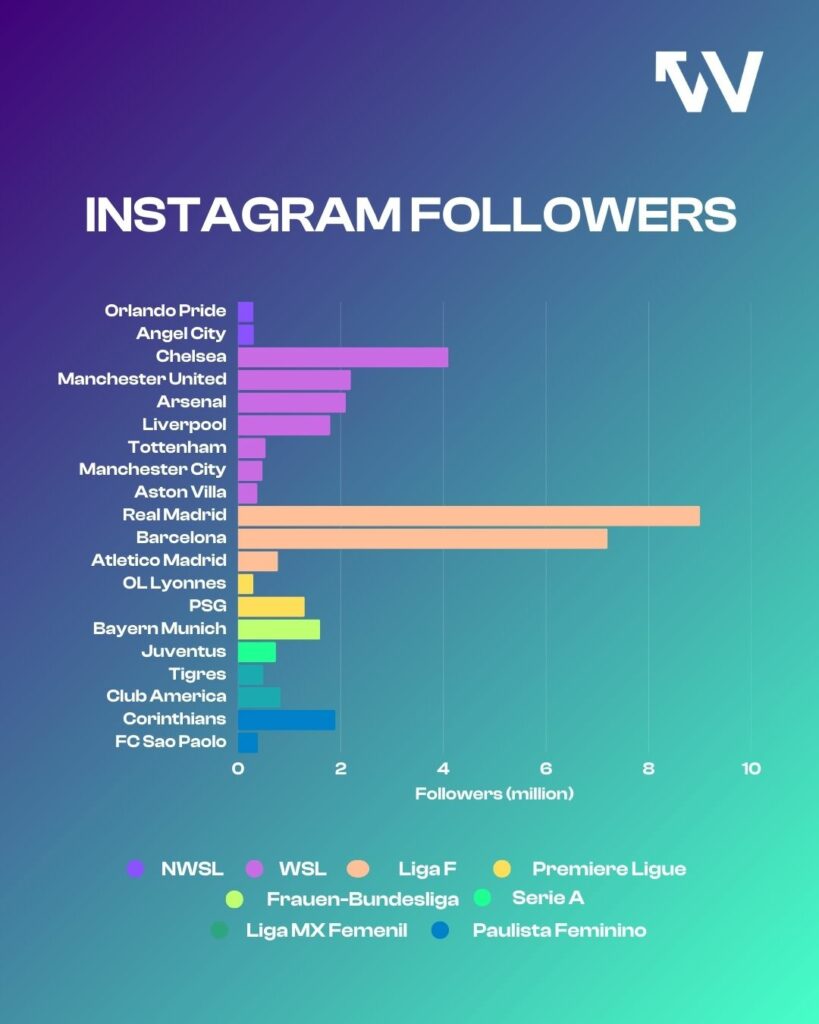
At first glance, the Instagram leaderboard of women’s football clubs looks familiar. Real Madrid leads with 9.0 million followers, followed by FC Barcelona with 7.2 million and Chelsea with 4.1 million. These numbers reflect brand power, global reach, and the advantage of being part of some of the world’s biggest soccer institutions. However, some may be surprised to learn that clubs like Corinthians (Brazil) and Club América (Mexico) have a larger social media presence than many European and American clubs. This is another important reminder of how far women’s football has come in Latin America.
But follower count is only the starting point. When we shift focus to average engagement per post and engagement rate, a very different hierarchy emerges.
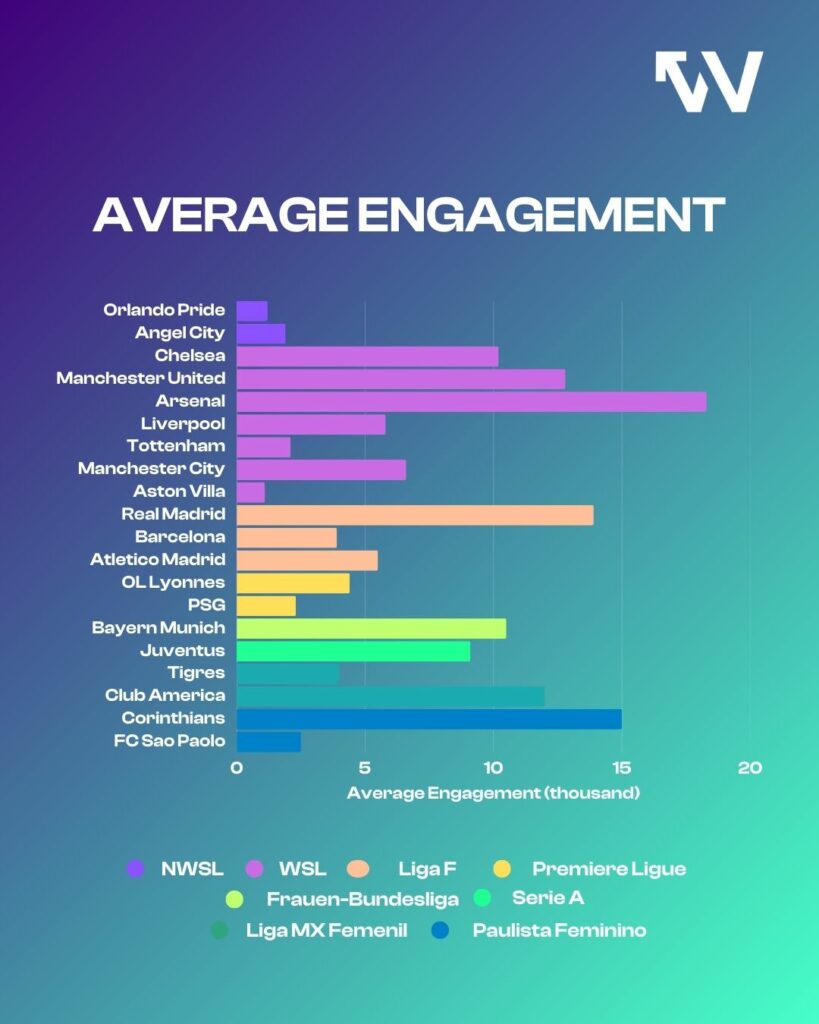
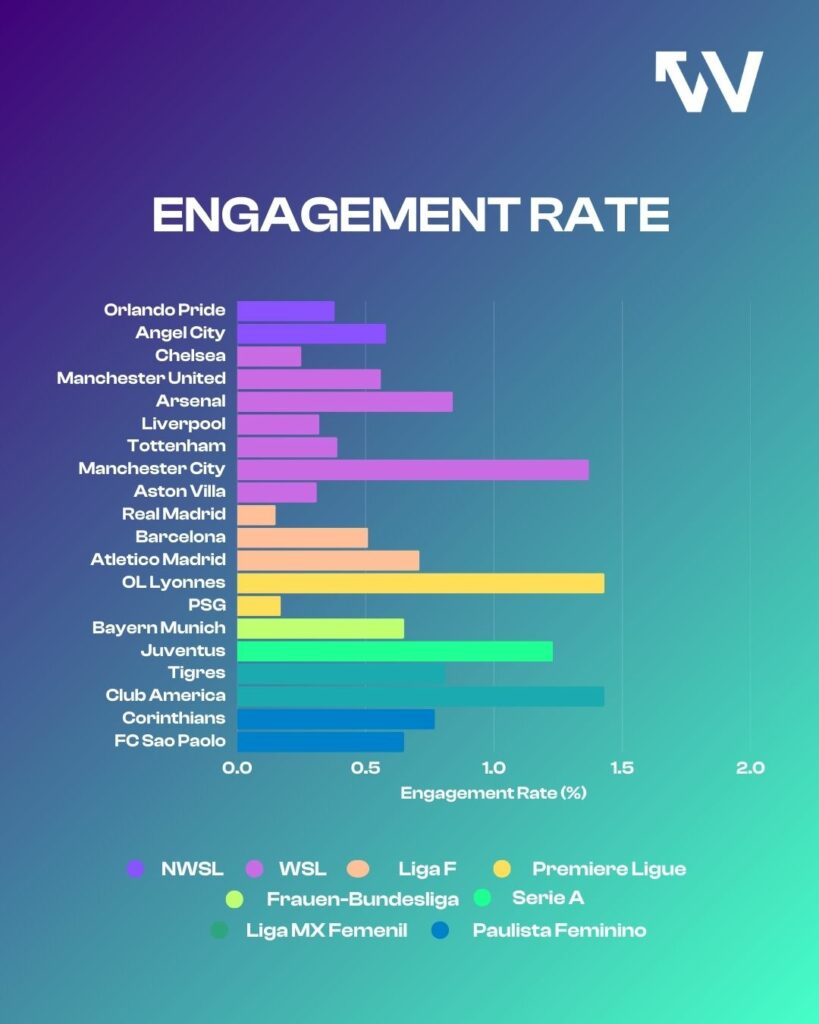
Arsenal, for example, have “only” 2.1 million followers, yet boast an engagement rate of 0.84%. Manchester United (0.56%) and Bayern Munich (0.65%) also outperform several clubs with larger audiences. At the very top, clubs like OL Lyonnes (1.43%), Club América (1.43%), Juventus (1.23%), and Manchester City (1.37%) stand out for their ability to turn followers into active fans.
This matters because engagement, not followers, is what algorithms reward and brands value. The overall median engagement rate across Instagram sits at about 0.36%. Brands in the top 25% reach around 1%, making that a realistic and meaningful benchmark for women’s football clubs. Clubs should question how they can improve their content on social media if they fall short of this target.
A follower gap in the top 20: Synergies matter
One of the most interesting findings is the considerable gap between the clubs in terms of social media following. OL Lyonnes, ranked 20th among clubs, have around 300,000 followers – less than 4% of Real Madrid’s follower count of nine million. This gap is similarly big in men’s football: AS Roma, ranked 20th, have 7.3 million followers compared to Real Madrid’s 175 million.
A key factor here are global brands. Twelve of the top 20 women’s clubs are part of men’s clubs that also rank in the top 20 globally. This opens the door to synergies that independent women’s teams simply cannot replicate on their own. Big clubs have access to a professional social media team to make more and better content – and can use the reach of the bigger men’s account to gain followers. It’s surely no coincidence that Real Madrid tops the follower charts in women’s football despite not being the most successful team on the pitch – instead, the Blancos have higher visibility thanks to the social media accounts of their men’s team.
But simply promoting the women’s account from time to time isn’t enough. These are three strategies top clubs use to increase their visibility on social media – leading to more commercial income in the long run.
1. The power of “One Club” content
The most successful posts across women’s football in 2026 so far all share one thing: they make women’s teams feel central, not separate.
The top-performing post among the 20 clubs analyzed in 2026 is FC Barcelona’s shared post celebrating the women’s team winning the Supercopa against Real Madrid. The post combines multiple success factors: silverware, a historic rivalry, and a clear “one club” message. The result? More than one million likes.
https://www.instagram.com/p/DT5_LgCDiq9/?utm_source=ig_web_copy_link&igsh=MzRlODBiNWFlZA==
Another Barcelona post, showing a 12–1 win against Madrid CFF, reached 660,000 likes. It underlines a simple truth: results on the pitch still matter enormously. Dominance, records, and moments of excellence drive attention in ways no content trick can fully replace. In the discourse about growth in women’s football, this message is sometimes lost: No matter how much investment and marketing there will be, the product on the pitch is what ultimately draws fans to the sport.
Arsenal offer another strong example for both using success on the field for social media and for promoting a one-club mentality. In a video shared with the men’s account, the club compared a goal by Mariona Caldentey to one by Martin Zubimendi from the men’s team. Both goals were scored against Chelsea and shown side by side. The message was similar to Barcelona’s: this is one club, one identity, one standard of football. Shared posts like these don’t just boost reach – they build legitimacy.
https://www.instagram.com/reel/DT74dxtDNJw/?utm_source=ig_web_copy_link&igsh=MzRlODBiNWFlZA==
2. Driving engagement with emotional attachment
When clubs look at their social media dashboards, the temptation is often to chase followers. But engagement tells a deeper story about emotional attachment.
In women’s football specifically, one challenge is to transform passive followers into engaging fans. The engagement rate of many clubs remains subpar – they have successfully put themselves on the map, but struggle to create interactions with their fans. This may be because many fans of the men’s team follow the accounts to stay up to date with the results, but don’t care deeply yet about the team itself.
This explains why clubs like PSG, despite having 1.3 million followers, struggle with an engagement rate of just 0.17%. The ultimate question is what the goal should be on social media. If it’s just about growing awareness that a women’s team exists in the first place, then a high follower count may be enough. But to attract fans to come to the games and to score attractive partnerships with brands, clubs shouldn’t neglect the engagement side of things.
3. Using players as growth engines
One of the most powerful – and sometimes underused – assets in women’s football is the players themselves.
The recent transfer of Alisha Lehmann to Leicester City is a textbook example. Leicester’s women’s account has just 112,000 followers. Lehmann has 15.9 million. The used the forward’s star power, publishing nine announcement posts, several of them shared with the men’s account. Within a week, the women’s account gained around 8,000 new followers. Clubs clearly benefit when players have built a strong brand, and should support them in their endeavor to find out what makes them stand out.
4. Consistent layout and a shared visual identity
Another recurring theme among high-performing clubs is visual consistency: A consistent layout, using the same graphics and colors for the men’s and women’s teams, helps create brand recognition. This kind of unity reinforces the idea that the women’s team is not an add-on, but an integral part of the club’s identity. A consistent layout is also easy to put into practice, and most clubs have already adopted it.
Comparing different leagues in women’s football: Clubs are ahead of leagues so far
In terms of visibility, leagues can be just as important as clubs. The NWSL leads in absolute terms with around 800,000 Instagram followers, followed by the WSL with 530,000.

Interestingly, the NWSL outperforms the league’s clubs in terms of followers. Orlando Pride, the most successful NWSL club on social media, has fewer than half the followers of the league’s account. This is not the case for any of the other leagues. This suggests that many in the US consider themselves fans of the league rather than of one specific club. The advantage is obvious: fans may watch more games and feel connected to more players from different clubs. However, it is harder to develop a strong emotional attachment in this case.
The engagement rate supports this idea: The NWSL doesn’t score as highly here as other leagues and averages less engagement than the WSL despite having far more followers. Italy’s Serie A Femminile (1.99%) and Germany’s Frauen-Bundesliga (1.76%) post the strongest engagement rates, even though their follower bases are comparatively small. The WSL also performs strongly at 1.29%, while Liga F (1.24%) and the Première Ligue (1.12%) sit comfortably above the 1% target.
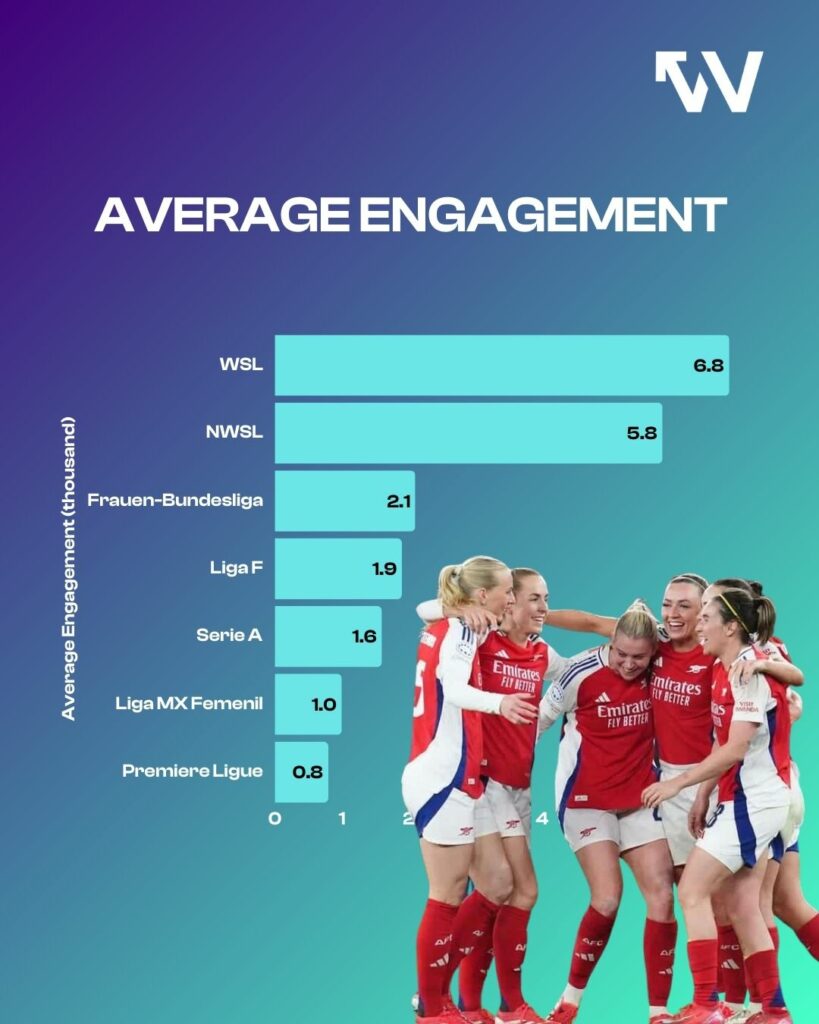
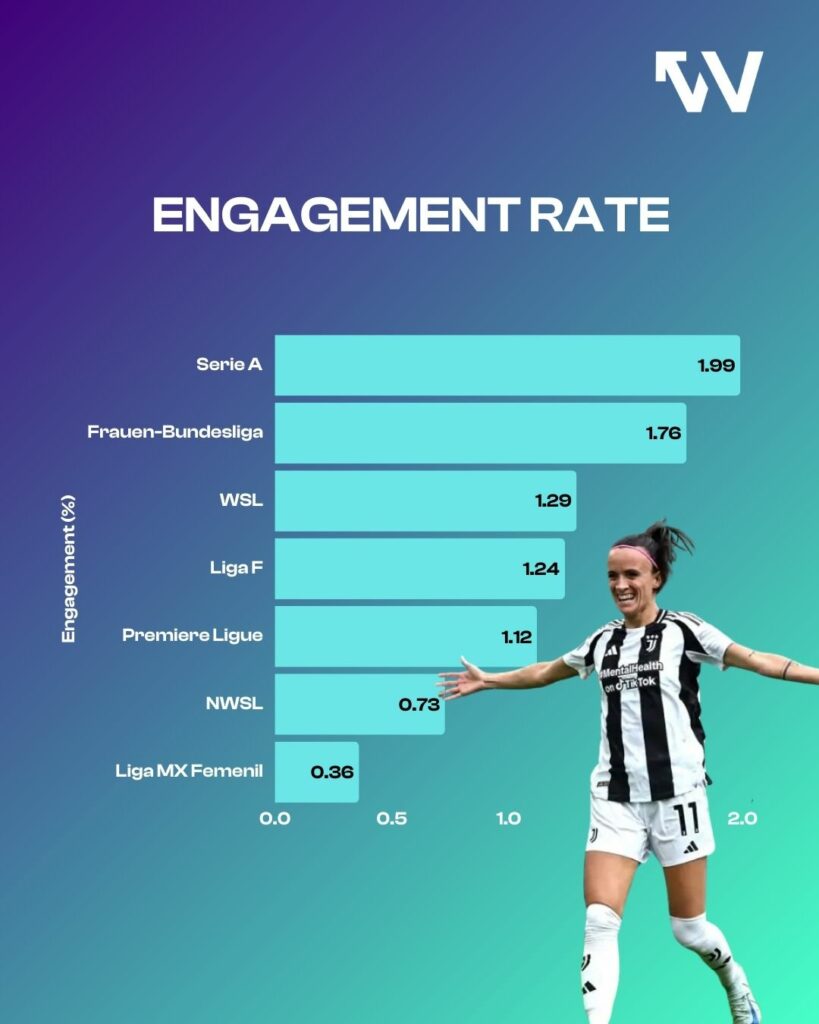
Liga MX Femenil is an outlier: despite 290,000 followers, engagement sits at just 0.36%, exactly at the overall median. This suggests that visibility alone is not translating into active fandom – a challenge leagues will increasingly need to address as commercial expectations rise.
Conclusion: Four strategies to grow on social media
In conclusion, high engagement rates and large follower counts are not accidents, but rather the result of well-thought-out strategies. The most successful social media strategies in women’s football incorporate four key elements:
1. Leveraging existing ecosystems, through shared posts and synergies with the men’s channels
2. Focusing on engagement, not just followers, with 1% as a realistic target
3. Using players as multipliers
4. Creating instantly recognizable posts by using the same layout of the men’s team.
Women’s football wouldn’t be where it currently is without social media: Many clubs have already successfully used platforms like Instagram to build their brand. Positive examples are Barcelona, combining a big follower count with high engagement; Arsenal, with a highly dedicated fanbase, and Corinthians, showing that women’s football is popular beyond Europe and North America. There are shining examples already. Now, some other clubs just have to follow suit.
Author: Helene Altgelt