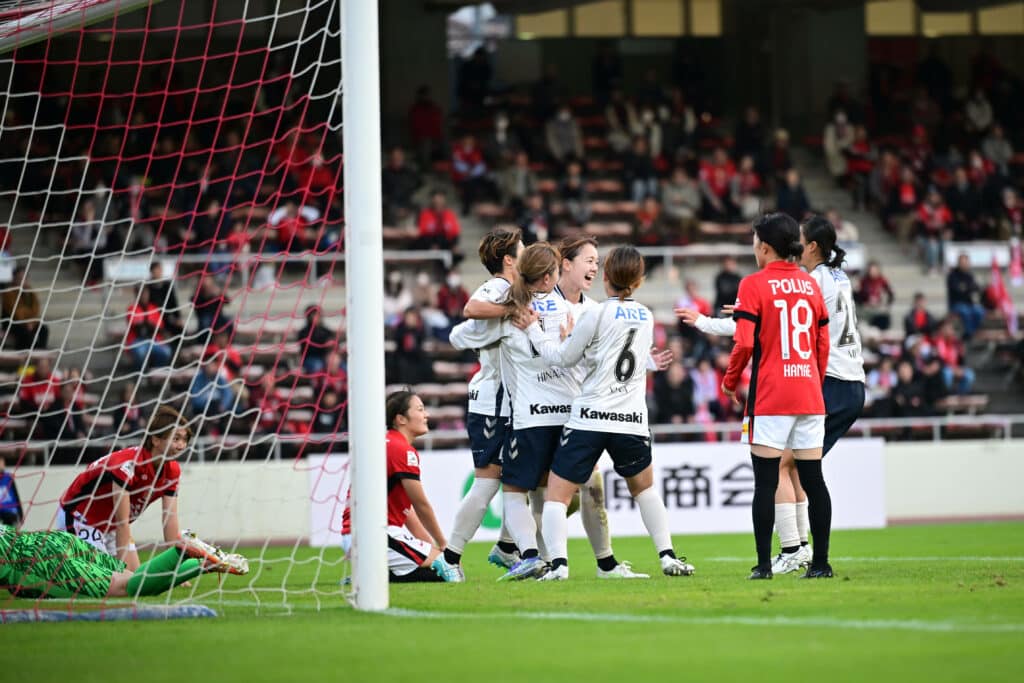
The Japan Women’s Empowerment Professional Football League – the WE League – is still in its infancy. Launched in the 2021-22 season above the long-standing Nadeshiko League, it represents Japan’s first fully professional framework for the women’s game. The Nadeshiko League has since been repositioned as the second and third tiers of the domestic pyramid, while the WE League currently operates without relegation. This year’s annual report, produced by the Japan Football Association with data partners Impect, SkillCorner and the Japan Meteorological Agency, offers a rare, data-rich overview of what has been achieved so far and what strategic steps could elevate the league’s quality in the years ahead.
Shifting Competitive Dynamics in the WE League
From a competitive standpoint, the WE League is undergoing a clear transition. What initially resembled the parity-driven model of the NWSL, characterised by narrow gaps between teams, is gradually shifting toward a structure closer to major European leagues, where the divide between top clubs and the rest is more pronounced. This shift becomes particularly evident when comparing the 2024-25 and 2025-26 seasons, marking a move from competitive balance to increasing stratification, a trend that will require closer monitoring in the coming years.
Between Identity and Ambition
The report highlights the key differences and similarities between the WE League and other major competitions, revealing several compelling insights. While Japanese women’s football remains in an earlier stage of development compared with the NWSL and Europe’s top leagues, the direction of travel is unmistakable. The league is following a defined strategic path, one that reflects a long-term vision for what Japanese women’s football aims to become, and, crucially, it underscores the existence of a distinct national footballing identity.
Japan’s national team reached the pinnacle of the sport by winning the 2011 World Cup and reaching the Olympic final the following year, yet the domestic league has not fully matched that international success. The WE League still requires further structural and competitive evolution to bridge that gap and support the next phase of growth.
The Tactical Approach of the WE League
One of the most revealing aspects of the report is the emergence of a distinct tactical identity within the competition. When match data is reorganised into comparable game-state profiles, a clear pattern emerges: Japanese women’s football is structurally less reliant on high-intensity transitions and far more oriented toward controlled, organised possession phases.
Compared with the NWSL – where end-to-end sequences and transition-heavy football are defining traits – Japan’s top division operates at a more measured rhythm. And unlike Europe’s major leagues, where aggressive pressing and territorial dominance often dictate the flow of play, matches in Japan tend to feature fewer extreme scenarios and a more stable tactical equilibrium.
This reflects a long-standing national preference for technical precision, spatial discipline and collective structure, qualities that have long defined Japan’s footballing identity. Even as the league’s competitive balance shifts, the underlying style remains recognisable, with fewer high-pressure waves, fewer chaotic turnovers and a greater emphasis on maintaining order in possession. The WE League is developing along a path that prioritises technical clarity over athletic disruption, shaping a tactical ecosystem that is uniquely Japanese and deeply rooted in the country’s football culture.
The Physical Gap: Structural but Not Technical
The physical data highlights one of the most consistent differences between Japan’s top division and the world’s leading competitions. Across nearly all game-state profiles, Japanese teams register lower high-intensity outputs than their European and American counterparts. At first glance, this might appear to be a purely athletic gap. In reality, it reflects deeper structural factors within the league’s ecosystem
The tactical environment – more controlled, less transition-heavy and less reliant on repeated high-pressure actions – naturally produces fewer opportunities for explosive runs, recovery sprints or chaotic defensive sequences. This is particularly evident in possession phases: when teams spend less time in high-risk, high-tempo situations, the physical load decreases accordingly. The data shows that forwards and wide players perform fewer high-speed actions when their team has limited possession, suggesting a style that prioritises technical circulation over vertical disruption.
What the Numbers Say
Role-specific patterns reinforce this interpretation. Central defenders, for instance, record significantly fewer accelerations than their counterparts abroad – a difference likely linked to the league’s more measured build-up and the reduced frequency of secondary movements after the first pass. Full-backs, meanwhile, show lower high-intensity values out of possession, reflecting the scarcity of urgent recovery runs in a competition where defensive lines are less frequently exposed in transition.
These trends should not be read as shortcomings. Instead, they reveal the structural characteristics of a league still consolidating its professional identity. The physical gap is not a verdict on player quality, but a signal of where investment, training methodologies and competitive intensity may evolve as the competition matures.
What the Data Suggest About WE League’s Future
The report also offers a clear indication of where the WE League is heading. The combination of tactical patterns, physical outputs and competitive trends points to a competition in the midst of structural transformation, gradually aligning itself with the demands of the global women’s game while preserving a distinctly Japanese identity.
The shift from parity to stratification is particularly significant. As top clubs consolidate resources, improve infrastructure and attract higher-level talent, the league is beginning to mirror the hierarchical structures seen in Europe’s major competitions. This evolution is not inherently negative; in many markets, a period of stratification has preceded broader professional growth, driving investment, raising standards and creating aspirational benchmarks for the rest of the competition.
The physical data reinforces this trajectory. Lower high-intensity outputs and role-specific gaps highlight areas where targeted investment – from conditioning methodologies to training environments – could accelerate competitive maturity. These are not limitations, but indicators of where the next phase of development is likely to occur. As clubs strengthen their professional frameworks, the physical profile of the league will naturally evolve.
Building the Future Through Data
At the same time, the competition’s tactical identity remains a strategic asset. Its emphasis on technical clarity and structured possession provides a foundation that can support long-term player development and differentiate Japan within the global market. If the league succeeds in combining this identity with increased athletic intensity and deeper competitive depth, it could position itself as one of the most distinctive and forward-thinking ecosystems in women’s football.
In this sense, the data does not simply describe the competition; it also outlines a roadmap. The league’s future will depend on how effectively clubs, the federation and stakeholders leverage these insights to guide investment, shape development pathways and build a sustainable competitive model.
Environmental and Contextual Factors
While the report is primarily focused on tactical and structural trends, it also examines the external conditions in which the WE League operates. Meteorological data – included to assess potential environmental impacts on match quality – shows that Japan’s climate differs
only marginally from that of Europe or the United States. The one meaningful distinction is the higher frequency of matches played in hot and humid conditions during the summer months, with elevated temperatures often extending into September.
These conditions are not severe enough to alter the league’s competitive profile, but they form part of the broader operational environment. In a competition still refining its calendar, infrastructure and professional standards, even minor contextual factors help explain how it functions and where future adjustments may be beneficial.
A League Defining Its Own Future
The WE League’s annual report does more than measure performance; it captures a competition in the process of defining itself. The data reveals a league that is still young but already shaped by a clear tactical identity, a distinctive developmental philosophy and a growing awareness of the structural demands of the global game. Japan’s approach – rooted in technical precision and collective organisation – remains a competitive asset, yet the physical and competitive gaps highlighted in the report point to the next frontier of evolution.
As investment rises and the league moves further along its professional path, the challenge is to raise athletic intensity and deepen competition without losing what makes Japanese football distinctive. If it manages that balance, the WE League could grow into a domestic competition with real weight, and a rare example of how identity and development can advance together. In this sense, the report is a map that outlines how Japan can translate its cultural strengths, analytical clarity and long-term vision into a competitive ecosystem capable of shaping the future of the women’s game.
A Growing Audience
Another factor – not included in the report but available through the league’s official data – shows how strongly supporters are responding to the women’s game. During the 2024-25 season, the WE League recorded 282,221 total attendees, with an average of 2,138 per match. Interest was further underlined by the season-high crowd of 26,605 for the 2-2 draw between JEF United Chiba and Omiya Ardija Ventus (Matchday 20), a striking figure given that both clubs were in the lower part of the table in a league without relegation.
Attendance figures from the 2025-26 season confirm a similar pattern. While some matchdays surpassed 10,000 or even 20,000 total spectators across all fixtures, the highest attendances for a single game were 9,677 on Matchday 2 and 9,531 on Matchday 14 – both recorded by Sanfrecce Hiroshima. This distinction points to a league where interest is steadily consolidating, with most fixtures now drawing around 1,000 spectators and only a few falling below the 800 marks. At the same time, the ability of certain clubs to attract crowds close to 10,000 shows the potential for further growth. As professional standards rise, strengthening this middle ground and gradually lifting overall attendance will be an important part of the league’s long-term development.
Author: Sebastiano Moretta