
If you’re reading this article, you’re probably interested in women’s sports. You’re likely to believe that coverage of women’s sports – while still lacking in some respects – has greatly improved over the last few years after being historically sexist or absent. And indeed, there’s ample evidence for that claim. Legacy media outlets like The Guardian and The Athletic have considerably increased their coverage, providing detailed analysis, podcasts, live reports and deep dives. There’s a plethora of independent blogs and podcasts, some more focused on tactics, others on specific clubs or sports culture. Being a fan of women’s sports online doesn’t mean screaming into the void anymore, and large communities of supporters have emerged online. Videos of fantastic goals or funny moments regularly go viral, be it in football, basketball or hockey.
That growth can lead fans to believe that the job is done: Women’s sports have broken into the mainstream. But a new scholarly study, “A Silo of Their Own: The Compartmentalization of Media Coverage of Women’s Sports, 1989-2024”, published in the journal Communication & Sport by Cheryl Cooky et al, challenges that optimistic assumption. This longitudinal study has analysed the coverage of TV sports news and highlight shows (e.g. CBS Sports HQ / Spotlight, ESPN’s SportsCenter and B1G Today) for 35 years. The results point to stagnation rather than drastic change.
Fragile growth and stagnation: Coverage of women’s sports in legacy media remains meagre
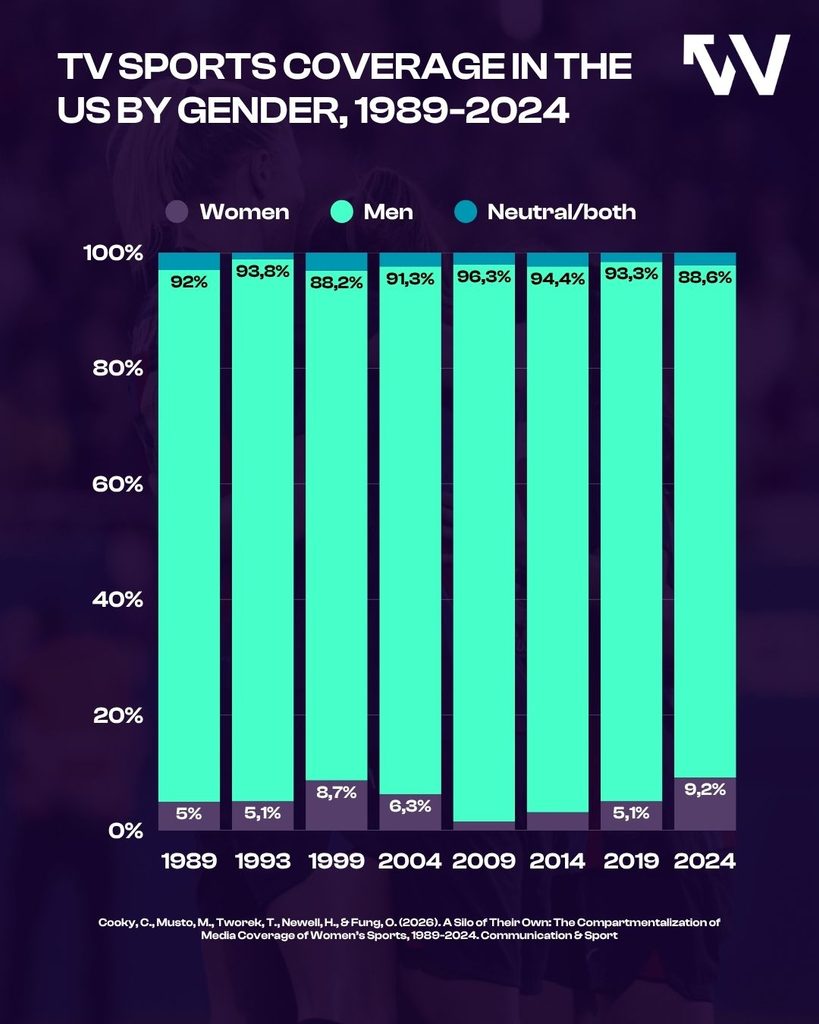
The study authors note a “continued eclipse of women’s sports”: Men’s sports still dominate airtime, by far. In 1989, when the study began, women’s sports made up just 5% of TV coverage with 92% going to men’s sports and 3% to mixed segments (broadcasts discussing both men’s and women’s sports). Decades later, there has been some change: In 2024, women’s sports accounted for 9.2% of the coverage. But that growth remains subdued, and the data suggest that it might be fragile.
In 1999, women’s sports coverage had considerably increased compared to the years before, accounting for 8.7% of total coverage. That increase was likely fuelled by the 1999 Women’s World Cup, where the US team sparked euphoria on home soil and more than 90 000 people attended the legendary final against China. On a side note, that tournament proves that not all coverage of women’s football is positive per se, as a fair share of media reports were rather sexist. The euphoria didn’t last, though, and in 2009, media coverage of women’s sports plummeted to a paltry 1.6%.
“Silo effect of coverage”: Women’s sports have found their niche, but mainstream success remains evasive
The picture is more positive when online newsletter and social media are considered too:
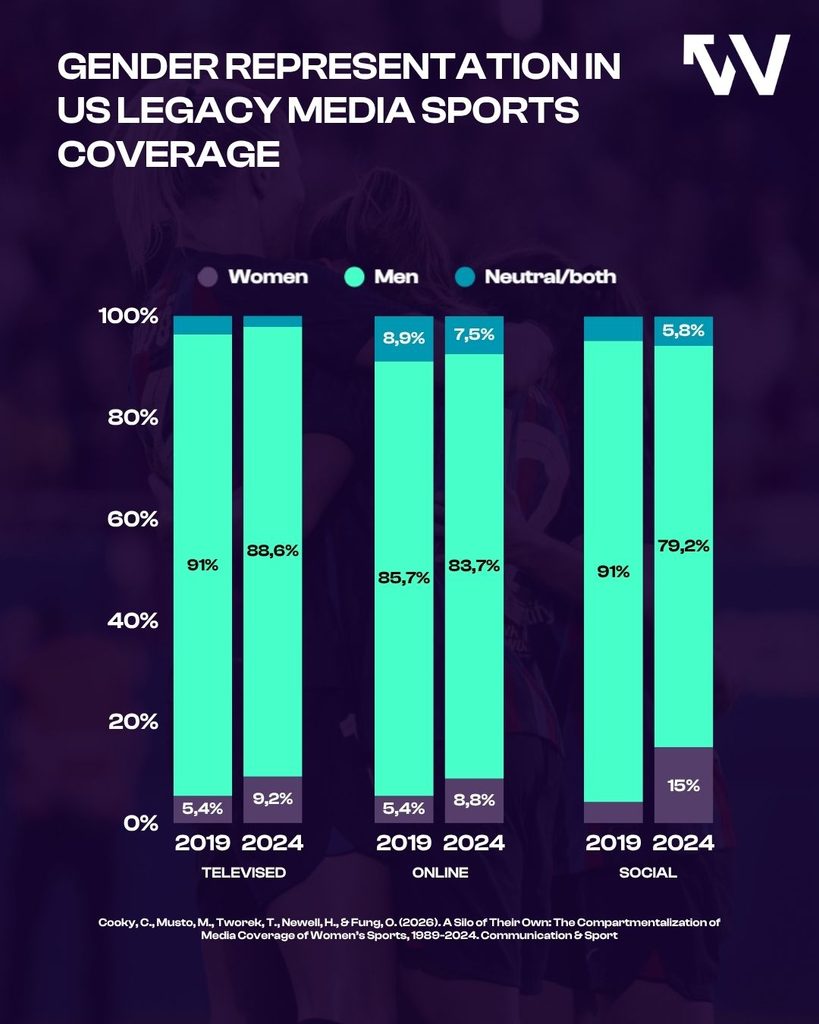
Legacy media outlets show more women’s sports on social media than on TV. That might be due to the demographics of women’s sports fans: As studies have shown, fans are on average younger, and thus more likely to use social media than to watch TV. But that difference in demographics also means that fans of women’s sports may tend to overestimate the amount and quality of coverage. Sports fans, just like any kind of internet users, live in their own bubble and therefore tend to believe that their areas of interest are more popular than they actually are.
The study notes that in recent years, media outlets have dedicated platforms specifically to women’s sports – espnW and NBC’s OnHerTurf are two examples cited, and one could add independent platforms like Just Women’s Sports (or our own, The Rise of Women’s Football) to that. Hence, there is a real increase in coverage, but the question is whether this coverage reaches new fans or just the familiar echo chambers. The truth is that, even in 2026, if you’re not interested in women’s sports already, you’re unlikely to become a fan just by watching TV. The difference from men’s sports – hard to avoid even if you’re not interested – is striking.
Cooky and her co-authors note that even when the NWSL and WNBA are playing but there’s no men’s sports on – during the summer break, for instance -, media outlets often prefer to extensively cover transfer moves and to build up excitement for the next season than to cover women’s sports: “The ongoing and pervasive coverage of men’s collegiate and professional football, basketball, and baseball on legacy media networks lends to the overarching impression that the men’s Big Three never go out of season.” The study describes this effect as the “silo effect in women’s sports media coverage”: high-quality coverage is restricted to emerging and niche platforms, while the legacy media only interrupt their coverage for rare and record-breaking moments.
“Gender bland sexism”: Differences in quality of reporting between men’s and women’s sports
As mentioned above, the quality of the coverage matters just as much. Cooky and her co-authors coin the term “gender bland sexism” for the problem with much of today’s coverage. While overt sexualization and trivialization of women’s sports rightfully aren’t en vogue anymore, the coverage of women’s sports often lacks enthusiasm and tension. Records and historic runs are often downplayed with nonchalance (“That’s a pretty good run, I think”, one commentator is cited), while they’re celebrated with superlatives in men’s sports.
Basketball drives coverage of women’s sports in the US
Another notable result of the study is the breakdown of which women’s sports get covered on US TV news. In Deloitte’s 2026 report “Game changers: Unlocking the potential of women’s sports”, women’s football and women’s basketball are each predicted to generate 35% of all women’s sports revenue in 2026, eclipsing all other sports combined at 30%. Cooky’s study paints a different picture.
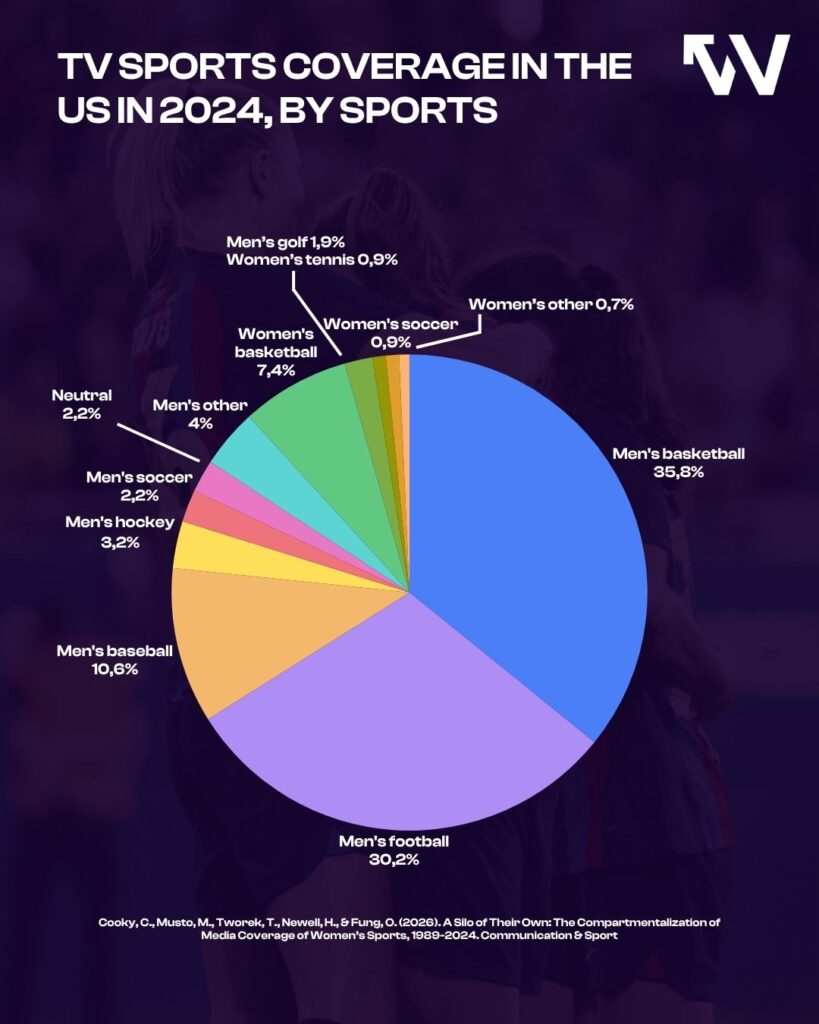
Basketball is the highest-represented women’s sport on TV with 7.4% share of total coverage, while women’s football and tennis each account for 0.9%. This is partly due to the fact that virtually all revenue for women’s basketball is generated in the US, while football is traditionally more of a European sport. Hence, while both sports are at similar levels of popularity globally, women’s basketball is comparatively more popular in the US than the NWSL. The fact that the difference is that stark, however, should make executives pause for a moment and think about what they can learn from basketball. Possible lessons include more cross-club cooperation, which already exists between the Portland Thorns and the Portland Fire, and drawing on the popularity of individual players.
But even then, coverage of women’s sports would still lag considerably behind men’s sports. The study by Cooky et al is a useful if uncomfortable reminder that women’s sports still aren’t where they want to be. Growing fanbases and narratives takes time, and men’s sports have an edge here due to the historic marginalization of women’s sports. Adding to that, broadcasters still neglect women’s sports or treat them in a lacklustre way. That’s a frustrating conclusion, but also a wake-up call: Women’s sports should not get too comfortable celebrating its own successes and records. In 2024, the gates to quality legacy media coverage remain largely shut. Women’s sports needs to keep pushing for them to open.
Text: Helene Altgelt