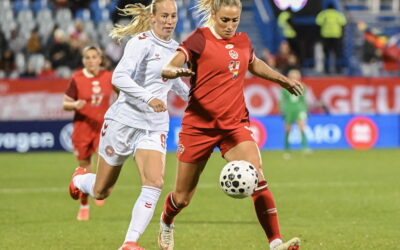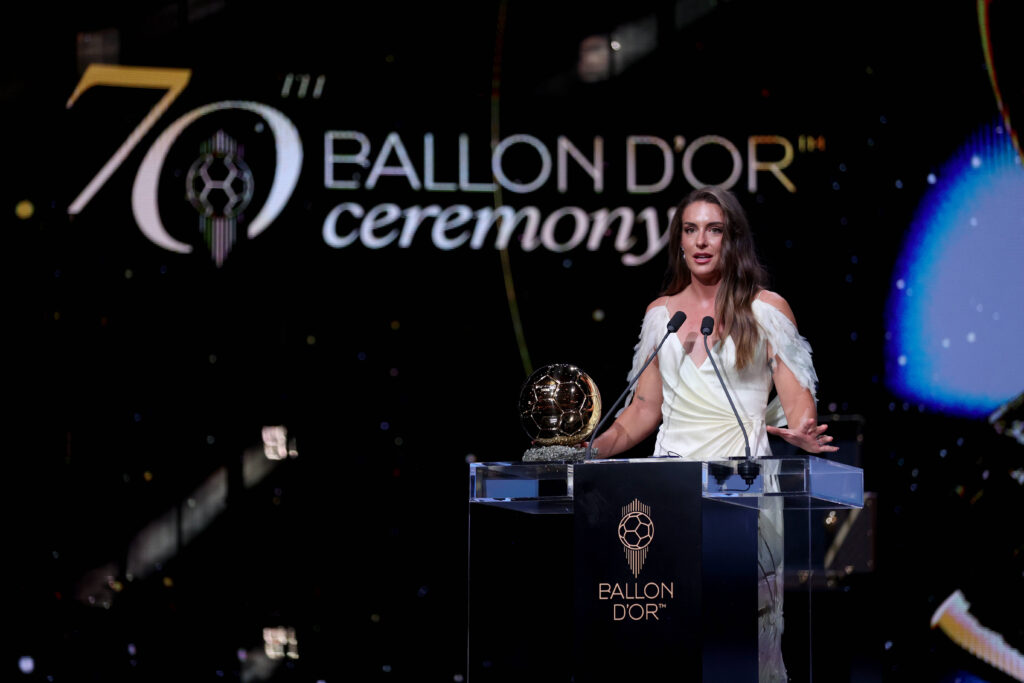
On Monday night, the Barcelona legend reclaimed the women’s game’s most prestigious individual award, adding a third Ballon d’Or to the trophies won in 2021 and 2022. The achievement puts her alongside Aitana Bonmatí as the only players to have won the award three times.
The recognition followed another extraordinary season with Barcelona. Alexia captained the side to a quadruple in 2025–26, including the UEFA Women’s Champions League, while helping carry the team through a campaign shaped by injuries and high expectations. Spain also continued its success on the international stage, winning another Nations League title.
Yet the night was about more than the numbers. She was recognised for what she had achieved on the pitch, but her return to the summit also offered a reminder of what it takes to get there again. The ceremony itself, meanwhile, raised a familiar question: when women’s football gets its moment in the spotlight, is it always given the respect that moment deserves?
A comeback that was never guaranteed
Putellas’s first two Ballon d’Or wins arrived at the height of her Barcelona influence. The third came after a very different journey.
An ACL injury in 2022 ruled her out of the European Championship and forced her to rebuild her game away from the spotlight. Returning from such an injury is difficult enough. Returning to the level required to win the sport’s biggest individual honour demands even more.
Speaking to Cadena SER after the ceremony, Putellas reflected on the challenge of reaching the top again.
“Coming back has been a real challenge, but I love challenges.”
The simplicity of that answer says a lot. Recovery is rarely a straight line, and returning to competition does not automatically mean returning to your best. She had to work through the physical demands of rehabilitation and the uncertainty that comes with not knowing exactly what the other side will look like.
During her acceptance speech, she also remembered the people who supported her through the hardest moments, recalling when her leg would fail her and the process of learning to walk, run and shoot again. In remarks reported by Telecinco, she described those moments of doubt and the people who stayed beside her.
The contrast between those early steps and standing on the Ballon d’Or stage is striking. The award celebrates a season of elite performance, but the journey behind it includes months of work that supporters never see.
Putellas has since moved to London City Lionesses, bringing her excellence into the Women’s Super League. Her third Ballon d’Or is not simply a return to a familiar place. It is recognition that, after everything, she remains among the best in the world.
What her victory means for the WSL
Putellas’s move to London City Lionesses gives her third Ballon d’Or another dimension. One of the most decorated players in the world is now part of the WSL, bringing her profile and experience into an English league that continues to attract leading international talent.
Her arrival is significant for London City, but the implications reach beyond one club. The WSL has invested in its ambition to become a destination for elite players, and Alexia adds another global name to that story.
Her presence also challenges the idea that a player’s legacy is tied to one club or league. Fourteen seasons with Barcelona gave her a career many players could only dream of. Her departure does not erase that history. It opens another chapter.
For the WSL, the opportunity is to make the most of her arrival without reducing it to a marketing exercise. Alexia Putellas is not simply a famous name to put on a poster. She is a player whose reading of the game, technical quality and experience can shape what happens on the and off the pitch.
The league’s responsibility is to give her and the other players around her the conditions to thrive. The audience’s attention will follow the football, but the long-term value lies in building a competition that can keep attracting talent and developing its own stars.
Vicky López and Cata Coll show that the future is already here
Putellas was not the only Barcelona player recognised on the night. Vicky López retained the women’s Kopa Trophy, while goalkeeper Cata Coll won the women’s Yashin Trophy.
Those awards matter because they show the depth of talent in this generation. Barcelona’s success is not the work of one player, even when one of its leaders receives the night’s biggest individual honour.
López represents the next generation of Spanish footballers making their mark at the highest level. Coll’s recognition reflects the importance of a goalkeeper whose contribution can be less visible than that of a goalscorer or playmaker. Their awards are reminders that excellence takes different forms, and that the women’s game has talent worth celebrating across the pitch.
Putellas made a similar point in her post-ceremony interview with AS, pushing back against the idea that Spain’s success comes down to her and Bonmatí alone.
“Spain does not reduce to just Alexia and Aitana.”
She also expressed confidence that more Spanish players would win the award in the future. It was a generous response from a player who had just reclaimed the individual honour, and an important one. Great players help define an era, but they also emerge from systems, teammates and generations that make their success possible.
The ceremony had plenty of individual winners. Its bigger story was the strength of the environment producing them.
Putellas was allowed to take her time
Putellas’s acceptance speech was long. It was also personal, generous and full of people she wanted to thank.
She acknowledged her teammates, coaches, Barcelona’s supporters, Spain’s national team and the family and friends who stood beside her through injury. She spoke about the difficulties her team had overcome and the pride she felt in captaining a group that had achieved so much.
Some online criticism focused on the length of the speech. There is a fair discussion to have about awards-show pacing, especially at a ceremony that ran late. But the player accepting the award should not become the target for every frustration with the event’s production.
Alexia had just won the Ballon d’Or for the third time. She was reflecting on a season that followed one of the most difficult periods of her career. It was reasonable for her to take a moment.
The speech also ended with a message to young people around the world who want to play football. Putellas told them:
“Don’t listen to someone who says you can’t do it. Believe in yourself.”
That message was more than a routine line at an awards ceremony. It spoke to the barriers that still shape who feels welcome in football, and to the power of seeing someone who has reached the top encourage others to follow.
For young girls watching, visibility is not an abstract concept. It is seeing a player who has experienced setbacks, returned to the highest level and been given the stage to tell them that they belong.
The speech was an opportunity to do exactly that. The message deserved to be heard.
La Reina is back
Not as the player she was before her injury, but as the one who fought her way back, found another level and reminded the world why she belongs among football’s all time greatest. A third Ballon d’Or does not erase the months of uncertainty or the work it took to return. It makes the journey all the more remarkable.
Alexia Putellas’s victory belongs to her, but its meaning reaches beyond one player. It belongs to the teammates who stood beside her, the people who helped her rebuild and the young girls who can now look at her and see what is possible. Greatness is not simply about reaching the top. Sometimes, it is about finding your way back when the path there changes completely.
The ceremony may not have given every woman on that stage the attention she deserved but Putellas gave the night something worth remembering: a reminder that women’s football has its own history, its own icons and its own queens.
La Reina never needed to be crowned again to prove who she was. But on this night, football got to celebrate her all over again.
Text. Fleur Dias