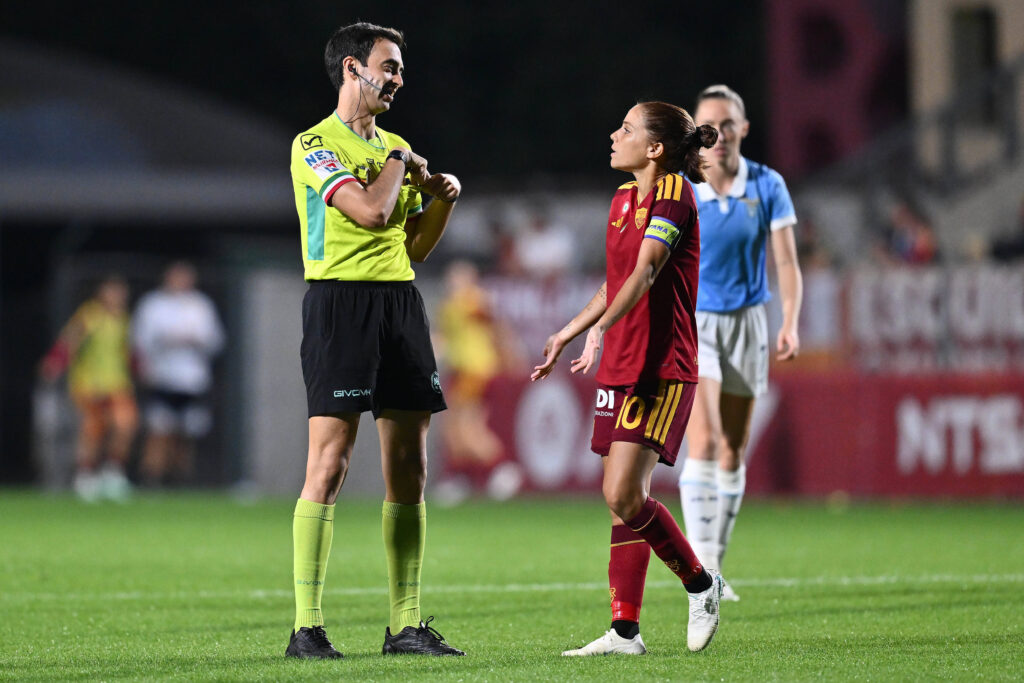
“No referee, no game” is one of football’s most basic principles. Officiating is an essential part of women’s football, particularly because, outside a handful of competitions where technologies such as the Video Assistant Referee (VAR) or Football Video Support (FVS) are available, there is often little room for error. In most women’s football matches, decisions are final. A call is either right or wrong, with no opportunity to go back and correct it.
That is why the game needs a system that allows referees to develop, improve and be held accountable when serious mistakes are made, including through suspensions or other disciplinary measures when necessary. However, building such a system requires officiating to be treated as a profession rather than a secondary commitment.
Officiating as a Profession: The WSL Model
England’s Barclays Women’s Super League is aiming to build a fully professional refereeing system by the 2029-30 season. While the timeline has disappointed some clubs that had hoped for a faster transition, the goal is to create a more comprehensive structure in which professionalism brings meaningful changes to referees’ careers rather than serving as a symbolic gesture.
The principle behind the project is straightforward, as without proper support, referees cannot truly develop. Professionalisation is not simply about paying officials to work full-time. It is about providing the education, mentoring, performance analysis and institutional backing required to help them improve and perform consistently at the highest level.
The Italian Situation: How Is the Refereeing Pyramid Structured
Italy’s refereeing system is organised through the National Referees Commission (Commissione Arbitri Nazionale, or CAN), which is divided into several tiers in order to cover the country’s different competitions. At the top of the pyramid sits the CAN responsible for men’s Serie A and Serie B, where referees operate within a fully professional environment. Below that is CAN C, which oversees men’s Serie C and Serie A Women. The two competitions are grouped together because the contractual framework of male and female players is broadly comparable in terms of protections and minimum salaries.
The next level is CAN D, which covers the amateur game. For women’s football, this means all competitions from Serie B Femminile downwards. This level frequently faces staffing challenges, as the number of available referees is often insufficient to meet the demands of a large number of weekly fixtures. Separate commissions also exist for futsal and beach soccer. CAN 5 Élite oversees the top divisions of men’s and women’s futsal, while CAN 5 is responsible for the lower categories. Beach Soccer also has its own dedicated refereeing commission.
Possible Solutions for Refereeing in Italy: Stronger Evaluation
Before designing a fully professional model, the Italian Referees Association (AIA) should first focus on making better use of the human resources already available within the system. At present, officiating a women’s football match in Italy has little impact on a referee’s career progression, regardless of whether their performance is outstanding or whether they make significant mistakes. In many cases, referee assessors are not even assigned to evaluate performances.
Yet without proper evaluation and recognition, it becomes difficult to expect officials to consistently perform at their highest level. If referees are not valued, they cannot be expected to feel equally invested in the competitions they oversee. A stronger system of assessment, feedback and career development would not only improve accountability but also encourage greater commitment from match officials.
Possible Solutions for Refereeing in Italy: Dedicated CAN
A second possible solution concerns perception. Among many supporters and observers, there is a widespread feeling that women’s football does not receive the same level of attention from the refereeing structure. The perception, whether fair or not, is that officiating in the women’s game is often viewed as a step down from the men’s game, or even as a form of punishment for referees who have underperformed elsewhere.
To address this issue, the AIA could consider creating a dedicated refereeing body for women’s football. Such a structure could help alleviate broader staffing shortages while creating a pool of officials who are genuinely committed to the growth of the women’s game. It would also allow referees to specialise in the specific demands of women’s football while continuing to develop both technically and physically.
Why Women’s Football Needs Better Support for Officials
The debate around officiating is often shaped by a contradiction. Supporters frequently argue that football should preserve the human element and accept refereeing mistakes as part of the game. Yet when a major error occurs, the same mistakes are rarely treated as inevitable human errors. They are interpreted as evidence of incompetence, bias or even bad faith. Women’s football cannot continue to demand higher officiating standards while rejecting the very tools and structures designed to help referees improve. The challenge is not choosing between technology and tradition, but the right balance between accountability, professional development and support for match officials.
Another challenge concerns the relationship between referees and the women’s game itself. Across the lower divisions, many clubs report feeling that women’s football is not always treated with the same level of attention and respect afforded to the men’s game. Whether this perception is accurate or not, it affects trust in officiating and contributes to a sense of distance between clubs and match officials. Building a stronger refereeing culture in women’s football would therefore require not only technical improvements, but also a genuine commitment to understanding and supporting the specific realities of the women’s game.
Building Women’s Football Through Better Officiating
Women’s football has made enormous strides in recent years, both in terms of visibility and professionalisation. However, the growth of the game cannot rely solely on players, coaches and clubs. Referees are equally important stakeholders within the football ecosystem and should be given the same opportunities to develop their skills and advance their careers. Raising officiating standards is not simply a matter of reducing mistakes. It is about strengthening the credibility and competitiveness of the entire sport.
Professionalisation is only one piece of a much larger puzzle. What matters most is creating an environment in which officials are properly trained, regularly evaluated and genuinely valued for their contribution to the game. Whether through the WSL’s long-term project or potential reforms within Italy’s refereeing structure, the ultimate goal remains the same: building a culture of officiating that grows alongside the evolution of women’s football.
Text: Sebastiano Moretta