
This article will explain how these market values are determined and why they aren’t always aligning with transfer fees. More importantly, this article shows that while the rise of market values has been steady, it has also been uneven. Different market value estimations of clubs and leagues will be studied to understand what they reveal about the balance of power in the global game.
How are market values set?
Before exploring the numbers, it is crucial to understand what a “market value” in women’s football is.
Unlike transfer fees, which are concrete and visible, market values are estimates. The platform Soccerdonna, operated by Transfermarkt, its equivalent on the men’s side, has been systematically assigning market values since 2021. As Soccerdonna’s manager Kay-Ole Schönemann explains while speaking to The Rise of Women’s Football, the goal of these market values is not to predict a future transfer fee, but to reflect expected demand for a player in the medium term.
As Schönemann says, these values are built on a broad mix of qualitative and contextual factors rather than an algorithmic formula. “Numerous factors combine to determine the existing demand on the market,” he says, from performance and age to marketing potential and the financial strength of leagues.
Key criteria include:
- Sporting performance at club and international level
- Age and future development potential
- Reputation and marketing value
- League strength (both sporting and financial)
- Injury record and consistency
- Market dynamics, including trends and demand
Importantly, Soccerdonna separates market value from contract situations. A player nearing the end of her contract may command a low or even zero transfer fee but still retain a high market value. This is one reason market values and transfer fees may differ.
It’s also important to understand that the market value system is still expanding. Soccerdonna is run by volunteers, who contribute their analysis on the leagues they follow closely. Thus, market values are still lacking for important leagues like Mexico and Brazil. One problem is that many leagues in women’s football are still not streaming all of their games, making it hard to make realistic estimates. Finally, it’s important to consider that market values are always subjective, they don’t represent an ultimate truth. Still, the evolution of market values over just a few years tells a striking story.
From €425,000 to €1.6 million: the transformation of player valuations in women’s football
When Soccerdonna introduced its first valuations in 2021, German midfielder Dzsenifer Marozsán topped the list at €425,000. Today, the leading player, Aitana Bonmatí, is valued at €1.6 million. That near fourfold increase is not an anomaly. Twenty players now exceed €800,000, reflecting a broader inflation of value across the elite tier.
Schönemann traces this shift back to a structural change in investment behavior: “Between 2017 and 2020, there were only isolated transfers with larger fees. By the end of the decade, the willingness of international clubs to invest was quickly increasing.” Soccerdonna had to react to a new investment climate and adjust market values: Retaining accuracy in a context of ever-rising transfer values is no easy feat.
For Schönemann, a symbolic turning point came with Lena Oberdorf’s transfer within Germany, from Bayern to Wolfsburg in 2024: “When Oberdorf’s transfer fee exceeded €400 000, we understood that our market values had to increase at a higher pace to reflect market dynamics” he says. Since then, growth has been relentless. “Every year there is a new record transfer. That is also reflected in the development of market values”, says Schönemann.
Recent transfer records underline this trend. The €1.16 million move of Olivia Smith in 2025 was surpassed after just a couple of weeks by Lizbeth Ovalle, whose transfer reached around €1.3 million. This record didn’t last for long either, though, as Grace Geyoro joined the London City Lionesses for €1.65 million shortly after. Just a few years earlier, in 2020, the €350 000 paid for Pernille Harder by Chelsea was considered extraordinary. All the ten most expensive transfers in the history of women’s football were made in 2025 – a staggering development.
Schönemann even thinks that the pace of this growth will accelerate even further. He predicts the first €2 million transfer could arrive as early as this year or next, with a €10 million deal possible within five years.
The most valuable players in women’s football: Spain boasts individual brilliance, but structural problems remain
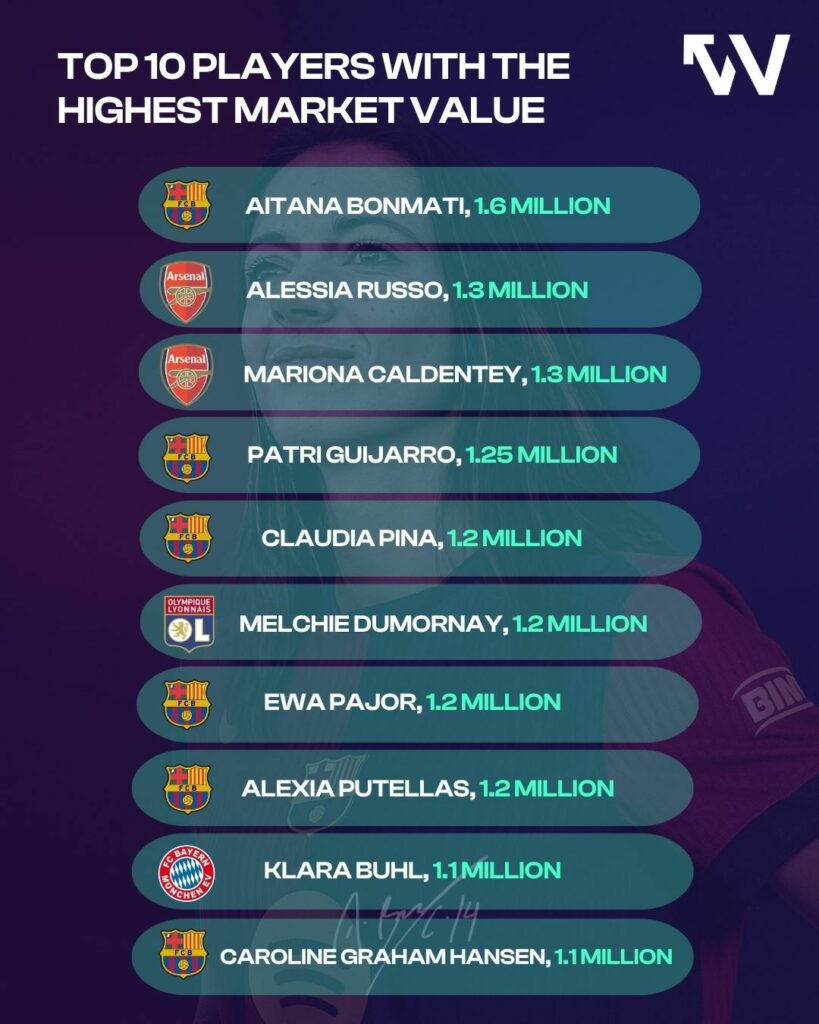
The current top 10 is dominated by Spanish players and clubs, particularly FC Barcelona: Half of the players in the top 10 are Spanish, and six out of ten play for the Blaugrana. Spain’s recent international triumphs, such as the 2023 World Cup and back-to-back Nations League victories in 2024 and 2025, have demonstrated the individual brilliance of La Roja’s roster. One key factor is Spain’s strong youth system, which values technical proficiency and the ability to make effective decisions under pressure and in small spaces.
Yet this dominance also highlights structural imbalance. Liga F shows one of the widest internal gaps in the sport: FC Barcelona’s squad value far exceeds that of most domestic rivals, and more than a quarter of the league’s squads is valued by Soccerdonna below the €1 million mark. This is unusual in international comparison, and it’s easily explained by the fact that the Spanish league is bigger than most elite tiers in women’s football with 16 teams. But whether this is good for the league remains a question for debate. Barcelona has played 21 games in Liga F this season, and in only 7 of them, they scored less than four goals. For neutral spectators, this is hardly thrilling; and even Barcelona would benefit from being challenged more in its domestic league.
England: Driving the player valuations upwards
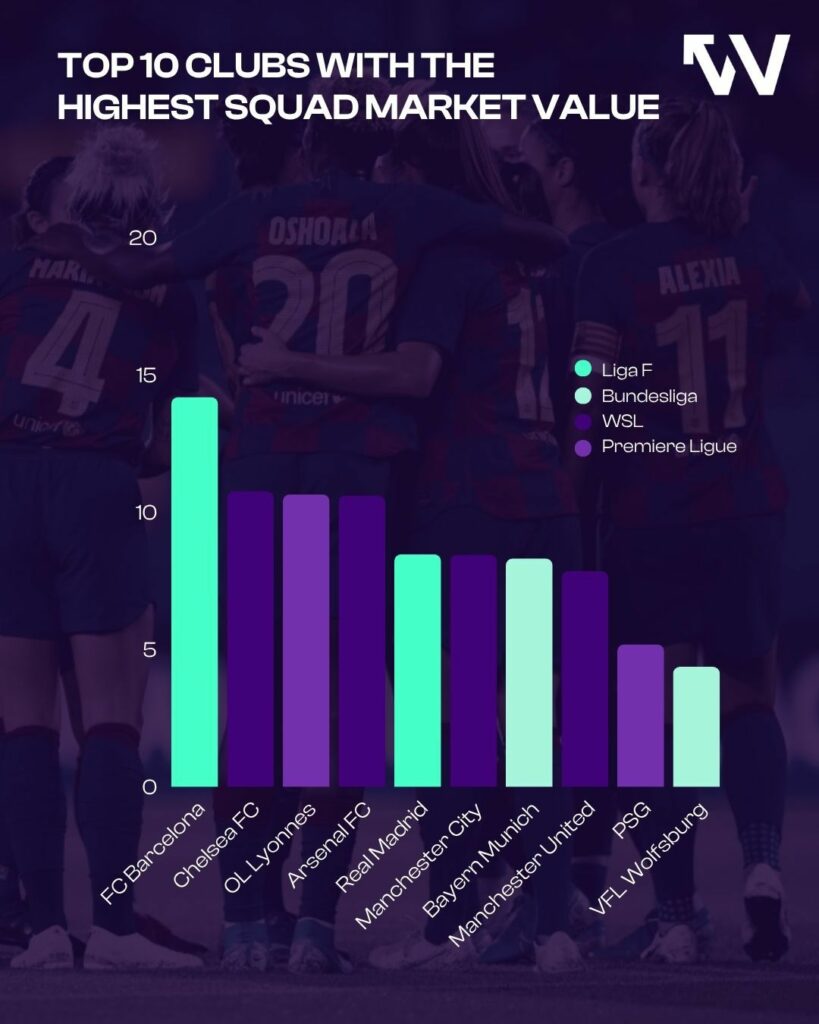
A different picture emerges if we look at the squad market value of the best clubs globally: If Spain represents excellence at the top, England represents depth. Four English clubs appear in the global top 10. Every club exceeds a €1 million squad valuation – a benchmark matched only by the NWSL.
This reflects the financial backing of English clubs, many of which are tied to wealthy men’s teams or investors. “In England, clubs have high financial leeway; the development of market values is extreme,” says Schönemann. This means demand from England drives up market values on the entire market. In recent years, English clubs have succeeded in signing top talents from Scandinavian and West European markets by putting more money on the table.
This willingness to invest is high across the board, meaning the WSL is comparatively balanced. “Many teams operate at a similar level, both sportingly and financially,” Schönemann adds. That parity enhances competition and makes the league more attractive commercially.
The NWSL model: stability without superclubs
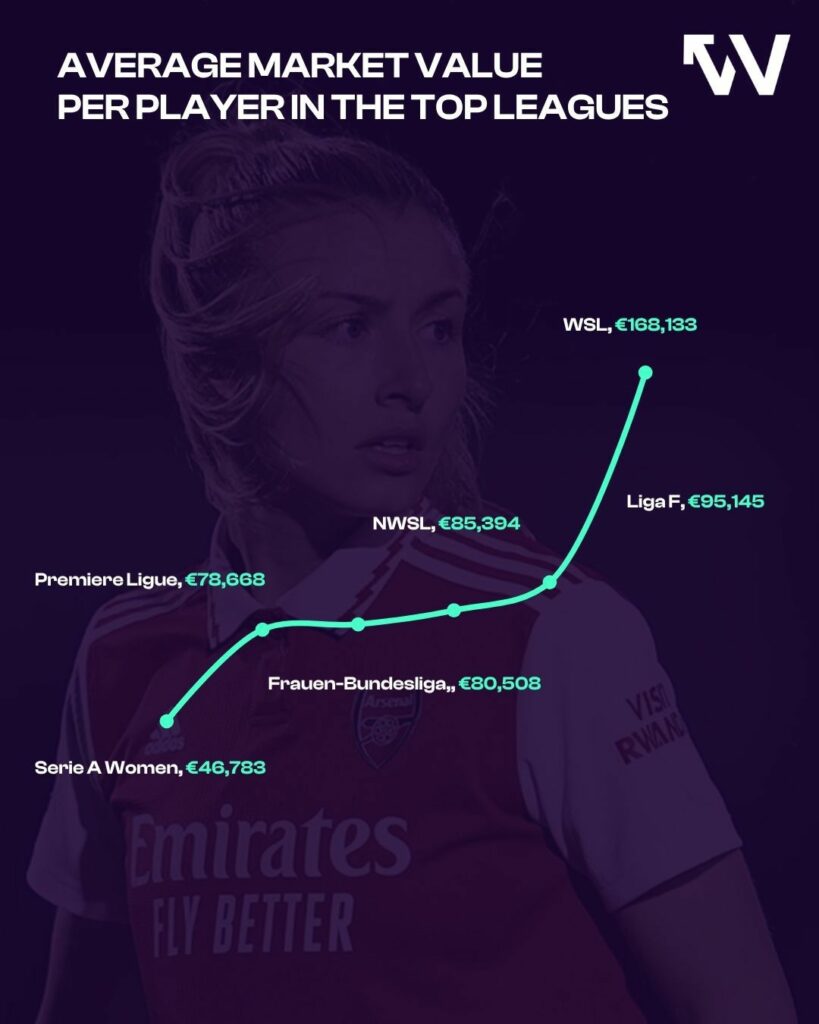
Average market values per player show that one league is clearly ahead, and another clearly behind. For Italy’s Serie A, a league that is struggling to attract investment, these figures are a cause for concern, particularly given that Italian clubs are also absent from the global top 10 for squad market value. Juventus sits at the top domestically, but its squad market value of €2.56 million pales is similar to that to that of many English mid-table-clubs.
On the other end, the Women’s Super League has the highest average market value per player of any major league worldwide. Remarkably, the average market value per player in the WSL is more than double that in the NWSL, the second-best league in this category.
Despite these strong average values, the league lacks the extreme highs seen in Europe. No club exceeds €5 million in squad value, meaning there are no powerhouses like Barcelona or OL Lyonnes. This is a direct result of structural mechanisms of the NWSL ecosystem, such as the draft system and limited allocation money. Still, the league is capable of retaining the best talent, as demonstrated by Trinity Rodman: The USWNT forward recently secured a new contract with the Washington Spirit, reportedly making her the highest-paid player in the world.
Emerging markets and the talent drain problem

Beyond the top leagues, growth is evident but remains fragile.
Sweden and the Netherlands, for example, consistently manage to develop talent. Retaining young prospects is the far bigger challenge, though, as examples like Wieke Kaptein or Smilla Holmberg show.
For clubs with a strong academy, transfer fees can be a viable business model if they keep rising. Clubs like Ajax Amsterdam have demonstrated this in men’s football.The Damallsvenskan and the Eredivisie have established themselves as top producers of talent, with prices rising accordingly. For clubs in the top leagues, this increases the need for good scouting: Outside of Europe, market values remain lower and clubs can find hidden gems without spending excessively
The youth boom: Market values explode for talents
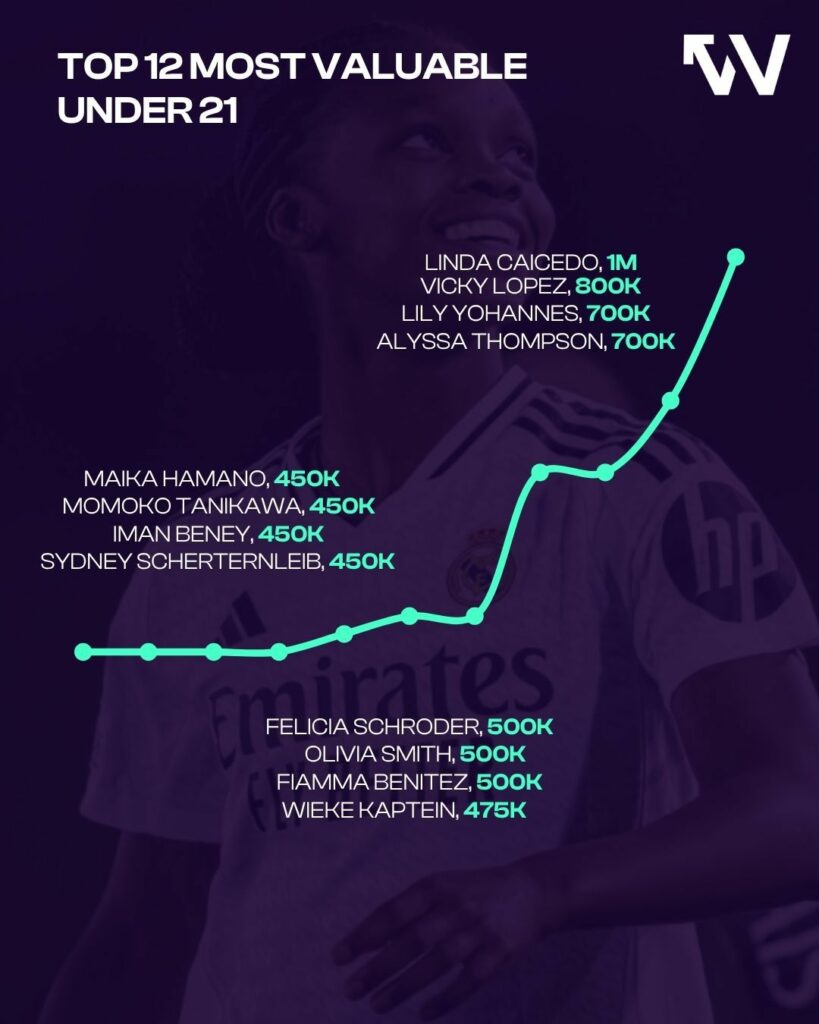
Perhaps the most striking trend is the surge in young talent values.
Players like Linda Caicedo and Vicky López already command valuations close to or above €1 million before turning 22. The under-21 ranking shows a geographically diverse future, with strong representation from the United States, Switzerland, and Japan. This reflects a growing willingness to invest in potential, but not everyone is happy with the direction the transfer market is taking.
The case of Lucía Corrales illustrates the disconnect that can emerge. Despite a market value of just €100,000, her transfer fee reached £430,000 when the Spanish youngster joined the London City Lionesses in 2025. Corrales isn’t an outlier. Sums of €500,000 or more are frequently paid for players who aren’t well known to a wider audience. This trend is driven by ambitious investors like Michele Kang at London City Lionesses.
For some clubs, this raises sustainability concerns. If a few investors push prices upward, others have no choice but to follow, even without matching revenue growth. In the short-term, top clubs need to take financial risks if they want to compete at the highest level. As market values and transfer fees continue to rise, operating smartly and efficiently will be crucial to retain financial sustainability.
Author: Helene Altgelt