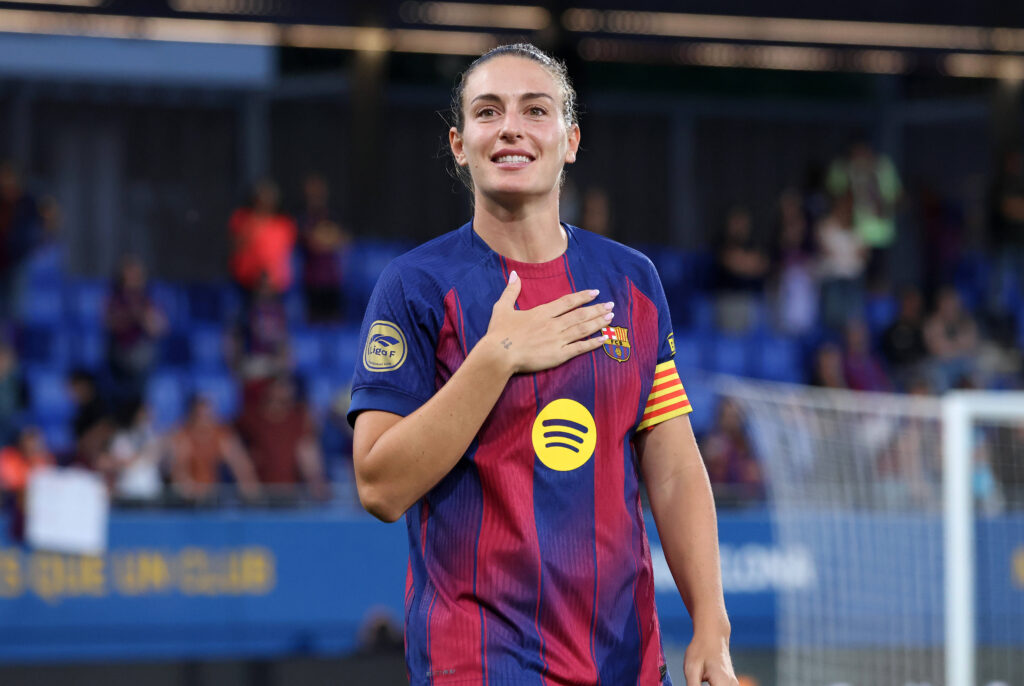
Which is why the immediate reaction to her departure has focused on emotion. Fourteen years. More than 500 appearances. Four Champions Leagues. Two Ballons d’Or. An entire generation of supporters raised alongside her career. But once the shock settles, another question emerges. What if this move actually makes complete sense? Not only for football. For Alexia.
“I’ve given everything, and this has been a perfect story,” she said in one of the most emotional farewells Barça supporters can remember. “I felt that continuing any further could blur the path we’ve built together, and lifting the club’s fourth Champions League was the perfect ending. That’s how I felt.” Her words captured something elite athletes rarely admit publicly: sometimes the perfect ending only remains perfect if you choose to leave at the right moment. Sometimes leaving is not an abandonment of what was built; it is proof that what was built no longer needs protecting
Leaving at the Peak Is Not Walking Away
The easiest version of this story is to treat it as an emotional farewell. Barcelona icon leaves. Era ends. Football moves on. Yet, that interpretation ignores something important. Alexia is not leaving because she stopped being elite. If anything, she appears to be leaving after proving she still belongs among the very best.
This season became her strongest campaign since returning from the ACL injury that interrupted what had already become one of the defining peaks in modern women’s football. Across 42 appearances, she recorded 21 goals and 13 assists. In the Champions League alone she finished with seven goals and seven assists in eleven matches, leading all players in goal involvements and earning UEFA Women’s Champions League Player of the Season. Those numbers matter because they challenge one of football’s most familiar assumptions. That great players leave because they can no longer carry what they once did.
This departure feels closer to the opposite. A player deciding the final image should still look like excellence. Putellas herself framed it that way: “I wasn’t aware of the weight I had been carrying on my shoulders. When they asked me how many titles I had won, I didn’t even know,” she admitted. “You don’t truly value that constant cycle of pressure and expectation until you stop. I could have won all of this again next year, but it cannot become normalised.”
That perspective explains why her farewell never sounded like exhaustion or decline. It sounded like clarity. “I always said I wanted the final moment to come while I was still at my best, giving everything and playing with 100 percent energy. And that moment is now. It has been a perfect story.” This was not somebody waiting for football to decide but somebody choosing the ending.
Before and After the Injury: Two Versions of Greatness
There is another reason this move makes sense personally. Alexia has already lived through the hardest kind of transition.
The version of her career that existed before the ACL injury in 2022 was almost impossibly dominant. Between 2020 and 2022, she became the center of Barcelona’s rise and women’s football’s most recognizable individual star. She won back-to-back Ballons d’Or in 2021 and 2022. She became the first Barcelona women’s player to achieve global football celebrity at a level comparable to the club’s biggest men’s stars. Then the injury happened.
For nearly two years, the conversation around her changed. Recovery replaced football. Every appearance became a comparison. The question stopped being whether Alexia Putellas remained world class and became whether she could ever truly return to the player she had once been. That uncertainty also shaped her last contract renewal. Both sides agreed to a two-year extension with the option of an additional season, though that extra year ultimately never materialised.
In fact, last summer, after a late multimillion offer arrived from Paris Saint-Germain Féminine, Alexia and the club reportedly reached an understanding: if, at the end of the season, she decided to leave, Barcelona would not stand in her way. And in many ways, that is exactly what happened. Over the course of the season, Alexia gradually began to picture herself bringing an era at Barcelona to an end. But she only communicated that decision to the club once she was completely certain.
By then, she was coming off one of her best seasons since the injury, which made the timing feel almost impossibly perfect. As she herself explained, the goal was never simply to continue for the sake of continuing. It was to leave while still feeling complete, still feeling decisive, still feeling like herself. Her game became more efficient. More selective. Still decisive.
Ahead of Euro 2025, Putellas reflected publicly that she finally felt she had closed the chapter of injury physically and mentally, describing herself as feeling free again after years of rehabilitation and setbacks. The hardest comeback has already happened. The pressure to prove she still belonged has already been answered.
Barcelona Gave Her Everything. Liga F May No Longer Be Able To
This is where the conversation becomes uncomfortable. Acknowledging why this move makes sense personally does not diminish Barcelona. Nor does it diminish Liga F. Barcelona gave Putellas the environment to become the player she became. Liga F gave her technical development, tactical maturity, institutional support, and a team structure capable of maximizing her strengths. There is no Alexia Putellas as the world knows her without Barcelona.
However, growth in elite sport creates a strange problem. Eventually dominance stops producing friction. Barcelona have won league titles at a historic rate, seven in a row.They have become so structurally ahead of much of Liga F that domestic competition increasingly serves as maintenance rather than discovery. That is not criticism of Spanish football. It is partly a reflection of Barcelona’s own success. Yet football history repeatedly shows the same pattern. Elite players eventually seek environments that ask different questions. Not because the current environment failed but because it succeeded.
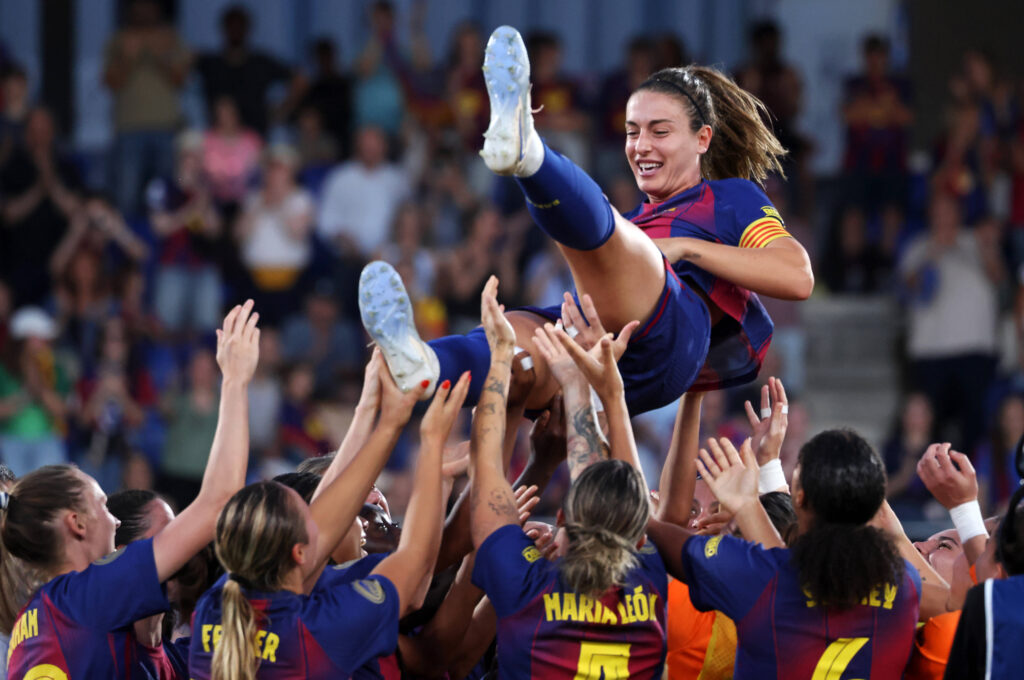
Putellas has spent fourteen years proving she could build. At thirty-two, the challenge may no longer be building. It may be experiencing something different. A new tactical language. Different league rhythms, expectations and even scrutiny. That possibility does not reduce Barcelona’s importance. If anything, it validates it.
“I still feel good and I want to continue my career,” Alexia Putellas explained, “but the best part of my career has already happened, and it was this: Barça. Wherever I go, I will not have these teammates, this stadium, these supporters. None of this can be replaced.” And perhaps that is the clearest measure of what FC Barcelona Femení became during her time there: not just a team defined by success, but part of a wider movement that reshaped the visibility and place of women’s football in Catalan society, changing expectations of what the sport could represent far beyond the pitch. But all stories, even the most perfect ones, have endings — or at least a pause along the way. And the goal of a great institution is not to convince people never to leave. It is to leave them prepared to.
The Ballon d’Or Conversation Changes Everything
Perhaps the strongest argument that this move is not about decline is the timing within the individual awards cycle. Two years ago, conversations around Alexia centered on whether she belonged among the elite anymore. Today, the conversation sounds completely different.
Her Champions League campaign, Barcelona’s European success, and her individual production have pushed her back into serious Ballon d’Or discussion, with growing media and supporter consensus placing her among the current frontrunners for a third award. That matters. Because a third Ballon d’Or would not simply confirm longevity. It would redefine her career.
Two Ballons d’Or can become attached to one era. Three suggests something else. Reinvention. Winning again after the injury would make this season impossible to frame as nostalgia. It would become evidence that a second peak existed. If and when that happens, leaving immediately afterward starts looking less emotional and more strategic. Not leaving because the story ended but leaving because the story changed.
End of an Era or Beginning of a New One?
The greatest compliment supporters often give is wanting somebody to stay forever. But forever rarely exists. Sometimes the better question is whether staying would actually add anything new. Alexia Putellas leaves Barcelona with 504 appearances, 232 goals, 38 trophies, and a place in football history that no transfer can change.
There is very little left to prove there, which may be why this decision feels less sad the longer it sits. Not because Barcelona becomes smaller without her or because she becomes bigger elsewhere. Mostly because, for the first time in a long time, there is uncertainty – for both Alexia Putellas and the club. But that uncertainty is not necessarily negative. It is tied to a future she has long wanted to help shape, ensuring there is a new generation ready to take over.
After becoming almost a maternal figure to many of the younger players in the dressing room, she made sure to include them in her farewell video. And after seeing Vicky López cry during the goodbye, she said: “My generation moved the world, but they will take it even further.” So for the club, “La Reina” sees not decline, but continuity – more future than uncertainty.
As for her, uncertainty, even for someone who has already achieved everything, can still feel less like fear and more like excitement. Perhaps this is not the end of La Reina after all. It is simply the first time in fourteen years that the queen gets to discover who she is somewhere else.
Text: Fleur Dias & Irati Vidal