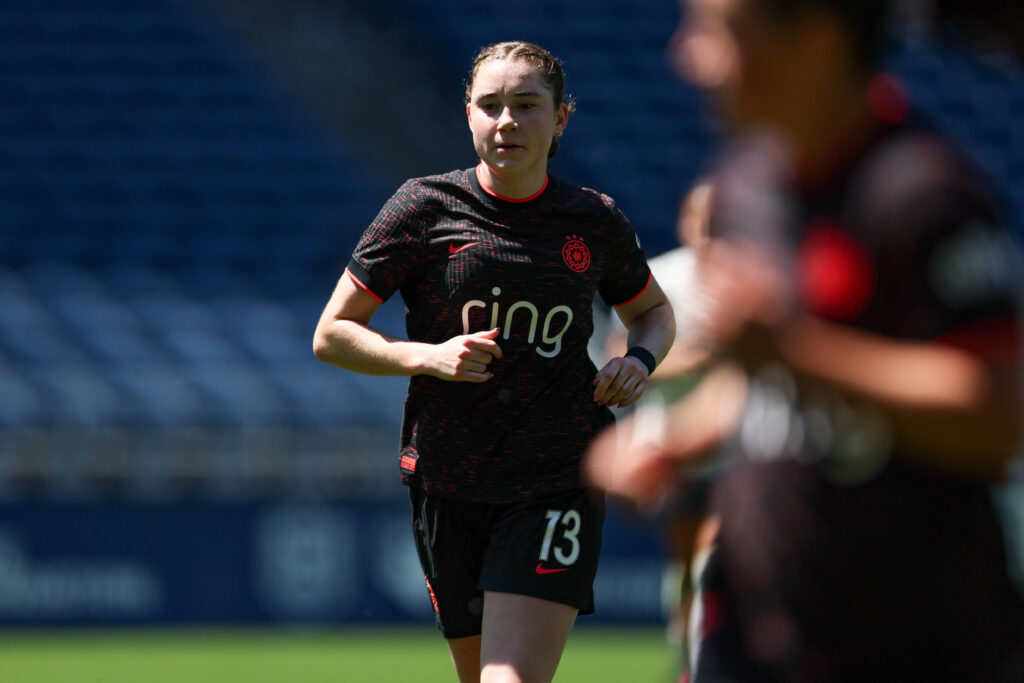
“If you’re good enough, you’re old enough.” This is Olivia Moultrie’s conviction, shared in a 2024 profile by the LA Times. At the time, the then 18-year-old was preparing for an upcoming training camp with the US women’s national team and her fourth season with the Portland Thorns. Wait, her fourth season? Indeed: Moultrie debuted in the NWSL when she was 15.
For years, the league had kept minors out of the competition. Moultrie, a soccer wunderkind who received a college scholarship from North Carolina at 11 and signed a representation deal with Wasserman and a Nike deal at 13, challenged that system in court. She won a preliminary injunction in 2021, allowing her to play, and the NWSL subsequently introduced an under-18 entry mechanism.
The youth movement in the NWSL
Created in 2022, the mechanism establishes a clear process and safeguards for signing minors. Teams must offer teenagers contracts until the season in which they turn 18 – to create long-term stability – they cannot be waived or traded without their consent, the club must provide separate locker rooms to change and shower, and the players must live with a parent or guardian. Since the introduction of the entry mechanism, more than a dozen minors have taken the opportunity to enter the league. In some cases, clubs have also provided a chaperone for away travel and player mentors – this is what Gotham did for 13-year-old McKenna Whitham, who in 2024 moved 4,000 kilometers away from California to New Jersey with her parents and went on to make her debut at 14.
So far, the youth boom in the NWSL has, by all accounts, been as a success story. The clubs have gained outstanding talent, some of whom made a real impact under 18. Fans get to cheer on exciting players like Kennedy Fuller or Olivia Moultrie years earlier than they might have expected. And the players themselves have been enthusiastic about their opportunity to prove themselves at the highest level. The only losers, one could argue, has been the college system, which has seen some of its most promising teenagers choose professional football instead.
Good enough to play professional football – old enough to deal with the pressure?
And yet, there’s the occasional quote that makes you pause for a second.
In an interview with Deseret News, Moultrie stressed how grateful she was for her trajectory and that she would not change anything looking back. But sometimes, she said, she looks at pictures from her first training sessions in Portland and can’t help thinking “how small and little I was.” At 13, she said, she was not ready for professional football: “It was hard. It was really hard.” Kennedy Fuller said she felt “comfortable being uncomfortable at Angel City”, explaining that ultimately, her experience made her grow not only as a player but also as a person.
Both are in favor of young players going pro. But their experiences show something that, for all the talk about records and wonderkids, often gets lost: there’s wonder in wonderkid, but also kid. These players are still children when they get thrown into this competitive work environment. So how can they be protected?
The question is not exclusive to the NWSL. Europe has a much longer tradition of teenagers making their debuts in the highest leagues. Vivianne Miedema, for example, played in the Dutch first division at 15. Years later, however, she admitted that there were seasons early in her career when she was not able to enjoy football.
Pressure is omnipresent when players make headlines as “the youngest…”, and warning examples from men’s football, which has embraced the youth boom even more fervently, spring to mind. When Cavan Sullivan made his debut in MLS in 2024, comparisons with the failed prodigy Freddy Adu, hailed as “the next Pelé” twenty years earlier, immediately followed.
Linda Caicedo experienced a different version of that pressure. She made her professional debut for América de Cali at 14 before moving to city rival Deportivo Cali later that year. Looking back at the criticism she received as a teenager, she said the “nasty comments” affected her deeply. “Back then, I had a child’s mindset,” she remembered.
Who protects the prodigy?
For young players, the actual performance is often the least of the problems. But children need a stable environment to navigate a workplace that wasn’t designed for players their age. Parents can provide this, and often do. But they’re not necessarily experts in football contracts, media requests and business inquiries. And in some cases (see: Jennifer Capriati), parents may prioritize their own interests and ambitions over those of their children.
In the best case, agents can be part of that stable environment. They can provide professional mentorship early in a player’s career, explain decisions that a teenager and their family might not understand, protect them from external pressure and help them think beyond the next contract. Ideally, it’s a win-win scenario. Claudia Pina’s agent Carlota Planas remembered in an interview: “Taking her on at age 16 and eventually seeing her play at Camp Nou in front of 90,000 people was thrilling. When I started representing her, she was on Barça B, earning very little, and we didn’t know what her future held.” For agents, finding players with potential early, can be lucrative. Problems arise when what’s best for the player is not always what’s best for the agent.
Imbalance of power, money and knowledge
Men’s football has provided some uncomfortable examples. Jorginho was brought from Brazil to Italy by an agent when he was 15. He later remembered having only 20 euros a week to live on and discovering that the agent had been taking money from his salary without his knowledge. “I was completely devastated,” Jorginho said. His example shows that young players are especially vulnerable when they moved from one country to another.
John Obi Mikel remembered a different kind of pressure from when he was 16 and one of the most sought-after young players around when talking to Four Four Two: “The agent had a briefcase full of cash sitting right next to him, about £50,000, saying: ‘Listen, I think a big Dutch club want you to go there, so sign for them and sign for me.’”
These are, of course, anecdotes rather than evidence of how agents operate. Yet, they illustrate the imbalance that always exists when a teenager enters an industry where adults have considerably more knowledge, money and power. One player interviewed in a scholarly study admitted: “I had no idea what I signed. I was young and stupid.”
In women’s football as well, players are becoming younger as they’re approached by agents. In 2019, French agent Sonia Souid reported on practices by some agents: “They end up encouraging players to accept contracts that benefit them but not the players, and urging 15-year-olds to confront their clubs to demand more money. This creates difficulties for clubs that invest in women’s soccer. Some even go so far as to wait for young players at the end of their practice to hand them envelopes.”
Agents can be the single most important person in a young players’ career, but that also comes with risks of dependency. These days, agents manage not just transfers but often also media opportunities, sponsorships and image rights – everything that makes players a “brand”, a notion that is also problematic for minors.
Agents don’t operate in an unregulated space. FIFA’s regulations state that agents can only approach a minor within six months of the age at which that player can sign their first professional contract. They must take tests to receive a license and then complete a special education to be able to represent minors. Legal guardians also need to agree to any agreement signed by the agent. International transfers, like Jorginho’s from Brazil to Italy, are prohibited under FIFA regulations and are only allowed under exceptions – for example, if the parents of the family move for reasons not linked to football, if the new club is very close geographically, or if the transfer takes place within the EU/EEA. Here, the age limit is 16.
Children risk quickly becoming an investment in the football world
These regulations are a good first step, but some of them can easily be bypassed, and many agents who don’t own a license are active. Besides, it’s hard to address the key problem of youth players in regulations: What happens when teenagers are seen as investments by those around them, be it agents, clubs, sponsors or parents?
Take education as an example: In the NWSL, the players who came in through the under-18-mechanism skipped college, some of them were still in high school when they went pro and simply didn’t have time to commit to studying. Being a student is a full-time job, but being a pro footballer also is, and only one of those two will pay the rent at the end of the month. If they’re unlucky and tear their ACL, then their MCL, their career might be over soon.
In women’s football, two developments currently lead to a high risk of vulnerability for young players. The first is the youth boom, as described above, with clubs going to great lengths to find the best talents – a sort of “race to the bottom” for the youngest players. The second is the sudden influx of money into the system, which creates a higher risk of “money grabs” and the players’ entourage advising young players to take the money and run rather than go for a steady and healthy development.
Young women and children risk to be seen as investments, repeating the errors of men’s football and ignoring the damage caused to teenagers. Leagues should monitor their young players very closely, checking on their training environment with the club, their closest advisors and their wellbeing. At 13, a player can be good enough to play with the pros. That doesn’t mean she’s actually ready to be one.
Text: Helene Altgelt