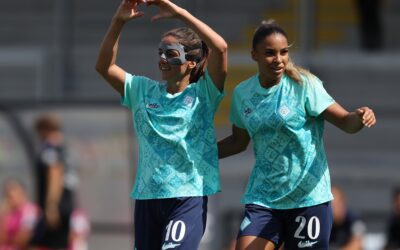
Thanks to EA Sports, women’s football has finally entered mainstream gaming. It began in 2015 with FIFA 16, the first football game to include women’s national teams. Since the 2022-23 season, club football has also been represented: first D1 Féminine (now Première Ligue), the NWSL and the Women’s Super League, followed by the Frauen‑Bundesliga, Liga F, and selected clubs such as Juventus, Roma, Zürich Frauen and Rosengård. EA FC 25 and 26 even allow players to create their own women’s teams in career mode.
Football Manager followed suit. Starting from the 2025-26 edition, the game includes a full women’s football ecosystem, adding leagues such as the Welsh Genero Adran Premier, Italy’s Serie A Women, Denmark’s A‑Liga, Australia’s A‑League Women, Japan’s WE League, Scotland’s Premier League, Sweden’s Damallsvenskan and some second divisions. Still, women’s sport occupies very little space in the gaming industry.
Why Women’s Sports Are Under‑represented in Gaming
The gaming industry is complex. Developers must balance player demand, creative ambition, hardware limitations, licensing costs and revenue projections. This is why football is the only women’s sport consistently represented, being the only one with a large enough commercial ecosystem to justify investment. Other sports have not been as fortunate.
Tennis has recently regained momentum thanks to renewed global interest, prompting 2K to revive TopSpin after a 14‑year hiatus. Cyanide, despite financial struggles and even insolvency filings, has managed to keep Tour de France and Pro Cycling Manager alive. But the comparison is stark: while female individual athletes are represented, the entire women’s cycling system – one of the fastest‑growing sports worldwide – remains absent.
This gap is not simply the result of twenty years of limited interest. It also reflects the economic challenges of modern game development. Producing a sports game is more expensive than ever, and publishers cannot be sure they will recover the investment. In many cases, the cost outweighs the projected revenue. Or perhaps, it is simply a lack of courage. There are still two ways developers could bring women’s sports into gaming: dedicated women’s sports titles, or full integration into existing franchises. Neither path has been fully explored.
How Difficult Is It to Create a Sports Videogame
Creating a sports videogame is far more complex than it appears. Some sports are easier to translate into digital form – Formula 1 and MotoGP, for example, rely on fixed tracks, predictable physics and controlled environments. Yet even these titles exclude entire women’s competitions such as the F1 Academy, despite offering female avatars. Other sports depend heavily on how accurately the game can replicate ball movement and player interaction.
Football is the clearest example: for years the genre was defined by the rivalry between EA Sports and Konami, until Pro Evolution Soccer was rebranded as eFootball in 2021, losing the identity that had shaped an entire era. Volleyball illustrates the challenge even more clearly. The sport has never had a fully functioning, widely accepted videogame – aside from a few solid beach volleyball titles and two attempts at indoor volleyball simulations. Basketball took longer to evolve, but 2K eventually integrated the WNBA into its ecosystem.
Women’s sports face an additional layer of complexity. Because many women’s leagues have developed only recently, the competitive gap between top‑tier teams and lower‑tier ones is still wide. For game developers who aim to create balanced gameplay – something the sports themselves are actively working toward – this disparity becomes a major obstacle. In men’s sports, the gaps are generally narrower, making simulation more straightforward.
What Modding Can Change in Women’s Sports Gaming
Modding can transform women’s sports gaming by giving women’s teams and athletes something they still lack in most commercial titles: existence. Representation is a form of visibility, and visibility is a form of legitimacy, as demonstrated by countless campaigns for body positivity and minority inclusion. In football gaming, PES has historically been the title that allows players to fully recreate entire leagues, teams and seasons. Even FIFA 16, the first game to include women’s football, can be modded to rebuild complete past seasons. Yet when it comes to women’s football, the potential remains largely unused. The tools exist, but women’s sport is not treated as a priority.
Online, for example, it is possible to find a PES 6 patch that includes the women’s teams featured in FIFA 23, so the Women’s Super League, the D1 Féminine, the NWSL, plus selected clubs such as Real Madrid, Juventus, Wolfsburg, Barcelona (with a limited squad of 15 players) and Eintracht Frankfurt, along with several national teams. Recent footage suggests that player faces and physical attributes have improved significantly, but the core limitation remains, and it is not the modders’ fault. The entire game is built on a gameplay system and an edit mode designed around men’s football.
A similar issue appears in a still‑in‑development project where a modder is attempting to recreate the entire 2018-19 women’s football season: all Serie A clubs, three Serie B teams, every club involved in the Round of 16 of the UEFA Women’s Champions League, the 2019 NWSL, all teams from the 2019 FIFA Women’s World Cup, and selected sides from Europe’s top leagues. It is an ambitious project, but like all amateur, free‑to‑release mods, it requires enormous time for creation, testing and stability, which explains why it has not yet been launched.
The Limits of Modding
Modding still faces significant limitations imposed by consoles, licensing restrictions and game engines built entirely around men’s football. The most advanced modding ecosystems exist on PC, which immediately excludes a large portion of interested players. Many mods are difficult to install, require a degree of technical literacy, and depend on owning the original game, not always easy to find at a reasonable price. They also require a computer capable of running modified files without crashing. For older games this is manageable; for modern titles, it becomes a major barrier.
Another challenge is the knowledge of the women’s game itself. Adding a selection of teams is relatively simple, but creating fully functional leagues requires understanding competitive balance, player attributes and tactical identity. Lower‑ranked women’s teams cannot simply be assigned the same values as lower‑ranked men’s teams, as the competitive structure is different, the gaps are wider, and the gameplay must reflect that.
Cycling provides a clear example. Not all UCI Men’s WorldTour teams have a Women’s WorldTour counterpart. Modding a complete women’s cycling ecosystem requires understanding how the sport works today, how teams are structured, and how competitions are organised. It is a challenge that can only be solved through deep knowledge of the sport, something the industry has never invested in.
Another Solution, Another Problem
If modding is usually free and community‑driven, there is another possible path to creating dedicated women’s sports games, and it is indie development. Indie titles are generally cheaper to produce and require fewer resources, and developers can rely on Patreon, subscriptions or crowdfunding to support their projects. But if the goal is to recreate an entire sporting ecosystem, an edit mode becomes essential, and players must be able to build their favourite teams, athletes and competitions themselves.
Purchasing official licenses is technically possible, yet often unrealistic for small studios or one‑person projects. Women’s licensing is usually less expensive than men’s, but in football the costs can still be prohibitive. Even so, indie development remains a potential route: if major publishers refuse to prioritise women’s sports, then representation may need to come from independent creators willing to build it with their own hands. But indie games face the same structural challenges as modding. They require time, funding, technical expertise, and a deep understanding of the sport they aim to simulate. Without these elements, even the most promising projects struggle to reach completion.
Women’s Sports Require Representation and the Gaming Industry Must Provide It
As we have seen, there are three potential ways to represent women’s sports in gaming: dedicated official videogames, which may never recover the money invested in developing them; modding existing titles, which remains largely limited to PC; and indie games, which face the same structural challenges with fewer resources. None of these paths is easy but the need for representation is undeniable.
Women’s sports deserve a stronger presence in gaming. Visibility helps integrate them into cultural spaces, builds communities of fans and supporters, and strengthens the connection between the sport and its audience. Representation is not just a matter of fairness; it is a catalyst for growth. More visibility means more business opportunities, more commercial interest, and ultimately more attention to the sports themselves.
If the gaming industry truly wants to reflect the world of sport, then women’s competitions must be part of the picture. Not as an optional add‑on, not as a marketing gesture, but as a fundamental component of the ecosystem. Representation in games is representation in culture, and it is the culture which shapes the horizon of sport.
Text: Sebastiano Moretta