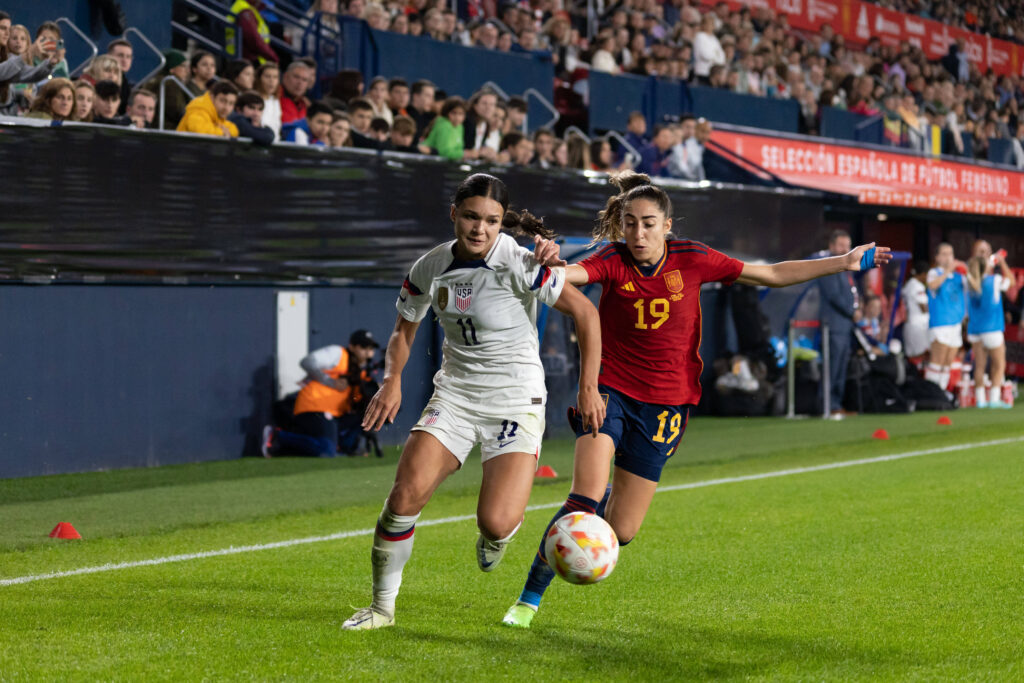
For years, the United States set the standard in women’s football. Its success was built over decades, backed by a deep talent pool, a strong development system and a culture that expected to win. Spain’s rise has offered a different picture of what dominance can look like: one built around technical precision, collective movement and a generation of players capable of taking control against the best in the world.
When the two sides meet in Washington, D.C., on Saturday before facing each other again in Pennsylvania on Tuesday, they will bring more than their recent success to the pitch. They represent two footballing powers at different points in their evolution, meeting in a sport whose centre of gravity is shifting. Elite players are crossing borders, tactical ideas are travelling between leagues and the established order is facing a growing challenge.
For the United States, the games offer a measure of how far the team has come as it prepares for the next World Cup cycle. For Spain, it’s another opportunity to prove that its rise is no passing moment. For women’s football as a whole, the series offers a glimpse of the global game in which no single nation can afford to stand still.
“I think it’s ultimately an opportunity that we’re all really excited about,” US defender Kennedy Wesley said during the pre-match press conference.
“We have been working so hard for the last few months, not just in this camp, to be prepared for these matches, but ultimately to test our tactics, our style of play against the best team in the world is exactly what we want, especially going into World Cup qualifying and a World Cup year.”
That desire to test themselves against the best reflects a wider change in international football. Being a leading nation is no longer just about building a winning team. It is about continually adapting to opponents who bring different ideas, different strengths and increasingly sophisticated ways of playing.
Spain’s rise is changing the conversation
For much of the modern women’s game, the United States was the benchmark. Four World Cup titles and sustained Olympic success established the USWNT as one of international football’s defining dynasties. Its influence stretched beyond trophies, helping shape the visibility and professional development of the women’s game.
Spain’s emergence has challenged the idea that the established powers will always dictate the terms of competition.
Spain won its first Women’s World Cup in 2023, defeating England in the final. They retained the UEFA Women’s Nations League title in 2025 and reached the final of that summer’s European Championship, where it lost to England on penalties. The results have established Spain as a consistent contender for the biggest prizes, rather than a team enjoying a brief period of success.
Its influence is about more than silverware. Spain has developed a recognisable identity built around possession, intelligent movement and technical quality. Its players look to create space through coordinated rotations, draw opponents out of position and find passing lanes that can turn a crowded midfield into an attacking opportunity.
Stopping Spain, then, means dealing with more than a collection of talented individuals. It means disrupting a collective understanding of the game.
“They have very talented individuals, but they’re also really, really talented as a collective,” Wesley said.
Spain’s depth makes that combination particularly difficult to contain. Alexia Putellas brings the experience and vision of a two-time Ballon d’Or winner, capable of dictating the tempo in midfield and finding openings where little space appears to exist. Her ability to pick a pass between the lines or arrive in dangerous areas gives Spain another dimension in the final third.
Clàudia Pina offers a different kind of threat. Direct, inventive and comfortable operating across the forward line, she can create chances through quick combinations or take matters into her own hands with her movement and finishing. Then there is Vicky López, whose technical confidence and ability to carry the ball into tight spaces reflect the next generation of Spanish talent. Still young, she brings unpredictability to the attack, able to turn away from pressure, accelerate into space and link play in congested areas.
Together, these players illustrate why Spain can be so difficult to defend against.
The American defender pointed to Spain’s dynamic movement and constant interchange as particular challenges for the USWNT. To contain them, the Americans will need to remain disciplined without allowing Spain the time and space to settle into its rhythm. Pressing high will be important, but so will knowing when to hold their positions rather than being drawn away from them.
It is a demanding balance, particularly for a United States side still shaping its identity ahead of the 2027 World Cup.
The Americans have spent the past year facing teams with contrasting approaches, including Japan’s possession-based game and Brazil’s more direct, physical style. Wesley said that variety had helped the squad become more resilient and better equipped to respond to different challenges.
“The variety I think ultimately just kind of polishes all the tools in our toolbox and gives us more tools going forward,” she said.
Spain offers another opportunity to add to that experience. But the significance runs in both directions. The United States is learning how to compete with a team that has redefined expectations, while Spain is being measured against a nation whose history of success remains a powerful standard.
The old hierarchy has not disappeared. It has simply become harder to take for granted.
The global game is becoming more connected
The shift in power is happening alongside another transformation. Elite women’s football is becoming increasingly international, with players building careers across leagues and carrying their experiences back into their national teams.
A player’s footballing education no longer belongs to one country or one domestic competition. Different leagues offer different tactical demands, training environments and styles of play. As players move between them, they take those experiences with them, helping ideas travel in ways that make the global game more interconnected.
The careers of Lily Yohannes and Wesley offer a glimpse of that changing landscape.
Yohannes, who grew up in Virginia before moving to the Netherlands, now plays for Lyon in France. Wesley plays for San Diego Wave in the United States’ National Women’s Soccer League. Their club experiences place them in different footballing environments, but their international careers bring them together on the same side.
Yohannes also has a direct connection to Spain through her Lyon teammate Salma Paralluelo, one of the Spanish national team’s most dangerous attacking players.
“Obviously I play with Salma Paralluelo in Lyon,” Yohannes said, describing her as one example of the many talented players in the Spanish squad.
The connection is a reminder that international rivalries rarely exist in isolation. Players who will spend 90 minutes trying to outmanoeuvre one another for their countries may share training sessions, dressing rooms and tactical conversations at club level. They can become familiar with each other’s strengths long before they meet on the international stage.
Yohannes said the upcoming series had come up in conversation with her Spanish teammates after the fixtures were announced. The exchanges were light-hearted, she explained, but the anticipation was real.
That overlap between club and international football is becoming increasingly important. The movement of players across leagues can expose them to new tactical approaches, raise competitive standards and introduce supporters to clubs and competitions they might not otherwise follow. It also creates a more complex relationship between national identity and footballing experience.
This is not simply a story of European players moving to Europe or American players staying in the NWSL. Talent and knowledge move in multiple directions, connecting leagues that once operated with more distinct identities.
Greater movement does not automatically mean equal growth. The challenge is to ensure that the benefits of an increasingly international game extend beyond its wealthiest clubs and most established competitions. The sport needs investment in coaching, facilities and professional opportunities across a wider range of countries if its growing global reach is to translate into a deeper pool of elite talent.
The more connected the game becomes, the more important it is to consider who has access to the opportunities that connection creates.
A rivalry with a wider audience
There is also a growing audience for matches like these. Spain and the United States bring different footballing identities, histories and supporters to the same stage, creating a contest that is compelling well beyond the immediate result.
Spanish defender Lucía Corrales captured the anticipation surrounding the series, describing it as “a really exciting match to watch” and saying that supporters would want to see “good football.”
Her comments point to an expectation that goes beyond a close scoreline. These are teams capable of producing a game shaped by technical quality, tactical adjustments and individual moments of brilliance. The appeal lies in seeing how two elite sides respond when neither can assume it will control the match.
“They’re going to be two very competitive matches,” Corrales said. “It’s really good for us to measure ourselves against national teams of such a high level.”
For Spain, the games provide a chance to test itself against a country with a long record of tournament success. For the United States, they offer a clearer picture of how its developing style holds up against the current world champions. Both sides have something to learn, even if the lessons are different.
Spain head coach Sonia Bermúdez also emphasised the quality of the spectacle, saying supporters would see “great players who will give everything on the pitch.”
That matters in a sport whose growth increasingly depends on turning occasional moments of attention into lasting engagement. International fixtures of this calibre give supporters another way to follow players across domestic leagues and national teams, building connections that stretch beyond club loyalties and national borders.
Yet the significance of a growing audience should not be measured in attendance or television figures alone. Visibility matters, but it needs to be matched by investment in the structures that sustain the game: better facilities, stronger development pathways, more professional opportunities and environments in which players can thrive.
The USWNT’s new national training centre offers one example of that investment. Speaking about the team’s first camp at the facility, Yohannes described a place where the federation’s women’s, men’s and youth teams could come together and access the resources needed to perform at their best.
She also highlighted details designed with female athletes in mind, including dedicated spaces for breastfeeding mothers.
These considerations might seem far removed from the tactical battle awaiting the two teams, but they belong to the same conversation. The quality of football on display is shaped long before players walk onto the pitch. It depends on the environments in which they train, recover and develop, as well as the opportunities available to the generations coming behind them.
The globalisation of women’s football is not just about where its biggest stars play. It is also about how countries and clubs build the conditions that allow more players to reach that level.
What comes next?
For Spain and the United States, the immediate goal is to leave the series better prepared for the challenges ahead. But the wider significance lies in what their meetings reveal about the direction of the sport.
Spain has shown that the established order can be challenged through sustained development, a clear footballing identity and a generation capable of delivering on the biggest stages. Its rise has forced other leading nations to reassess how they play, how they develop talent and how they compete against opponents who can control a game through collective movement and technical precision.
Meanwhile, the growing movement of players between leagues is making footballing identities less confined by geography. A national team’s style is still shaped by its own history and development system, but its players increasingly arrive with experiences gathered across different countries and competitions.
For Yohannes, facing Spain is as much about collective growth as individual performance.
“Playing against such a top side, it requires a lot of collective work,” she said.
Building connections with teammates, maintaining discipline and staying focused throughout the match will be essential, particularly against a side capable of exploiting even the smallest lapse in concentration.
That is part of what makes this series so compelling. The United States brings a history of success, an established footballing infrastructure and the ambition to remain among the sport’s leading nations. Spain arrives as the world champion, with a playing identity that has helped reshape the conversation around who can dominate the international game.
Neither side can afford to stand still. And neither can assume that its position is secure.
As women’s football expands across borders, the measure of a leading nation will increasingly be its ability to keep adapting: to develop talent, learn from different footballing cultures and remain competitive as more teams close the gap.
The old hierarchy has not vanished, and two matches will not determine the future of the sport. But the growing number of nations capable of challenging at the highest level, alongside the movement of players and ideas between leagues, suggests that the balance of power is becoming more fluid.
Spain versus the United States is more than a meeting between the reigning world champions and one of the most successful teams in history. It is a snapshot of a sport in transition, where legacy still matters, new powers are demanding their place and the next era of women’s football is being shaped by a much more connected world.
Text: Fleur Dias