For the 2025-26 season, Serie A Women has returned to its most familiar format, meaning a 12-team league – used in 20 previous editions – after three years with a 10-team structure split into a regular season and the Poule Scudetto (for the title and Champions League spots) and the Poule Salvezza (the relegation round). Most clubs are the women’s sections of their professional men’s teams, with three exceptions: Como Women, Napoli Women and Ternana Women, the last of which is newly promoted and still in the early stages of defining its business model. Como is owned by Mercury/13, a US-based investment fund reportedly holding 100 million dollars to invest in women’s football (and also owner of Bristol City in England’s WSL 2). Napoli is owned by Italian entrepreneur Marco Bifulco, previously a shareholder and board member before taking full control in 2024. The two clubs are pursuing different paths in their attempt to build long-term success.
The Story of the Two Clubs
Como Women began as Como 2000, then – after the 2019-20 season was interrupted by the Covid-19 pandemic – acquired Riozzese’s sporting title, as the club faced financial difficulties linked to the pandemic. After finishing fifth in the 2020-21 Serie B season under the name Riozzese Como, the club rebranded to its current identity, earned promotion to the top flight, and has since recorded three consecutive seventh-place finishes.
Napoli’s story is more linear. Founded in 2003 as Calciosmania Napoli, the club underwent several sponsorship-related rebrandings before becoming Napoli Femminile in 2010, and finally Napoli Women for the current season. Historically, Como now has almost no continuity with its origins, while Napoli maintains a clearer link with its past.
The Economic Difference
From a financial perspective, the two clubs operate in very different ways, at least on paper. With a strong investment fund behind them, Como Women could theoretically spend heavily on the transfer market to attract top-level players. Instead, they have chosen not to overreach, focusing on building a clear football identity and developing young talent. Their only major expense has been Alisha Lehmann’s salary for the first part of the current season. The goal is to blend experience and youth, with a squad averaging around 27 years of age and featuring veterans like Sophie Howard alongside emerging players such as Nadine Nischler, promoted last year from the third tier.
Napoli Women’s president Marco Bifulco explained in a recent interview on the Scontro Diretto podcast that the club’s main challenge lies in securing sponsorships. Without any connection to SSC Napoli’s men’s team, and having spent most of its history fighting relegation, the club struggles to attract major sponsors, many of whom prefer not to associate with a team that is not competing for Europe or the title. As a result, Napoli is working to build a more sustainable model based on local partnerships which, from an economic standpoint, do not guarantee significant revenue.
Como Women: Stability Without a Breakthrough
Both clubs entered the 2025-26 campaign with different targets. Como Women aimed to raise their level compared to last season, trying to close the gap with the Champions League spots and stay as high as possible in the standings. However, they reached the first international break of 2026 still in seventh place, having lost Alisha Lehmann – attracted by Leicester City -and Zara Kramžar, who was recalled by AS Roma from her loan and then transferred to Everton. They also changed head coach, replacing Stefano Sottili with Piacenza men’s legend Paolo Tramezzani. On the pitch, their tactical structure has remained based on stability, a solid defensive block, and rapid counterattacks. There have been small improvements compared to last year, especially in big matches: they beat Juventus on Matchday 2 and made Roma and Inter work hard to take all three points. Still, little has changed compared to previous seasons.
Napoli Women: From Survival Battles to European Dreams
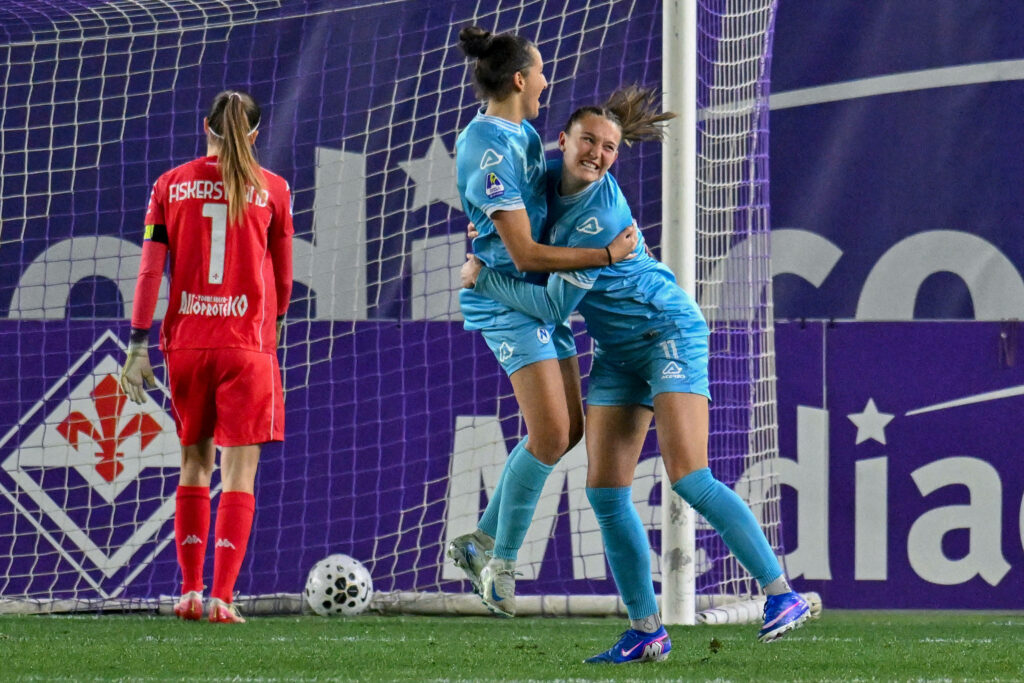
Napoli Women, on the other hand, are performing very well after two consecutive years finishing second-to-last. Their summer transfer window was solid: they managed to attract players such as Cameron Brooks – later sold in January to North Carolina Courage – and Magou Doucouré, who also left in the winter window for Hamburger SV in the Bundesliga. Their best signing, however, has likely been Cecilie Fløe Nielsen, one of the most underrated strikers around, with two Danish titles at HB Køge, as well as Champions League experience and a USL playoff win with Tampa Bay Sun FC. She decided the opening match against Fiorentina and has scored five goals so far, including the winner against Inter on Matchday 6. At the international break, Napoli sit in a comfortable fourth place, three points behind Juventus, and are beginning to dream of a potential Champions League qualification.
Future Perspectives and Challenges
For the future, Como Women will face several challenges. The rise in operating costs and a transfer market increasingly driven by the FA Women’s Super League, NWSL and other growing leagues around the world make it harder for the club to attract top-level players. Without a finish in the top half of the table, Como will likely need to rely on developing their own talent rather than competing for the best names on the market. There is also a potential territorial challenge. Como 1907 are now dominating the Second Division and aiming for a quick promotion to Serie A. Backed by the Indonesian Djarum Group and the Hartono family, the club could become a far more attractive destination in future transfer windows and holds a stronger strategic position in the local area. Meanwhile, Como Women remain split between two provinces – training in Varese and playing home matches in Seregno, in the province of Milan – which complicates their territorial identity and long-term positioning.
Napoli Women: Breakthrough Season or Long-Term Rise?
For Napoli Women, the future looks less intricate, but several challenges remain. Having opened a pathway to Denmark, the club now has the opportunity to attract young Danish talents who can integrate quickly thanks to the players already in the squad. At the same time, there is the risk of losing them to the WSL, NWSL or to top domestic clubs, especially if their performances continue to grow. And if the long-term target is to compete for a Champions League spot, the overall level of the squad will need to rise, which implies additional expenses that the club must be ready to absorb.
If the current growth continues, Napoli could become more attractive to sponsors, and this may prove crucial for the club’s sustainability. On the pitch, a clearer identity and improvements in midfield have created stability after difficult years. What remains to be seen is whether this season marks the beginning of a long-term rise or if it represents more of a breakthrough moment. Only time will tell.
Two Models, One League
Como Women and Napoli Women represent two different ways of surviving and trying to grow in a league that is becoming more competitive every year. One relies on identity and controlled development, the other on sustainability and gradual ambition. Their trajectories show how diverse the pathways to stability can be in Italian women’s football, and how much the league now depends on clubs capable of building long-term structures rather than short-term results. Whether these two projects will turn into consistent top-half contenders or remain transitional stories will depend on their ability to adapt to a rapidly changing landscape. What is clear is that their presence adds depth, variety and strategic complexity to Serie A Women’s future.
Author: Sebastiano Moretta