
Revenue in women’s sports: Football and basketball dominate
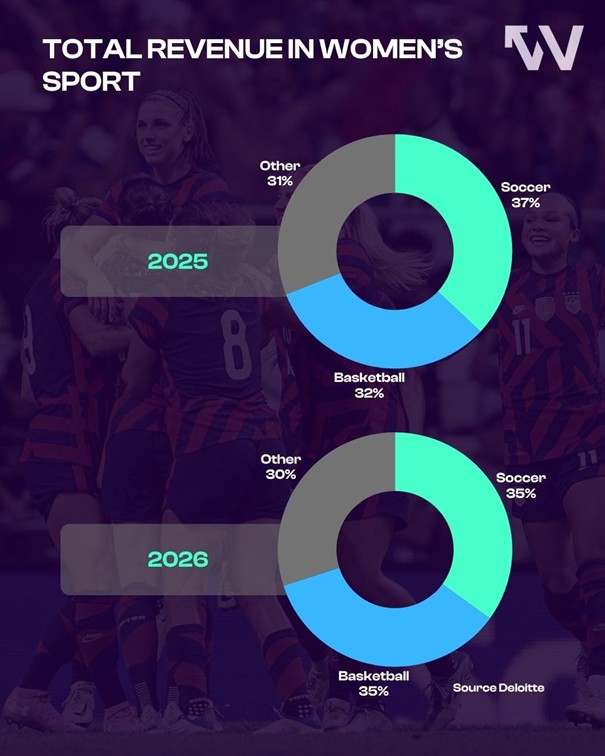
Basketball and football together account for the majority of revenue in women’s sports. According to Deloitte’s 2026 report Game Changers: Unlocking the Potential of Women’s Sports, basketball represented 32% of total women’s sports revenue in 2025, with football / soccer at 37%. According to the estimations, both will account for 35% in 2026, meaning the gap between both sports is closing. Women’s basketball has witnessed an arguably even sharper rise than women’s football over the last years. For football leagues and teams, this means that taking a look on basketball’s growth strategies can offer new insights.
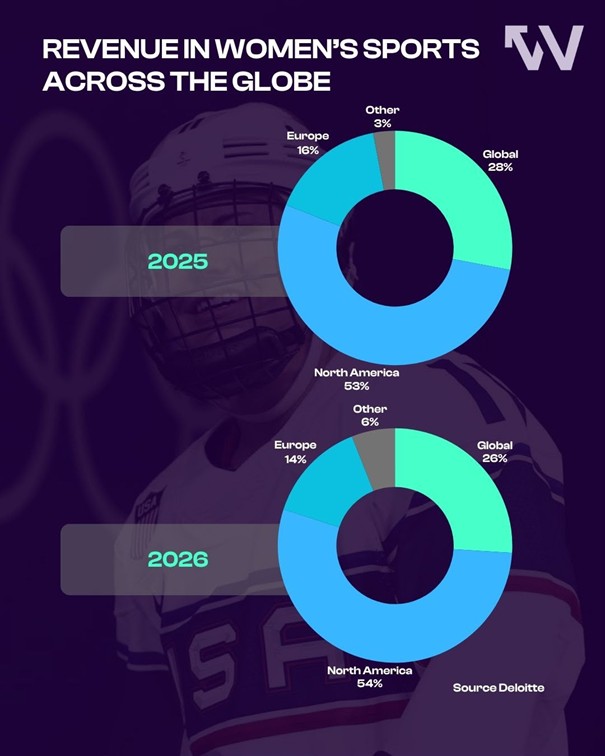
However, one disclaimer has to be put first: the growth of women’s basketball, unlike football’s, remains primarily a North American phenomenon. According to Deloitte’s report, North America accounted for 53% of global women’s sports revenue in 2025 and 54% in 2026 – so the share is even growing. Europe, despite hosting some of the world’s largest football clubs, represented just 16% in 2025 and 14% in 2026. For football, the shares are more balanced, but in basketball there simply is no debate about which league is the best in the world: The WNBA, with an estimated annual revenue of around $200 to 250 million, dwarfs most European women’s basketball leagues. The NWSL sits at roughly $262 million. The Professional Women’s Hockey League (PWHL), by comparison, generates around $15 million per year. These numbers illustrate just how dominant these two sports are.
What did women’s basketball get right?
Deloitte’s analysis identifies a focus on fan engagement as a major behind basketball’s rise, specifically the understanding that women’s sports fans are a distinct audience, not a subset of men’s sports viewership. In the North American context, this philosophy is more natural than in Europe, since the franchises aren’t affiliated to a men’s team.
The WNBA team Golden State Valkyries illustrate this idea well. Playing at Chase Center, known informally as “Ballhalla” in a nod to the Norse mythology behind the team’s branding, the franchise built its identity separately from the Golden State Warriors. Warriors players promoted the Valkyries, but through different colours and the active involvement of cultural influencers in the region, the WNBA team managed to create a distinct identity. The gameday experience was designed around the team’s own fan personas, not borrowed from the men’s side. The Valkyries are now estimated to be worth around $1 billion, making them the most valuable women’s sports franchise in the world.
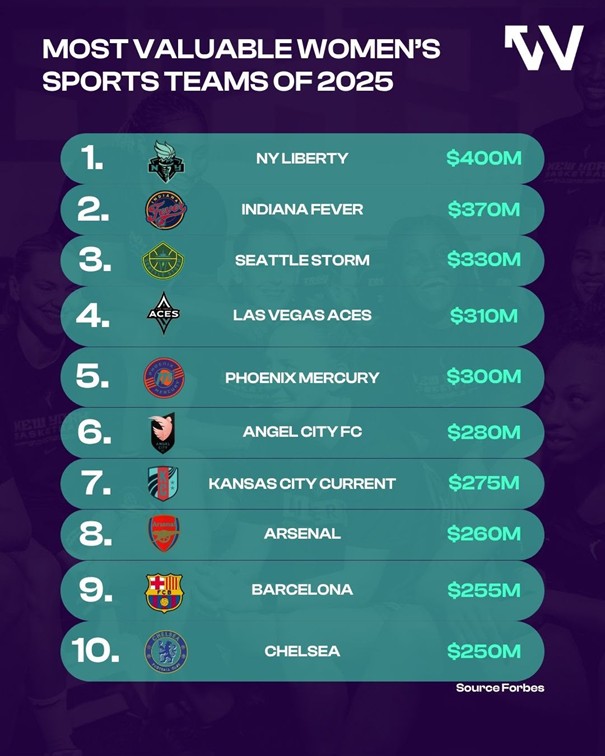
For context, the NY Liberty was valued at $400 million in Forbes’ 2025 ranking, with Indiana Fever at $370 million. This means the Valkyries are more than twice as valuable as the current leaders. The most valuable NWSL clubs, Angel City FC and Kansas City Current, sat at $280 million and $275 million respectively. Arsenal, Barcelona and Chelsea represented European football’s highest valuations at $260 million, $255 million and $250 million. Football is not far behind, but the distance seems to be growing rather than shrinking currently.
One advantage the WNBA has is that many players arrive in the league as stars, not as unknown faces: The Women’s NCAA March Madness tournament has become a substantial driver of WNBA fandom. College athletes like Caitlin Clark and Paige Bueckers amassed loyal followings during their times at Iowa and UCONN at college. Clark’s entry into the WNBA produced measurable spikes in TV ratings and attendance across the league, and not just for her team, the Indiana Fever. College players and future WNBA stars like JuJu Watkins have generated much attention too. For the NWSL, this means that cooperating with college teams – some of which, like the North Carolina Tar Heels, have strong prestige and have attracted top European prospects in the past – would be a great long-term investment.
“Pay us what you owe us”: the debate on salaries in women’s basketball
Stars are instrumental to the WNBA’s success. Yet, the question of how much they should be paid, has sparked heated debates in the last year, and it is also relevant for women’s football. After months of negotiations, the WNBA and the Women’s National Basketball Players Association in March 2026 reached a compromise for a new Collective Bargaining Agreement (CBA). The agreement runs for six years and decides where the money goes.
Before the new CBA, WNBA players received a revenue share of approximately 7%, and the debate revolved around this number. For comparison, NBA players receive 50% of basketball-related revenue. The WNBA’s new arrangement remains far below that benchmark, which makes sense given the scale of investment for owners, but the players rightfully celebrated an important step. It wasn’t an easy one, though.
The negotiations became publicly visible when players appeared in “Pay us what you owe us” shirts, thus building public pressure on the league. Players had initially pushed for a 25% revenue share in the first year, growing from there. The final agreement fell short of that target, but the improvements are on a scale that is different to anything women’s sports have seen yet: the minimum salary of $270,000 now exceeds what had previously been the maximum salary of $250,000. Top earners can now make up to $1.4 million per season. The team salary cap rose from $7 million to $15 million.
Women’s football is heading towards similar conversations. Club revenues are rising, media deals are growing (the NWSL’s groundbreaking $240 million four-year media rights deal changed the financial situation of the league), and the gap between what the sport generates commercially and what players are paid is increasingly difficult to justify. The WNBA’s experience gives an idea on how those discussions might unfold, and what the likely pressure points will be.
Kansas City Current players wore “Pay them what you owe them” shirts in solidarity with WNBA players during the negotiations. This is just one example that shows that, up to now, the cross-sports cooperation in football and basketball has probably been more profound on the players’ level than on the club level. Players’ associations in both sports, like FIFPRO and the WNBPA, have worked together before, notably on joint initiatives against online abuse.
Cooperation on club level: Much potential left to be unlocked
Cross-sport collaboration on the club level remains rare (and pretty much non-existent in Europe), but there’s one example of how that cooperation could look like. The Portland Fire (WNBA) and Portland Thorns (NWSL) have the same owner and recently organized a doubleheader where tickets and merchandise were sold together. Fans who attended both events wore shirts reading “Portland Loves Women’s Sports”, and Thorns star Olivia Moultrie attended the Portland Fire game after playing her own match. The two clubs are jointly building the Kaiser Permanente Performance Center, a 63,000 square-foot training facility that both teams will use. Creating synergies makes a lot of sense, especially in the financial sense: US-American women’s football teams can’t use the facilities of the men’s team like the clubs in Europe, so it’s smart to find other partners. Research on the audiences of women’s football and women’s basketball also show that the overlap is huge. In both cases, fans are younger and more likely to be female than the average sports fan.
Similar pairings exist elsewhere: NY Liberty and Gotham FC in New York, Bay FC and the Golden State Valkyries in the Bay Area, Seattle Storm and Seattle Reign, Chicago Sky and Chicago Stars. In each case, the same city hosts a WNBA team and an NWSL team, and there’s lots of potential left to unlock. Right now, the cooperation in most clubs stops at players occasionally visiting the other team’s games or congratulating them on social media. But double-headers, shared infrastructure or shared fan initiatives could be the next steps. What makes cooperation more difficult, of course, is the fact that women’s football and basketball are also competitors when their games are played at the same time, trying to attract similar types of fans.
The caveats of basketball’s growth: warning signs and the question who actually profits
None of this means women’s football should simply import the WNBA’s recipe for success. Basketball’s growth remains heavily concentrated in North America. European women’s basketball, with the EuroLeague as the top competition, benefits from WNBA players like Breanna Stewart or Gabby Williams choosing to compete overseas during the off-season, but the new CBA’s improved financial terms may reduce that incentive. If the best players stay in North America year-round, European competition loses quality. The WNBA’s dominance also means it’s relatively easy for the league to attract international fans, while the NWSL has far more competition.
On a deeper level, some cracks have started to appear in both football and basketball on who gets to profit from women’s sport’s rapid ascension. The expansion of both the WNBA and NWSL has created controversy. The incoming NWSL franchise in Columbus, backed by the Haslam family, who also own the Cleveland Browns and Columbus Crew, has drawn criticism on multiple fronts, including the planned conversion of McCoy Park, a facility for people with disabilities, into a training ground. And both the WNBA and the NWSL face uncomfortable questions about older fans being gradually priced out as tickets become more and more expensive.
Similar challenges across women’s sports
Looking at the growth of the NWSL and the WNBA, it becomes clear that both leagues face similar challenges, and the potential for cross-sports collaboration hasn’t yet been recognized. That collaboration can help teams to operate more efficiently, for example through joint training centres, but it can also advance labor rights through cooperation between players’ associations. Individual players – Caitlin Clark, A’ja Wilson, Paige Bueckers in basketball, Trinity Rodman in the NWSL – will remain central to the success of both leagues, and ads with women’s stars from different sports also have great potential. Many fans are attached to personalities rather than to institutions. Recognising that dynamic is one of basketball’s clearest contributions to how women’s sports can grow.
While the case for collaboration is clearly the easiest to make for basketball and football, other sports are also interesting to follow: many women’s tennis players are amongst the highest-paid athletes in the world – despite the sport as a whole struggling to generate the same level of revenue as football and basketball – and their popularity could be used for cross-sports initiatives. The ice hockey league PWHL, a young league established in 2024, has also seen a good start. And even in more niche sports, growth is hard to deny. Cricket has often been overlooked in conversations on women’s sports in a Western-centric perspective, but the ICC Women’s Cricket World Cup India 2025 final drew 185 million viewers, matching the audience of the men’s T20 Cricket World Cup final in 2024. Here, a huge potential for fanbases beyond Europe and North America is visible. Rugby is also growing fast, as more than 82 000 fans were in attendance for the final of the 2025 Women’s Rugby World Cup in England.
Across all these sports, struggles like online abuse, creating distinct identities and attracting fans across the whole season, not just individual games, can be recognized. Cross-sports cooperation can start relatively easily with joint plans at club level and joint initiatives from players’ initiatives – and ideally, grow from there.
Text: Helene Altgelt