Germany is an example that illustrates both the progress and the struggles for women in football business very well. While some appointments have received international attention and praise, women are still almost absent in many areas. And a second factor makes Germany an ideal case study: Thanks to the initiative “Fussball kann mehr” (FKM), an advocacy organisation for women in football, there is data available showing where progress is and where it’s not. For many other leagues, that data is lacking altogether. And with it, the accountability.
Across the 36 clubs of the men’s Bundesliga and 2. Bundesliga, exactly 100 people form the collective top management. Six of them are women. Of 19 new appointments made in the 2024/25 season, 18 went to men. In the supervisory boards, women hold roughly one in ten seats. The 2025 report published by Fussball Kann Mehr shows clearly how underrepresented women still are in football. The pace of change is slow, and it is not uniform.
Germany: Four historical appointments at once – why?
Julia Möhn, head of FKM, is currently working on the 2026 report. And she’s positive that this report will be more optimistic: “This year we had some decisive firsts in Germany. We have Tatjana Haenni as the first female CEO of a club. We have Marie-Luise Eta as the first female head coach in the men’s Bundesliga. We have Svenja Schlenker at Borussia Dortmund: a woman in the executive board of one of Germany’s two biggest clubs, for the first time. Kathleen Krüger will fill the position as board member for sport at Hamburger SV in July. Of course, it’s not a pace you can be satisfied with. But every appointment matters, because they clear the burden of being the first.”
The concentration of firsts is striking. How can they be explained: how much is coincidence and how much can be attributed to structural progress? Möhn says that networking like FKM’s matters: “We’ve managed to make this topic something that gets discussed publicly”, she says. Several of the women now in prominent roles are part of FKM’s Female Leaders network. But she also emphasizes that the appointments themselves were not picked because of their gender. “Each of these women has earned it. None of them is a symbolic appointment so that these clubs can say they now have a woman in their top management.”
What explains the clustering of many significant appointments at once, she says, is a combination of network, visibility, and what she calls the ketchup-bottle effect. “There are so many qualified women who simply haven’t been given the chance. But they are there. For marketing roles, finance roles, legal roles: there is a large talent pool of women.” This means the pressure on the market has been growing for a while, and now, it’s exploded at several places at once.
Why do these firsts matter? Visibility is important, and equally is the idea that women in charge can help other women take the next step in their careers. But these appointments can also counter pessimism, says Möhn:
I have a lot of conversations in which I hear: ‘It won’t happen – there won’t be a female CEO, there won’t be a female sporting director.’ And now it has simply happened. And so, the next time will feel much more natural, and much less about ‘there’s a woman’, and much more about ‘this is a person with these qualifications’. That is where you need to get to.”
The FKM report looks not just at top management but at the level below it: the second tier of leadership, which reports directly to the top management. This is where the picture is more positive, and where Möhn sees the most potential. Five clubs have women in at least 30 percent of these positions: SV Elversberg, 1. FC Kaiserslautern, TSG Hoffenheim, Eintracht Braunschweig, and Borussia Dortmund. If this tier is seen as the talent pipeline that will eventually feed the top, then it’s just a matter of time until the number of 6% of women in top management positions will increase.
New perspectives: Recruiting differently, not more of the same in another font
But would this really be the ideal solution? Möhn suggests that the problems don’t end there. The issue of women in top management can be treated as something that can easily be solved by spotting talents within the clubs and helping them achieve their potential, and by simply keeping the same recruiting mechanisms but hiring more women. But that would be a missed chance: Instead, recruiting for the top management could be reconsidered in a more holistic way that allows for more diversity in several aspects.
The lack of women in football is a problem, yes. But it’s also a symptom for a broader lack of different perspectives. Many top managers are hired from the same firms and fit the same profile: they’ve gained experience as managers before, for example at consulting firms, and they’re a lifelong fan of the football club. This approach leads to converging perspectives, which are bad for business in the long term, and to an imbalance from the beginning: “If the majority of your fan base happens to be men, then you’ll often find that’s also the case in your pool of applicants”, says Möhn.
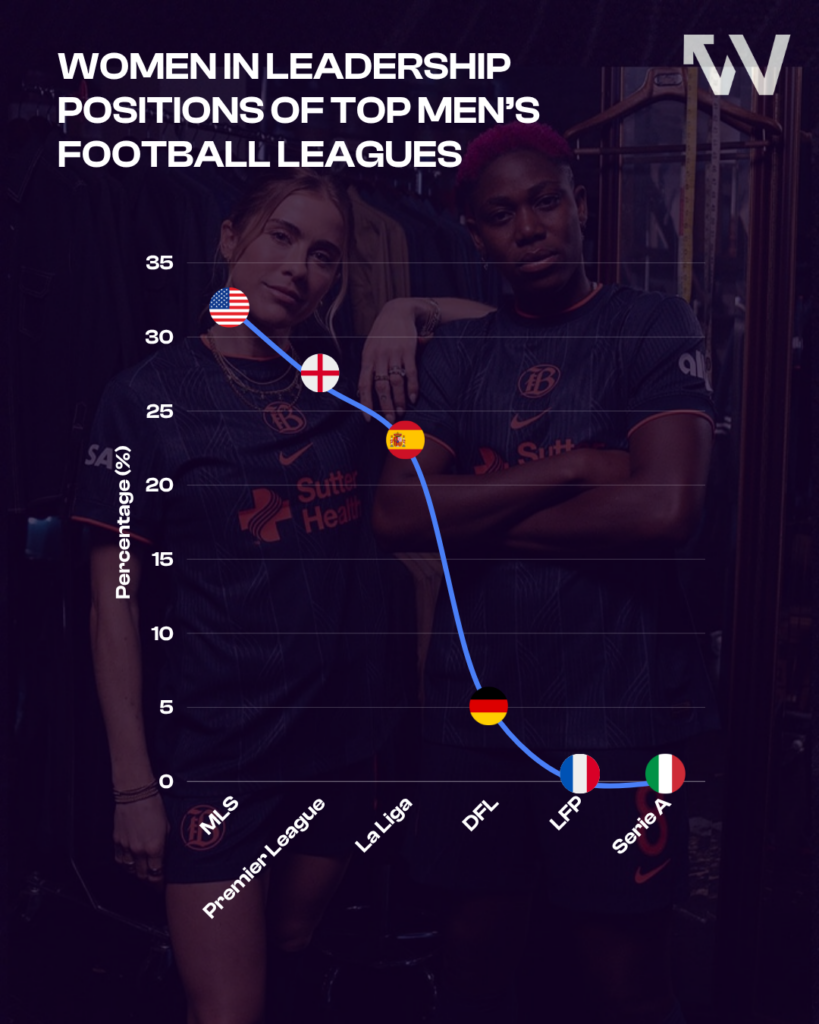
If we zoom out from the German clubs to the league themselves, the picture isn’t any better: In the leadership of the DFL (the association that manages the 1. and 2. men’s Bundesliga), 5% of the top management positions are filled with women, according to data collected by The Rise of Women’s Football.
The comparison with other countries shows that other countries are ahead: The MLS leads the comparison group at 32 percent, followed by the Premier League at 27 and La Liga at 23. But progress is uneven: In the league’s leadership in France (Ligue du football professionnel) and Italy (Serie A), zero women are represented.
Women in top coaching positions: Uneven progress
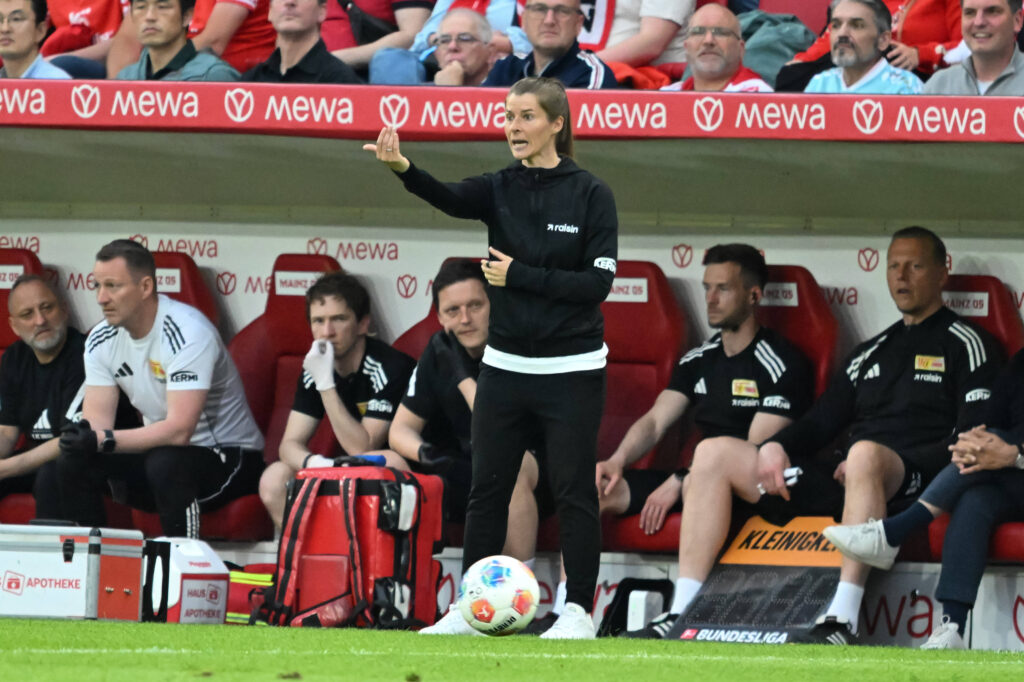
If we look beyond top management and towards top coaching positions, there’s no need for a graphic on how many female coaches are represented in men’s top leagues: The number is zero across the board. This spring, Union Berlin made headlines by appointing Marie-Louise Eta for the remaining five games of the season. For a short period, there was some change. But it was clear from the beginning that Eta would only be an interim solution. From summer on, she’ll coach Union’s women’s team. There, the numbers look better from Germany, albeit, not too long ago, there was only one female coach in the league. Since there is more fluctuation in coaching than in top management, the numbers are arguably less revealing but still show interesting trends.
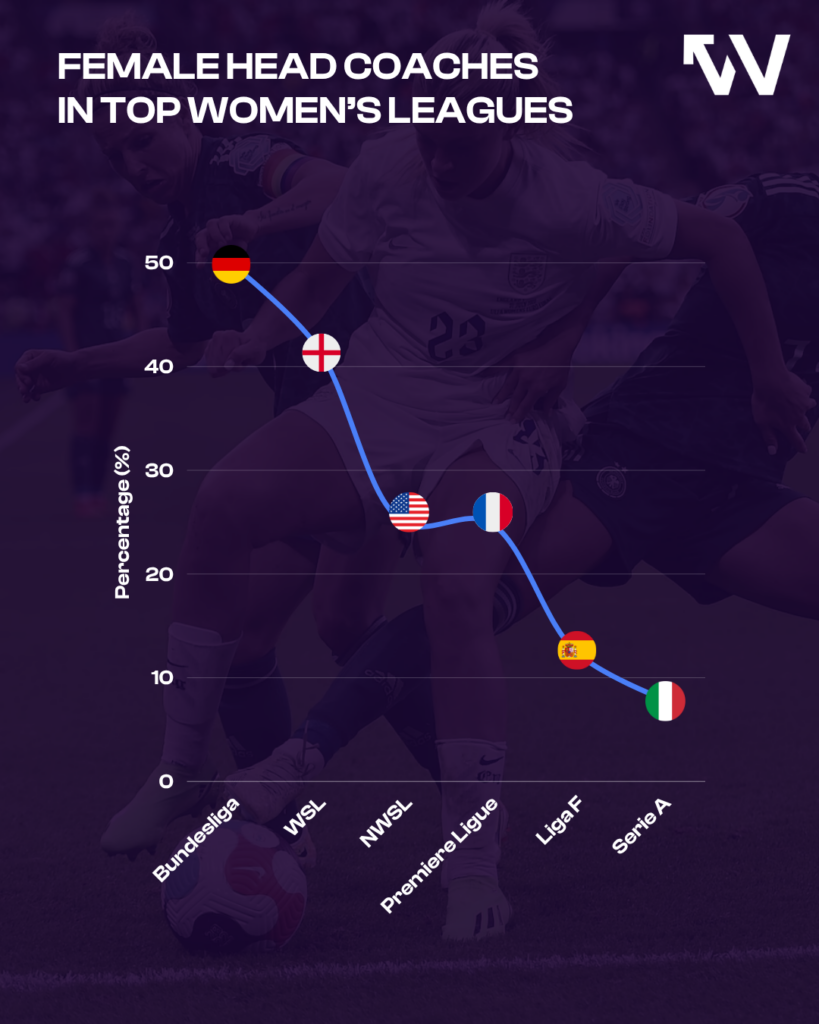
The Frauen-Bundesliga currently leads all top women’s leagues, with 50 percent of head coach positions held by women. The WSL follows at 42 percent; France, the NWSL, and Spain’s Liga F trail significantly. Italy’s Serie A Femminile sits last with only eight percent.
Given that former female players would be particularly suited for these roles, the numbers are shockingly low here as well. Some trends are similar in both examples – women in the management of men’s leagues and female head coaches in top women’s leagues: England and the US do relatively well comparatively, while Italy sits last in both cases, indicating that some serious questions should be asked there.
The need for structural change to nurture female talent
Structural reforms come into play here: The licensing system itself creates structural disadvantages, as under the current points structure for coaching qualifications, experience with a women’s team is valued less than experience with a men’s team, meaning women face higher barriers to reaching the top licence level.
Some changes are on their way, though: “The UEFA now requires that at least ten percent of participants in coaching courses are women. Before that, they weren’t – which is already grim enough”, Möhn says. And the FIFA now obliges women’s national teams to have at least one female assistant coach or head coach at international tournaments.
These thresholds are important, but so far, the share of women in coaching courses mostly sits at exactly 10%, and not more. And for real change, similar thresholds would need to be implemented way lower down the performance level. As long as there is no continuity in nurturing female talents in management in coaching from the beginning, change will remain uneven.
Text: Helene Altgelt