Building an international brand is becoming increasingly essential as women’s football continues to grow, attracting new sponsors and opening fresh revenue pathways that can strengthen long‑term investment. Yet Serie A Women finds itself in a limbo between recent professionalisation and a system that has stalled since the 2022-23 season. In this context, both the Federation and the clubs must work together to explore alternative strategies for brand development. Italian clubs, in particular, need to differentiate themselves within a collective framework, enhancing their appeal in a rapidly expanding global market.
Why Italian Clubs Cannot Rely on Sporting Success
Italian clubs are creating a hard‑fought and balanced competition domestically, but when it comes to European tournaments, their achievements remain sporadic and largely dependent on isolated exploits. Brescia’s quarter‑final run in the 2015-16 Champions League, Juventus’ breakthrough in 2021-22, and AS Roma’s progress in 2022-23 stand out as exceptions rather than indicators of sustained competitiveness. No Italian club has reached the semi‑finals since the 2007-08 UEFA Women’s Cup, highlighting a long‑term gap at continental level.
A similar pattern emerges with the National Team: the promising results of the 2019 World Cup were followed by an inconsistent period, only partially reversed at the 2025 Euros in Switzerland. These fluctuations mirror the structural reality of Serie A Women, a league that is competitive domestically, yet still significantly distant from the four leagues above it in the UEFA ranking. Without a stronger commercial and organisational infrastructure, Serie A Women cannot amplify its sporting success beyond national borders.
Building an International Brand for Italian Clubs
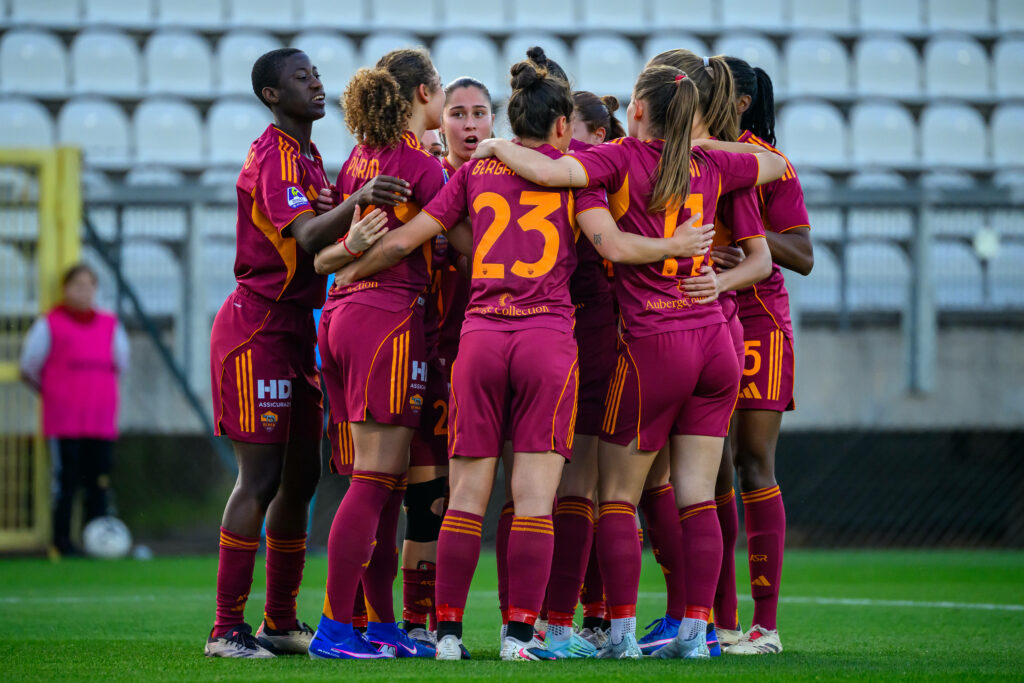
For Italian clubs, building an international brand requires identifying distinctive elements and shaping them into a personalised, coherent narrative. In the current landscape, several clubs are beginning to develop recognisable sporting identities that can serve as the foundation of their branding strategy. Roma, for instance, had established a nationally acclaimed style of play and is now actively rebuilding its squad to restore and reinforce that identity. Sassuolo, on the other hand, had crafted a clear model based on quick transitions and efficiency rather than possession dominance, but this season the team has partially drifted away from that approach, losing some of the recognisability that once set it apart, as shown by the standings.
Other Strategies for Brand Differentiation
Milan, meanwhile, is positioning itself around youth development. Six players from the U19 championship‑winning side of 2023-24 season have been promoted to the first team, allowing the club to craft a narrative centred on a young, home‑grown squad and the strength of its academy system. Fiorentina are attempting to position themselves as a bridge between Scandinavia and Italy, leveraging their recruitment strategy to build a cross‑cultural identity.
This approach could eventually evolve into a dedicated media narrative explaining why this pathway is central to their long‑term success. Lazio, meanwhile, have the potential to create stronger synergies within the territory of the capital, where nearly twenty women’s clubs operate. By establishing themselves as the reference point in such a dense ecosystem, they could strengthen both visibility and community engagement.
What Smaller Clubs Can Do
Teams such as Parma, Genoa and Como (both Como Women and Como 1907), on the other hand, could combine talent development with a distinctive style of play, using their smaller scale as an advantage to craft a clear, recognisable identity. These clubs may not have the resources of the traditional giants, but they can build international appeal by embracing uniqueness and consistency in their sporting and organisational models.
Ternana, meanwhile, can follow a different path by emphasising the unique characteristics of their home ground – the Moreno Gubbiotti Stadium in Narni, in the province of Terni. With the smallest pitch dimensions in the league, it has already become a difficult venue for visiting teams, as demonstrated by Juventus’ 2–2 draw there in February. This distinctiveness can be turned into a branding asset as an identity rooted in territorial specificity.
How the Italian League Can Evolve to Become a Brand
To help clubs evolve as a brand, Serie A Women may need to embrace a realistic and strategic transition. Rather than attempting to position itself immediately among the global elite, the league can consolidate its role as a launchpad for talent while simultaneously strengthening the infrastructures needed to build a more structured and competitive system. A temporary recalibration of ambition would allow Serie A Women to act as a bridge between the emerging leagues below it in the UEFA ranking – such as the Czech Republic, Sweden, Norway, Denmark, the Netherlands and Belgium – and the established powerhouses of Spain, England, France, Germany, as well as the United States. This intermediate positioning would give the league the time and space to solidify its identity without the pressure of matching the top competitions overnight.
Serie A Women as a Launchpad: Recent Examples
In recent years, Serie A Women has already demonstrated its ability to launch players into top‑flight football. Aurora Galli was among the first to make the jump, leaving Juventus for Everton, a path later followed by Martina Piemonte, who moved from AC Milan to the same English club before eventually returning to Italy with Lazio. Arianna Caruso left Juventus for Bayern Munich in January 2025, while Sofia Cantore joined Washington Spirit and Lisa Boattin signed with Houston Dash. Juventus also loaned the promising Azzurra Gallo to Anderlecht and Roberta Aprile to Galatasaray. Roma lost Lucia Di Guglielmo to the Washington Spirit this winter, and Gloria Marinelli (AC Milan) chose Servette in the Swiss Super League last summer. Another example is Elisa Carravetta, who played for OH Leuven before joining Lumezzane in the Second Division. And, last but not least, the iconic Cristiana Girelli signed with Bay FC until June.
A Talent‑Export Model for Serie A Women
For both clubs and the league, one of the most sustainable long‑term strategies may be to focus on developing talent and selling it to top‑flight competitions, following a model already adopted by several Scandinavian leagues. Italy currently finds itself in a complex position: its fifth place in the UEFA ranking does not reflect the international performances of its clubs, which – despite occasional strong results – still struggle to maintain continuity. In the short term, attracting investment may depend on selling players abroad, even if this means losing key talent.
However, this process can accelerate generational change, giving more young Italian players regular minutes in the first division, such as Giulia Galli at AS Roma, and allowing the country’s best players to compete in the world’s most advanced leagues. As long as Serie A Women struggles to attract top players in their prime and retain its own talent, the most pragmatic approach is to maximise revenue from outgoing transfers. These resources can then be reinvested into women’s football, helping the league transition from a developmental environment into one capable of attracting elite players. In this sense, selling is not a sign of weakness but a strategic step toward long‑term competitiveness.
Sustainability is the Key
The overarching strategy for both clubs and the league must be the pursuit of sustainability. The essential is balancing revenues and expenses to avoid excessive dependence on sponsorships or on the financial support of professional men’s clubs – support that, as history shows, can be reduced or withdrawn at any time. The Federation must prioritise technical continuity, modern governance and transparent data, while working at grassroots level to encourage more young women to play football and to build strong academies capable of developing players both as athletes and as individuals.
A sustainable system rewards effort, talent and mentality by creating pathways into the best clubs or into the top two divisions of the Italian pyramid. Maintaining professionalism while reducing financial losses will allow the league to grow organically, giving young players the time and space to develop while the country’s top talents gain experience abroad in more advanced competitions. This approach may temporarily widen the gap with Europe’s elite clubs, but the difference would be minimal compared to the long‑term benefits of building a stronger, more resilient ecosystem. In the long run, sustainability is not just a financial necessity, but it is the foundation for Italy’s future competitiveness at both club and national‑team level.
The Role of the FIGC
Obviously, none of this system can work unless the Federation invests in creating international visibility and delivering a clear, recognisable product. Storytelling can play a crucial role, but it must avoid artificial narratives or forced comparisons with men’s football. Instead, it should rely on authenticity, real stories and the specific identity of the women’s game. In this sense, the FIGC can act as a bridge between the clubs and their international ambitions, helping to coordinate and amplify their efforts.
Serie A Women and its clubs do not need to copy what other countries have done. They can build their own path by focusing on constructing a genuine product with a distinct identity, starting as a bridge and gradually transforming into a destination. This is the only way to remain competitive and relevant in the medium‑to‑long term.
Author: Sebastiano Moretta