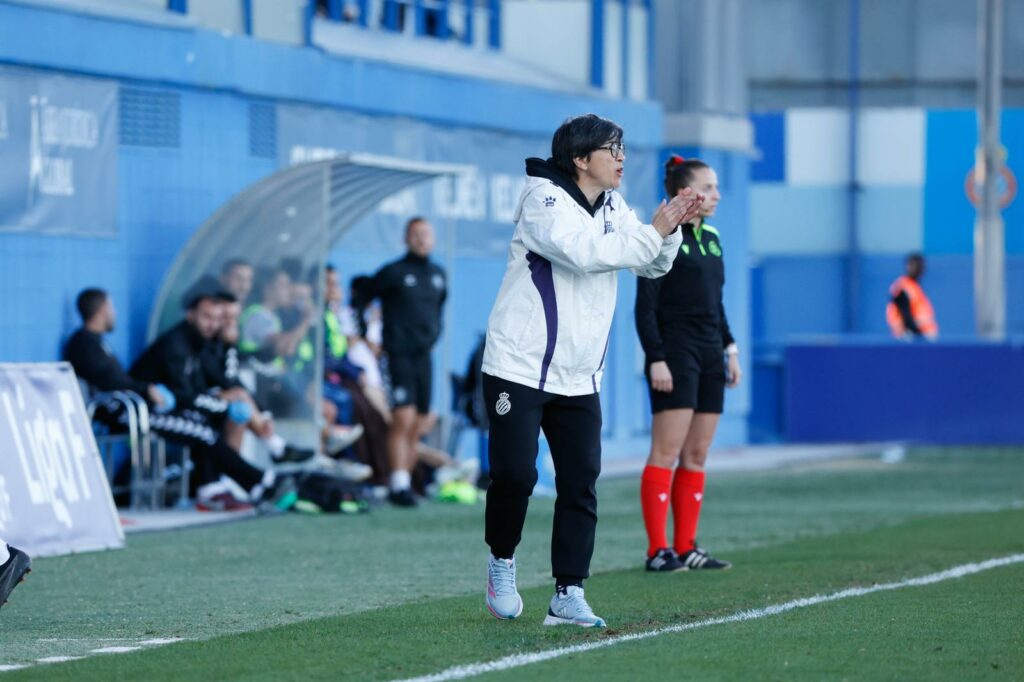
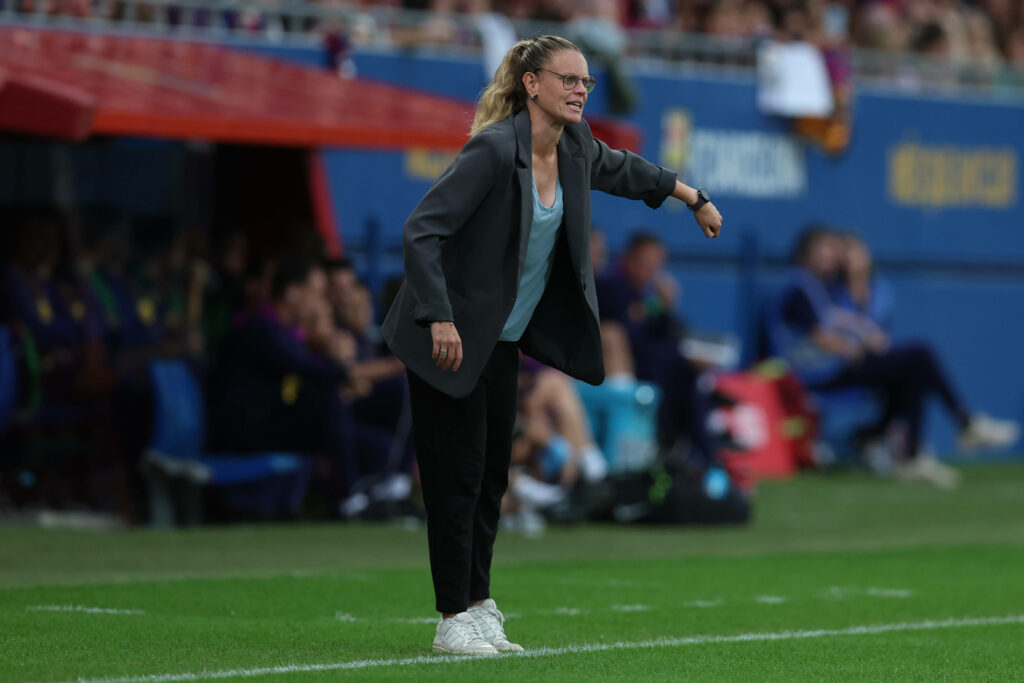
Both former players who moved into management almost by accident, they have built their careers through persistence and conviction in a profession that remains overwhelmingly male — even within the women’s game. Here, they reflect on coaching, doubt, opportunity and the personal cost of choosing life in football.
WHY DID YOU BECOME A COACH?
SARA: In my case, it wasn’t really a conscious decision — it just happened naturally. I knew I could coach, but I never imagined I would reach where I am now because, back then, we didn’t really believe you could make a living from this. I knew I wanted to dedicate time to it, maybe more as a hobby.
I completed two coaching licences and when I finished playing, Villarreal called me and gave me the opportunity. It all happened very quickly. I knew I wanted to coach because I loved football and refused to stop being involved in it. Villarreal offered me that chance and here I am.
Even when I was playing, people used to say I would become a coach because I was always directing things on the pitch, wanting to understand everything and showing interest in every detail. I love football — everything just came together.
IRENE: I think neither Sara nor I ever said as kids, “I’m going to be a coach.” One thing simply leads to another. When you’ve spent your whole life in football, in sporting environments you were part of purely out of passion — and at that time they were very precarious environments — eventually that becomes a professional link, and you start looking for a path once your playing career ends.
I had the added factor of getting injured very young, which accelerated my move into coaching. I had already been coaching children from the age of 18 because I loved pedagogy, and I did it alongside my life as a footballer.
After my injury, I thought: I’m not ready to leave football. I need to keep doing something connected to it. But I never imagined I would dedicate myself to this professionally. You do it out of commitment — when you do something, you want to do it well — but I never imagined I could make a living from it.
This is a life you choose, with conditions and instability that come with that decision. Circumstances push you to try, to grow, and one day you find yourself coaching in the top division and thinking, maybe I’m not that bad at this. Then you become more aware of wanting to improve, to educate yourself, to acquire more skills and adapt to a job that, when you begin, you don’t fully understand everything it will demand from you.
It transforms you as a person because you have to learn many things that have nothing to do with tactics. And most importantly, you have to do all of that without stopping being happy — because sometimes this job feels like emotional terrorism. You need strong internal management to keep enjoying the essence of it: going to the pitch, training, designing sessions, teaching, and trying to see your work reflected in matches. But there are many surrounding factors that make it difficult.
FIRST OPPORTUNITIES
SARA: I always give credit to Villarreal, and to Patri Traver and Lara Cuesta, who were the two people who called me and gave me that opportunity. For me, that was the most important thing.
After that you start opening your own path, with more or less luck and opportunities, gaining skills you didn’t even know you needed beyond tactics. That first opportunity is crucial — someone giving you that chance.
But we also have to be very consistent in making the most of it, because not everyone is willing to give you one. You’re basically putting your whole life into a single gamble. It’s quite masochistic — you really have to love it.
People often ask why there aren’t more female coaches. Well, this job demands a lot. You have to truly love what you do. You have to love teaching and love football deeply, otherwise it doesn’t compensate for everything you sacrifice.
It doesn’t pay much — and money isn’t the most important thing — but sometimes financial stability helps balance things. Neither of us wants to become millionaires, but when money isn’t there, the job has to reward you in many other ways. You’re far from your family, you earn little, and you need to become mentally very strong.
One thing Irene and I have talked about many times is constantly asking ourselves whether we are actually good enough.
IMPOSTOR SYNDROME
SARA: Yes — that’s exactly it. Impostor syndrome, which, excuse my language, is a bastard. I think women experience it a lot, especially in this world.
We often make ourselves smaller without meaning to. It’s like: OK, we’ve been given the opportunity — but do we really deserve it? Are we actually good?
IRENE: We always say certain men never even ask themselves that question.
SARA: Exactly. We keep overthinking everything. After every match: was that my fault? Did I get this wrong? Am I competent?
IRENE: You carry everything on your back.
SARA: The emotional burden we carry as women sometimes works against us along the way. But we’re very persistent, and we’ve fought a lot — often not against others, but against ourselves.
WHY DO YOU HAVE TO BE PERFECT WHEN MEN DON’T?
IRENE: That’s a big topic. We grew up in a highly masculinised environment — call it sexist or whatever you want — with many limitations. Growing up in that context creates limiting beliefs about who you are allowed to be.
Sara and I are both strong personalities, brave women who chose to step into difficult spaces and fight. But that doesn’t mean we don’t have internal struggles, doubts and fears.
Questioning yourself is natural, but sometimes we sabotage ourselves. I think we’re now reaching a stage of maturity where experience is strengthening our self-esteem. We’re starting to realise maybe it’s not us — maybe it’s the system.
At some point you say: enough. Because when a woman says “enough”, people react differently. I’ve argued with staff members and sometimes they say: “Irene, it’s not that serious,” yet when a man behaves the same way, everyone praises him. That’s the reality.
SARA: We’ve talked about this many times.
IRENE: You have to educate your environment.
SARA: Exactly. A man shows character and it’s admired; we do it and they say, “Don’t get emotional.” Excuse me?
IRENE: We’re given labels that don’t reflect reality. After many experiences you become defensive. I used to be more activist; now I try to focus my energy on things that don’t destroy my mental health.
Living from football is already difficult. Living from women’s football is even harder. But living from women’s football as a woman — that’s another level entirely.
There are unconscious egos and social dynamics at play. Sara is a highly proven coach, yet people talk more about men who have just arrived in women’s football. Hopefully that changes with new generations and better education.
Now we’re more aware that we are role models. It’s about opening mental doors so a girl sees us and thinks this is normal — and a boy thinks the same. Interestingly, many of our biggest opportunities have come from women.
SARA: In my case, both times.
IRENE: Mine too. My chance at Rayo Vallecano came from a woman. After eleven years playing there, the club didn’t initially offer me a role. I was coaching in small towns until Laura called and invited me to coach Rayo B. That meant everything to me — but again, it was a woman who opened that door.
I also had a female coach myself, Carmen, long before women’s football had visibility. Only later did I realise how much impact she had on me.
Life circumstances matter too. If at 30 you want a mortgage or a family, maybe we wouldn’t be here. At 30 I was asking my parents for money because coaching didn’t pay enough. I was investing in this career.
WHY THERE ARE SO FEW WOMEN COACHES
SARA: When you stop playing, you don’t have enough financial stability to start coaching properly. You don’t begin in the top league, and early salaries aren’t enough to live on.
Male players, after earning millions, can spend years preparing to coach. My first year at Villarreal I earned €500–600 a month without accommodation. I moved back in with my parents at 36. It’s an investment — you need support.
IRENE: Maybe we’ve been a bit kamikaze. But many women don’t even consider this path, and it requires sacrifices that often don’t compensate.
Men leaving men’s football have financial freedom to choose. Passion alone doesn’t pay the bills — you have to eat. Without family support, I couldn’t have worked at Decathlon to fund my coaching while doing what I loved.
SARA: My parents value it more now than when I was a player. My mum says, “Now you finally have a real job.” I played for 20 years, but that wasn’t seen as work. Now it is. They were worried about me not finding a job after football, they didn’t see it possible.
THE NEXT GENERATION
IRENE: I think a strong generation of female coaches is coming. Players who genuinely love understanding the game will feel that pull. I already see players who could become great coaches.
There will be more accessibility and it will become a more viable option. Just as has happened in men’s football, players with strong careers behind them will have an advantage. Zidane became a coach — and I don’t know what he was like at the beginning — but the admiration players have for someone like Zidane naturally helps. The authority you carry because of who you were as a player influences things a lot. It’s not the same being a coach depending on who you are. At the start, that definitely helps.
Even so, not all top players will want to become head coaches.
SARA: Do you think they actually want it?
IRENE: Some do or at least I see them as future managers
SARA: Many players tell me they’re not sure they want the head coach role. They see the responsibility and the sacrifices. After years without free summers and weekends, many just want to live their lives. The ones already studying to become a coach they tell me they see themselves as assistant coach, not head coach.
IRENE: They know is difficult, there are sacrifices. Last year I missed my best friend’s wedding. She asked, “Are you really not coming?”
SARA: Your family has to organise life around your availability. I always tell mine I only truly have a month and a half free per year.This is an emotional job with constant highs and lows. You must learn not to let results define your self-worth.
IRENE: Sometimes you think what you carry isn’t truly compensated. But then magical moments happen — a goal celebration, a victory, seeing something you trained appear perfectly in a match, a young player making her debut. That’s our fuel.
Interview: Irati Vidal