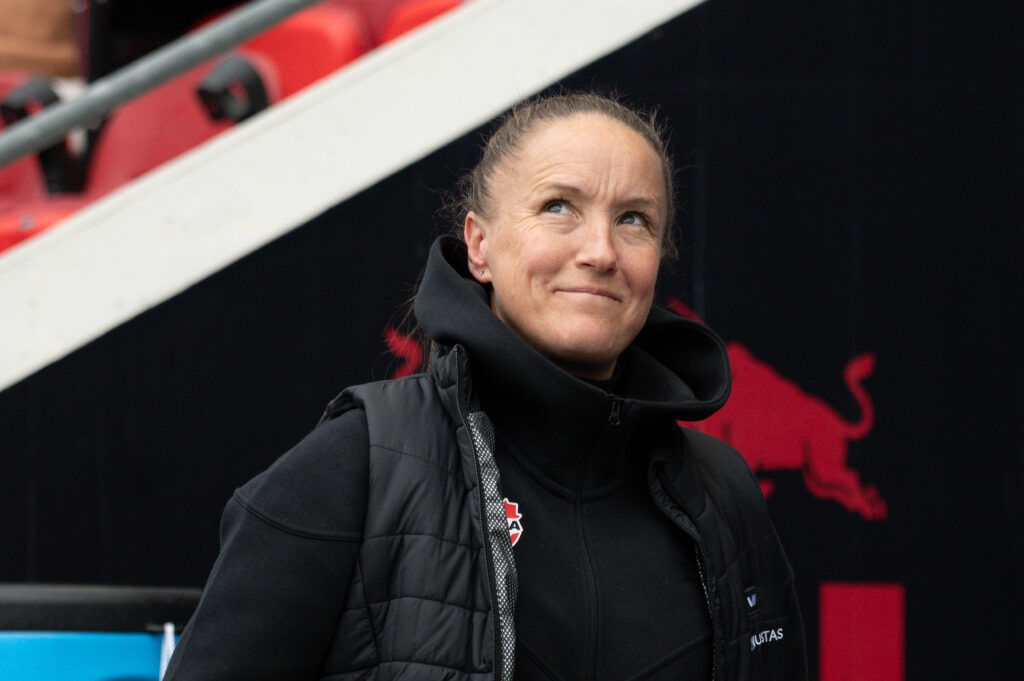
The stakes are high. The competition, which begins on November 27, will determine Concacaf’s representatives at the 2027 FIFA Women’s World Cup in Brazil and the LA28 Olympic Games. A place in the semi-finals would secure Canada’s World Cup qualification. There is little room for error, and Stoney has once again chosen a group with considerable international experience.
21 of the 23 players named for the tournament featured in October’s international window against Denmark. Most also played in Canada’s squad at the Paris 2024 Olympics, and eight are 30 or older. The continuity is understandable. Canada is preparing for a knockout competition, not a development camp. Experience matters when qualification is on the line.
Still, the numbers call for a deeper conversation.
Canada cannot rely indefinitely on the same core players. Injuries, retirements and changing club circumstances will eventually force a transition. The question is whether the programme is preparing for that moment or waiting until it inevitably arrives.
Jessica De Filippo’s omission brings the issue into sharper focus. The Vancouver Rise forward finished the 2026 Northern Super League season with 13 goals and four assists, winning the Golden Boot, Player of the Year and Forward of the Year awards. She was named to the 41-player preliminary roster for the Concacaf W Championship, but did not make the final 23.
Her omission is not, by itself, proof of a selection failure. Domestic form does not automatically translate into international suitability, and a coach must consider far more than a player’s goal tally. Yet when one of the country’s most productive forwards is left out of a squad at a time when Canada is discussing the need for greater depth, it is rather justified to ask how domestic performances are being assessed. Especially when it is a player from a national league club.
This is where the conversation needs to move beyond the head coach.
Building a stronger player pool is not the responsibility of one person, nor can it be solved through a handful of call-ups. Instead, it relies on institutional structures such as Canada Soccer’s youth development programs, partnerships with provincial associations, and professional leagues like the Northern Super League, which collectively identify and develop players. These organizations’ opportunities, alongside the senior team’s willingness to consider talent beyond established selections, are critical to expanding Canada’s pool of competitive players.
Canada’s challenge is not simply to find more players. It is to build a system in which more players can realistically compete for a place.
Who is responsible for building the pool?
The responsibility for developing Canada’s player pool is spread across the country’s football structure. Canada Soccer oversees the broader technical framework, youth development and relationships with provincial associations, clubs and professional leagues. Those foundations influence which players are identified, how they are supported and whether they have a clear route towards the senior national team.
Canada also has technical leadership with specific responsibility for how talent is found, assessed and developed across the national system.
That does not mean the impact of those appointments will be immediate. A new framework takes time to reach players at club and provincial level. They also need the cooperation of the wider game to become more than a strategy on paper.
The important question is whether these structures will produce measurable improvements in the number and quality of players progressing through the system.
Stoney’s responsibility is different, but no less important. She cannot control participation rates, provincial resources or the number of professional opportunities available across the country.
What she can control is how the senior team evaluates talent, what it asks of players and who receives opportunities to demonstrate their ability.
A head coach should not be expected to repair every weakness in a national development system. Equally, a coach who believes the available options are limited must be willing to examine whether the team is looking widely enough. The senior programme cannot wait for the development system to produce new players while continuing to draw from the same group.
Continuity is not the same as succession planning
Canada’s squad for the Concacaf W Championship is a clear example of the value and the limitations of continuity.
Twenty-one players returned from the October window against Denmark. The two changes were defender Jayde Riviere, who missed those matches through injury, and forward Annabelle Chukwu, who had been unavailable because of academic commitments.
There are good reasons for Stoney to favour that level of familiarity. Players need time to understand a coach’s expectations, develop partnerships and become comfortable with the demands of a particular system.
A major qualification tournament is not the moment to make sweeping changes simply to give younger players experience. The concern is not that Canada has selected experienced players. It is whether enough has been done to prepare those who will eventually replace them.
Age alone should not determine selection. Several of Canada’s established internationals remain important contributors, and their experience should be valued for what they bring to the team.
The problem arises when experience becomes a substitute for competition, or when younger players are expected to step into demanding roles without having been given the time to develop within the senior environment.
Succession planning is not about pushing established players out but ensuring that the next group is ready before it is absolutely dire.
There is a difference between selecting a veteran because she remains the strongest option and selecting her because the alternatives have not been given enough exposure to challenge for the position. Canada needs to understand where that line sits.
The next generation needs more than occasional opportunities
Canada has examples of what a stronger pathway can look like. Kaylee Hunter, now 18, has quickly become one of the Northern Super League’s most exciting attacking players. She finished the 2026 season by helping AFC Toronto win its first league championship and earned her fourth senior cap for Canada.
Her decision to commit to AFC Toronto through 2029 is also significant. It reflects the potential for the domestic league to retain young Canadian talent and give players a professional environment in which to develop over several seasons.
Annabelle Chukwu’s inclusion in the tournament squad offers another example of a younger player entering the senior set-up. These opportunities are encouraging, but they need to form part of a consistent approach rather than stand out as exceptions.
Not every promising teenager should be fast-tracked into the national team. Development is rarely linear, and players need time to establish themselves at club level.
However, the senior programme should be identifying those who could become important contributors over the next cycle and finding appropriate opportunities to assess them.
This requires more than merely naming a young player to the squad. Players must face varied opponents, training settings, and tactical challenges, and get enough playing time with the senior team to understand expectations and show their capabilities.
The Northern Super League has an important role to play here. It has created a professional platform at home, offering Canadian players opportunities to compete regularly and giving national-team staff another competition in which to assess talent.
Five NSL players feature in Canada’s final squad for this tournament: Sabrina D’Angelo, Marie-Yasmine Alidou, Kaylee Hunter, Delaney Baie Pridham and Shelina Zadorsky.
That is a meaningful connection between the domestic league and the national team. The next step is ensuring that the league becomes a consistent source of evaluation, not simply a place to look when established internationals are unavailable.
The Jessica De Filippo question

De Filippo’s omission is perhaps the clearest test of how Canada intends to connect domestic performance with senior international opportunity.
Her 2026 season was difficult to overlook. She led the NSL with 13 regular-season goals, added four assists and collected three of the league’s major individual honours. It was a campaign that confirmed her as one of the competition’s most influential attacking players.
It also followed a strong debut season with Vancouver Rise, where she helped the club win the inaugural NSL championship. Her experience extends beyond the domestic league, having played professionally in Germany and Spain before returning to Canada.
Her inclusion in the preliminary roster suggested that she was at least part of the wider conversation. Her absence from the final 23 raises a different question: what did the coaching staff need to see before considering her a viable option?
There are legitimate factors beyond statistics. International football demands different movement, decision-making and tactical discipline. A forward’s suitability can depend on the role required, the opposition and the balance of the squad.
Stoney is entitled to make those judgements, and a Golden Boot should not function as an automatic ticket into the national team.
Still, De Filippo’s strong season means she deserves serious consideration. The question isn’t whether she was owed a spot, but whether players performing at her level in Canada’s pro league have a real chance to compete for one.
Soccer and the league have a shared interest in making the domestic competition a credible part of the national-team pathway. Players need to believe that strong performances can bring them into consideration.
If the league is expected to help expand the player pool, its best performers should be evaluated with the same seriousness as those playing abroad. That does not mean domestic and overseas performances are identical, or that every standout NSL player should receive a call-up. It should, however, reflect that the league must carry equal weight in the selection process.
De Filippo’s omission does not tell us everything about how she was assessed, and it would be unfair to assume that the final decision was based solely on her league performances.
The public roster does, however, leave room for a fair question about how the national team weighs domestic production against other factors. The implications extend beyond one forward. If a player can dominate the domestic scoring charts and still struggle to see a clear route into the senior set-up, other NSL players may wonder what more they need to do.
Two qualification campaigns, one immediate test
The importance of the Concacaf W Championship makes the selection debate particularly pressing. Canada’s opening quarter-final against Panama on November 28 is the first step in a tournament that will shape the next two years of the programme.
The four quarter-final winners will qualify directly for the 2027 FIFA Women’s World Cup and advance to the semi-finals. The losing teams will enter a play-in round, where two places in the FIFA World Cup 2027 Play-Off Tournament will be available.
For Canada, the opportunity to secure qualification for both competitions in one tournament carries real weight.
The team is looking to return to the World Cup and build towards another Olympic campaign after its quarter-final exit in Paris in 2024.
The October results against Denmark: a 1-1 draw followed by a 4-3 defeat, offered a reminder that Canada still has work to do. They do not, on their own, justify sweeping changes to the squad. Nor should a tournament of this importance become a referendum on every selection decision.
The more useful question is what happened before this point.
Could emerging players have been introduced earlier? Could different combinations have been tested during previous windows? Was there enough time to assess alternatives without placing the pressure of immediate qualification on them?
A transition does not have to happen all at once. It can be gradual, with younger players brought into camps, given minutes and assessed alongside the established core. That approach protects continuity while making the team less dependent on a small group.
Canada now faces the challenge of competing for qualification with a squad that is largely familiar. The immediate priority is to perform. The longer-term responsibility is to ensure that the next tournament does not present the same questions.
Experience should be an asset, not a safety net
Canada’s established players have earned their place in the conversation. They have represented the country through major tournaments, carried responsibility in difficult moments and helped build the programme’s reputation. Their experience remains valuable, and they should be judged on what they contribute now rather than the number on their birth certificate.
However, experience cannot become a reason to delay succession planning. A national team needs more than a dependable starting group. It needs genuine competition for places, players capable of stepping in when circumstances change and a development structure that does not leave the next generation to find its own way into the senior set-up.
Stoney must assess the options available to her and create meaningful competition within the senior team.
A stronger development system will count for little if its best prospects are never properly assessed at senior level. Equally, a coach cannot build depth from players who have not been identified, supported or allowed to develop.
The NSL adds another important part of the equation. It gives Canadian players a professional platform at home, but its value to the national programme will ultimately be measured by the quality of the pathway it helps create.
Canada does not need to abandon its veterans or select players simply to make a point about youth development.
The question facing Canada is therefore bigger than whether its player pool is large enough. It is whether the country is making the most of the talent already within reach.
If the same names continue to dominate selection and the domestic league’s strongest performers struggle to enter the conversation, the issue is not only who is available. It is how the system is looking for them.
The Concacaf W Championship will test the group Stoney has chosen. The work that follows must test the structures behind it. A deeper player pool will not emerge from one tournament or one coaching decision. It will come from a connected system that identifies talent early, develops it consistently and gives players a genuine chance to prove they belong.
Text: Fleur Dias