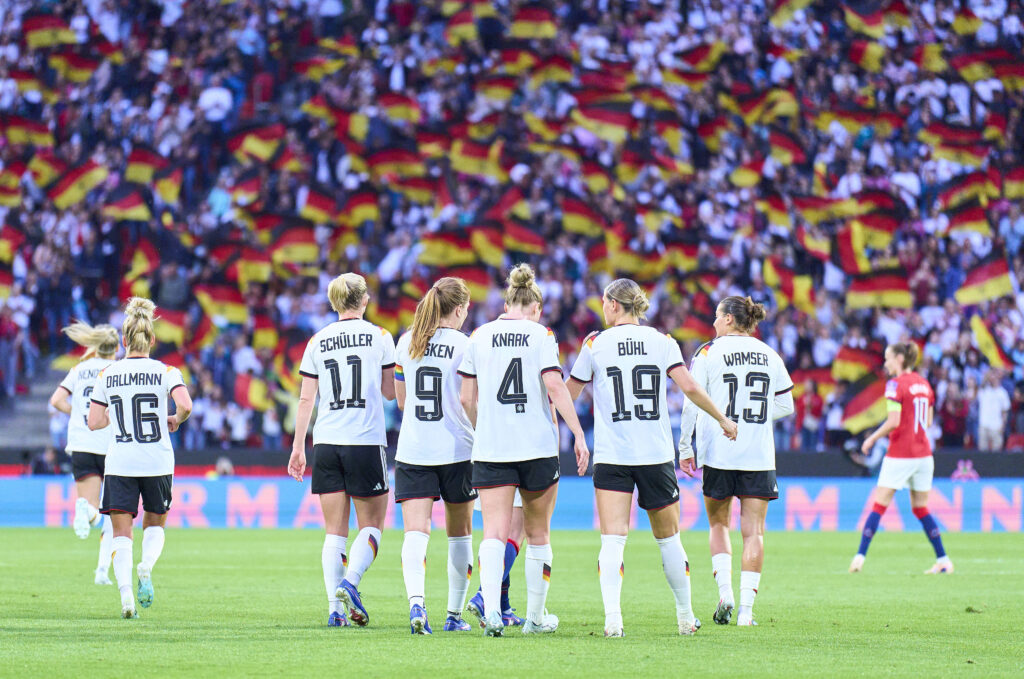
The growth of the Frauen-Bundesliga, increased international transfers, and greater commercial investment have transformed representation in women’s football. Yet agents operating in Germany must navigate an unusual overlap between FIFA regulations, domestic implementation by the Deutscher Fußball-Bund (DFB), and ongoing competition law disputes that have reshaped the regulatory landscape.
For lawyers, clubs and agents working in women’s football, Germany provides an important case study of how global sports governance collides with European competition law.
The FIFA Football Agent Regulations:
The FIFA Football Agent Regulations (FFAR), introduced in 2023, marked the return of extensive regulation after several years in which national associations largely governed intermediaries independently.
The objectives were straightforward:
- Mandatory FIFA licensing though examination process
- Enhanced transparency
- Regulation of conflicts of interest
- Greater protection for players
- Limits on agent remuneration
- Improved integrity within the transfer market
For international transactions, FIFA’s regulations apply directly. National associations were expected to adopt corresponding domestic regulations for purely national transactions. This is where Germany becomes particularly interesting.
Germany’s implementation has not mirrored FIFA’s model:
The DFB adopted new national regulations that entered into force in January 2025, implementing licensing requirements for domestic transactions while deliberately omitting some of FIFA’s most controversial provisions because of ongoing competition law litigation.
In May 2023, the Landgericht Dortmund (District Court of Dortmund) granted an interim injunction preventing FIFA and the DFB from enforcing significant parts of the FFAR in relation to the German market.
The injunction challenged, among others:
- Article 15 FFAR (service fee caps)
- Provisions regulating who may pay an agent’s remuneration
- Provisions requiring payment through FIFA’s clearing mechanisms
- Restrictions on multiple representation
- Extensive disclosure and reporting obligations
- Provisions requiring agents to submit disputes to FIFA’s regulatory framework
The Dortmund court held that these measures raised serious issues under Article 101 of the TFEU, which prohibits anti-competitive agreements and restrictions of competition.
The injunction was subsequently upheld on appeal by the Higher Regional Court of Düsseldorf in March 2024, significantly strengthening the position of agents challenging FIFA’s regulatory framework.
Rather than simply reproducing FIFA’s rules, the DFB therefore took a cautious approach implementing those provisions necessary for licensing and registration while avoiding provisions that remain subject to ongoing competition law scrutiny.
The result is a regulatory environment where international and domestic transactions may be governed differently, depending upon the nature of the deal. For lawyers advising clubs and agents, identifying which regulatory framework applies is now a threshold legal question.
Why this matters particularly for women’s football:
Women’s football increasingly operates across borders.
German clubs recruit players from Scandinavia, England, France, Spain, the United States and Australia, while leading German internationals regularly move abroad.
An international transfer involving a Frauen-Bundesliga club therefore falls within FIFA’s regulatory system, whereas a domestic transfer between German clubs may engage the DFB’s national rules.
This distinction can affect:
- Licensing requirements
- Permissible representation structures
- Disclosure obligations
- Disciplinary jurisdiction
- Dispute resolution mechanisms
As the women’s game internationalises, these jurisdictional questions become increasingly significant.
Dual representation remains a difficult issue
Historically, football agents frequently represented multiple parties within the same transaction. FIFA sought to restrict this practice, in order to reduce conflicts of interest and increase transparency.
Under Article 12 FFAR, an agent may generally only represent one party to a transaction unless the player and engaging club provide prior explicit written consent to dual representation. Representation of the releasing club simultaneously with another party is prohibited.
However, agents argued that these limitations interfere with commercial freedom and competition within the representation market. The Dortmund proceedings specifically questioned whether these restrictions go further than necessary to achieve FIFA’s stated objectives.
In women’s football, where smaller markets and long-standing relationships between clubs and agents are common, dual representation remains particularly sensitive. A relatively small number of specialist agents represent multiple elite players across several Frauen-Bundesliga clubs, making conflict management more complex than in the men’s market.
Fee caps have generated significant legal controversy:
Perhaps the most contentious aspect of the FFAR concerns limitations on agent service fees.
FIFA argued that fee caps would improve integrity and protect players from excessive commissions. However, agent organisations across Europe challenged the restrictions under European and national competition law. Germany became one of the principal battlegrounds.
Several German courts questioned whether FIFA’s restrictions were compatible with competition law principles, leading to interim injunctions and influencing the DFB’s decision not to implement certain provisions domestically.
As a consequence, FIFA temporarily suspended application of many contested FFAR provisions where a sufficient German connection existed while broader proceedings concerning the legality of the regulations continue before European courts.
The result is an unusual regulatory position in which some FIFA rules apply internationally while analogous domestic provisions have been omitted pending further legal developments. This creates considerable uncertainty for agents operating across both domestic and international markets.
Women’s football raises additional regulatory questions:
Although the FFAR applies equally to men’s and women’s football, the commercial realities differ substantially.
Women’s football remains characterised by:
- Lower average salaries
- Smaller transfer values
- Shorter contract durations
- More frequent cross-border movement
- Players balancing multiple career considerations
- Growing numbers of first-time professionals requiring legal advice
For many players, agents perform a broader advisory role than merely negotiating transfers, assisting with immigration, education, sponsorship and welfare matters.
This raises broader policy questions regarding whether uniform regulation designed primarily around the men’s transfer market appropriately reflects the needs of women’s football. Fee restrictions that may appear proportionate within elite men’s football could have different practical consequences where commissions already operate on significantly lower economic margins.
Germany as a testing ground for sports law:
Germany illustrates how sports governance increasingly intersects with European competition law. Rather than a straightforward implementation of FIFA’s regulatory ambitions, the German position demonstrates that international sporting rules remain subject to scrutiny by domestic courts and EU legal principles.
For practitioners specialising in women’s football, understanding this interaction is becoming essential. As the women’s transfer market continues to expand, legal disputes concerning agent regulation, competition law and contractual representation are likely to become more common.
Germany therefore offers an important preview of the legal issues that may shape the next phase of professional women’s football across Europe.
The Verdict:
The regulation of football agents is no longer merely an administrative issue. It has become a significant area of sports law, involving governance, competition law, contractual regulation and athlete protection.
Germany’s cautious implementation of the FIFA Football Agent Regulations demonstrates that even globally harmonised sporting rules can encounter domestic legal resistance. For stakeholders in women’s football, this evolving regulatory landscape presents both opportunities and challenges as the professional game continues its rapid international growth.
This article was written by our new partner Her Game, Her Verdict.