
Why do 38,000 people turn up to watch one women’s football match while another attracts just 14,000? What makes fans choose to spend their afternoon at a stadium rather than somewhere else? And why do some clubs like Barcelona or Arsenal succeed in building lasting audiences while others struggle to fill seats?
Dominik Schreyer, a professor of sports economics at WHU – Otto Beisheim School of Management, studies what drives attendance demand in sport, from ticket prices and star players to stadium atmosphere and fan habits. In this exclusive interview, he explains why Arsenal has become the benchmark for women’s football attendances, what “consumption capital” is and why it matters, and why German clubs risk falling further behind.
“Arsenal has become the benchmark in European women’s football”
The Rise of Women’s Football: Why do people show up to some sports events, and not to others? You’ve researched this question extensively, so let’s start with a little guessing game. In the first game of the Women’s Super League this season, Arsenal played on a Saturday at 2:30 pm against the London City Lionesses, while Chelsea played the Friday evening before against Manchester City. Both chose to stage their games in their club’s main stadium, and neither men’s team played that same weekend. Which game drew more spectators?
Dominik Schreyer: Actually, I have a spreadsheet with all attendance figures here: Arsenal drew 38,000, Chelsea 14,000. That’s a gap of nearly 25,000, and it’s not easy to explain. First things first, though: 14,000 for Chelsea is a remarkable achievement. The issue is that Arsenal has become the benchmark in European women’s football when it comes to attendance demand. Alongside Barcelona, there are very few reference points at that level. So almost everyone looks small compared to Arsenal.
The Rise: What explains that gap?
Schreyer: Courage and commitment, I’d say. Arsenal was one of the first clubs to commit early and seriously to developing women’s football. They started playing games at the Emirates earlier than many other clubs, and it has paid off. In fact, Arsenal has pursued a consistent strategy of staging more and more home games in the club’s main stadium; last season, they played all 11 of their WSL home games there. So, by now, they have simply had more time to build a stable, recurring audience. If your average attendance is around 30,000, you’re working from a completely different foundation than if it’s 3,000. That creates a powerful dynamic in Arsenal’s favor. Not every one of those 30,000 fans will come back the next time, but if just one in ten does, that’s already great. Each time someone goes to a women’s game in the big stadium, they accumulate consumption capital.
The Rise: What does “consumption capital” mean exactly?
Schreyer: Consumption capital is what you accumulate over time by engaging with a product. If I go to a stadium for the first time, I first have to figure out what’s even happening: Who’s playing? Which way are they going? Why is there a half-time break? The more I engage, the more value I get from the experience – and the more attractive it becomes to go again.
This applies equally to women’s football. Every single contact, every encounter with the sport, builds that capital. If I walked into a stadium tomorrow and American football was being played, my consumption capital is close to zero – so the experience simply isn’t very valuable to me yet. It’s the same principle. For clubs, the point is simple: every good first experience can help turn someone who just came along into a returning spectator, and maybe even a fan.
The Rise: Even for Arsenal, there have been growing pains and games where less than 10,000 fans have attended at the big stadium. The atmosphere isn’t great then. Are these experiences necessary just so playing in the bigger stadium becomes normalized, or do they also pose a problem?
“Empty seats are bad PR”
Schreyer: Intriguingly, the effect of a poor atmosphere likely extends beyond the stadium, too. In fact, there are academic papers showing that if people see empty stands on TV, they interpret this as a signal for bad quality. And this puts them off from going to a game themselves – it’s a vicious circle. So I do understand why clubs can hesitate: empty seats are bad PR, as we’ve seen with the FIFA Club World Cup.
The Rise: What does the research say about the factors that actually drive stadium demand?
Schreyer: Whenever someone finds out there’s a game taking place, they run a quick, largely unconscious calculation: what’s in it for me, and what does it cost, including the opportunity cost of what I won’t be doing instead? A range of factors, including the ticket price, the weather, or the quality of the competition, play into that. But one factor dominates: the attractiveness of the opponent. So, yes, people buy season tickets because they want to support their club. But whether they actually show up to individual games often comes down to who’s visiting. When one club dominates commercially, like Arsenal or Barcelona do, the other clubs benefit too because they draw fans to their away games.
The Rise: How important are ticket prices? We’ve seen different approaches in women’s football here – at Arsenal, for example, the prices have risen over time but remain affordable. How much do prices influence the demand?
Schreyer: Price is a signal. I’m cautious about the argument that lowering ticket prices automatically means higher attendance, because prices also shape the perceived value of the product. In the men’s game, there’s essentially no ceiling in leagues like the Bundesliga or Premier League where demand for tickets outstrips supply, and clubs could sell tickets at even higher prices if they wanted to. However, that excess demand doesn’t yet exist in women’s football, so the challenge is finding the right balance. How do you make the product accessible without undermining your pricing structure? After all, in the women’s Bundesliga, matchday revenue already accounts for around 16 percent of total income. That’s not far off the men’s game proportionally. Clubs cannot simply give that up to fill seats, at least not without a strategy to compensate for the lost revenue.
the Caitlin Clark effect
The Rise: What role do star players play in driving attendance?
Schreyer: The Caitlin Clark effect in America is well-documented by academic papers: When she entered the WNBA, the USA’s top women’s basketball league, attendances went up sharply. So, when there’s someone the public really wants to see, someone whose remarkable performance has been turned into a public story, people come through the gates. And a small share of those first-timers come back for the next game too.
The problem in German women’s football is that these players aren’t being turned into stars systematically by the clubs themselves. I mean, if you stopped someone on the street and asked who the big stars of the Frauen-Bundesliga are, you might get Giulia Gwinn or Alexandra Popp. But it stops there. Jule Brand played in a Champions League final with Lyon, which is the biggest possible stage in women’s club football, and yet I’m not sure even she is a household name. That is, fundamentally, an investment problem.
“I don’t yet see a very bold strategy for the development of women’s football at Bayern”
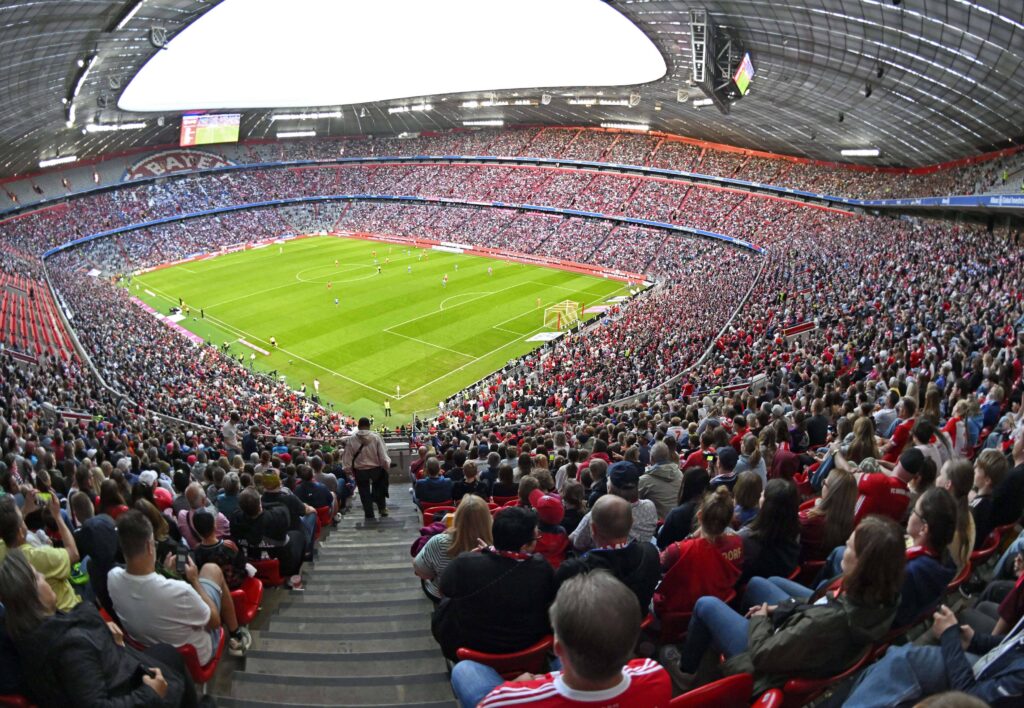
The Rise: How do you evaluate the evolution of attendances in Germany? Bayern Munich drew 57,000 spectators to the Allianz Arena for the Bundesliga season opener. How much significance does such a number have in the long run?
Schreyer: Attendance demand is growing again after plateauing over the past three seasons, which is promising, of course, and Bayern’s record-breaking season opener was no doubt a remarkable result. After all, nearly ten percent of all tickets distributed across the entire women’s Bundesliga last season came from that single Bayern Munich game.
Still, my sense is that this record number happened somewhat by accident. I don’t yet see a very bold or coherent strategy for the development of women’s football at Bayern. Until now, they have remained very cautious about staging games in the Allianz Arena, despite being one of the best teams in the world and operating in an interesting market.
And let’s not forget: Bayern Munich has more than 400,000 members and sells out literally every men’s match. From this perspective, having the women’s team play in the Allianz Arena in front of 20,000 or so empty seats is also a bit disappointing.
But what’s even more frustrating is the decision to return to Bayern’s regular home ground, the Campus, which only holds about 2,500 people. So even if fans wanted to come back, this was not really possible. The stadium is simply too small.
The Rise: Which is why Bayern will move to a bigger stadium with 20,000 seats in Unterhaching. Isn’t that a perfect solution?
Schreyer: A 20,000-seat stadium is a good intermediate stage: large enough to absorb some spillover from highlight games, but small enough to fill all seats consistently and create a proper atmosphere.
But this is where consumption capital comes in again. Bayern fans who usually attend the men’s games are not yet used to going to Unterhaching. Going back and forth between the Allianz Arena and Unterhaching is not ideal either, if the plan is to alternate between venues. Either way, it will take time to build routines there, and a separate stadium may contribute to the feeling that the women’s and men’s teams are two distinct entities with distinct fanbases.
Why German clubs risk falling further behind

The Rise: The Frauen-Bundesliga used to be the biggest league in women’s football. Now, it feels like it’s fallen behind. How is that reflected in the attendances?
Schreyer: In a futures study we conducted two years ago, experts were asked how fan demand in the women’s Bundesliga would develop through to 2031. The majority considered a tripling to be likely, from around 2,500 average attendance at the time to somewhere between 7,500 and 8,000. That would represent moderate, linear growth. Highlight games matter here, of course. Borussia Dortmund, despite missing out on promotion, is now entering the picture seriously, which is great. And Germany will host the Euros in 2029.
The Rise: That sounds good, but is it enough?
Schreyer: Even a tripling or quadrupling doesn’t mean that most stadiums will be filled. But many clubs currently seem to lack the commitment to make even that happen. Often, it feels like women’s football is still simply tolerated; it’s a nice-to-have. And in doing so, the clubs are repeating exactly the mistake German football made twenty years ago, when the Premier League was allowed to become the dominant international platform. Once that status is achieved, the effects become self-reinforcing, and being league number two or three becomes increasingly irrelevant. The WSL could become that platform for women’s football, and the Bundesliga is at risk of letting it happen.
But the WSL is also less far ahead than some might believe. It’s worth noting how dominant Arsenal is in the WSL’s overall numbers: the club accounts for around 40 percent of all tickets sold across the entire league. That tells you something about both Arsenal’s success and the scale of the challenge for everyone else. Arsenal is far ahead of the Frauen-Bundesliga, yes, but the WSL itself isn’t.
Interview: Helene Altgelt